This product is solely intended for research purposes as a chemical compound. Its designation permits its use exclusively for in vitro testing and laboratory experimentation. All information regarding this product provided on our website is purely educational. By law, any form of bodily introduction of this product into humans or animals is strictly prohibited. It should only be handled by professionals who are licensed and qualified. This product is neither a drug, food, nor cosmetic, and must not be misrepresented, misused, or mislabeled as such.
In stock
Swipe right to view full table →
Cost per milligram |
$3.20 – $4.20 |
Purity |
99.89% |
Certified Endotoxin-safe |
Yes |
Independently Tested |
Yes |
Peptide Partners Manufacturer Id: VI32
Batch Id: PT202512
Title: Melanocortin Receptors, Melanotropic Peptides and Penile Erection
Authors: Stephen H King, Alexander V Mayorov, Preeti Balse-Srinivasan, Victor J Hruby, Todd W Vanderah, Hunter Wessells
URL: https://pmc.ncbi.nlm.nih.gov/articles/PMC2694735/
Published: Current Topics in Medicinal Chemistry, 2007;7(11):1098–1106
PT-141 (Bremelanotide) is a synthetic heptapeptide that represents a deaminated derivative and likely metabolite of melanotan-II (MT-II). This compound demonstrates strong binding affinity to melanocortin receptors 1, 3, and 4, with a higher affinity for MC4R over MC3R. Application of PT-141 to HEK-293 cells expressing MC4R increases cyclic adenosine monophosphate (cAMP) production, indicating that this compound, like MT-II, acts as an agonist at melanocortin receptors. This in vitro cell culture study demonstrated receptor activation through the cAMP signaling pathway, which is a key second messenger system in G-protein coupled receptor signaling. The study utilized human embryonic kidney cells (HEK-293) transfected to express the melanocortin-4 receptor, providing direct evidence of PT-141’s agonist activity at this receptor subtype through measurement of intracellular cAMP accumulation.
This research showed that PT-141 works by binding to and activating specific protein receptors on cell surfaces called melanocortin receptors. When PT-141 attaches to these receptors on cells grown in laboratory dishes, it triggers a chain reaction inside the cells that produces more of a chemical messenger called cAMP. This proves that PT-141 functions as an activator (agonist) of these receptors, particularly the MC4R type, which is important for understanding how the drug might work in the body to affect sexual function and other processes controlled by these receptors.
Title: Melanocortin Receptor Agonist Bremelanotide Induces Cell Death and Growth Inhibition in Glioblastoma Cells via Suppression of Survivin Expression
Authors: Shuhei Suzuki, Chifumi Kitanaka, Masashi Okada
URL: https://ar.iiarjournals.org/content/44/9/3875
Published: Anticancer Research, September 2024, 44(9):3875-3883
The effects of bremelanotide, a melanocortin receptor agonist, were investigated in human glioblastoma cell lines using in vitro methodologies. Bremelanotide reduced survivin expression and induced cell death in glioblastoma cells at concentrations that were not toxic to normal human cells. Both of these effects were canceled in the presence of an antagonist of melanocortin receptors 3 and 4, confirming receptor-mediated mechanisms. Bremelanotide-induced cell death was prevented by forced over-expression of survivin in glioblastoma cells, suggesting that bremelanotide induces glioblastoma cell death by inhibiting the expression of survivin, an anti-apoptotic protein. Additionally, bremelanotide promoted cell death induced by chemotherapeutic agents such as temozolomide and osimertinib. The study utilized human glioblastoma cell lines (U-87, GS-Y01, and GS-Y03) and normal human fibroblasts (IMR-90) to assess cell viability, survivin protein expression, and apoptotic markers through western blotting, cell viability assays, and molecular biology techniques.
This study discovered that bremelanotide can kill brain cancer cells (glioblastoma) grown in laboratory culture dishes without harming normal cells. The drug works by reducing levels of a protein called survivin that helps cancer cells stay alive. When survivin levels drop, the cancer cells die through a natural cell death process. The researchers proved this by showing that when they artificially increased survivin levels in the cancer cells, bremelanotide could no longer kill them. Importantly, bremelanotide also made standard chemotherapy drugs work better against these brain cancer cells, suggesting it could potentially be used alongside existing cancer treatments.
Title: Structural insights into ligand recognition and activation of the melanocortin-4 receptor
Authors: Huibing Zhang, Li-Nan Chen, Dehua Yang, Chunyou Mao, Qingya Shen, Wenbo Feng, Dan-Dan Shen, Antao Dai, Shanshan Xie, Yan Zhou, Jiao Qin, Jin-Peng Sun, Daniel H. Scharf, Tingjun Hou, Tianhua Zhou, Ming-Wei Wang, Yan Zhang
URL: https://www.nature.com/articles/s41422-021-00552-3
Published: Cell Research, 25 August 2021, volume 31, pages 1163–1175
This study reports four high-resolution structures of full-length melanocortin-4 receptor (MC4R) in complex with the heterotrimeric Gs protein stimulated by different ligands, including the FDA-approved drug bremelanotide (Vyleesi™). The structures were determined using single-particle cryo-electron microscopy (cryo-EM), an advanced in vitro structural biology technique that allows visualization of protein complexes at near-atomic resolution. The bremelanotide-MC4R-Gs complex structure was deposited in the Protein Data Bank under accession number 7F55 and Electron Microscopy Data Bank under accession code 31458, at a resolution of 3.1 Ångströms. Together with pharmacological studies, the results reveal the conserved binding mode of peptidic agonists and provide molecular details of agonist recognition underlying receptor subtype selectivity. The study demonstrates a distinct activation mechanism for MC4R, offering new insights into G protein coupling and receptor activation at the molecular level.
Scientists used a powerful microscopy technique to take extremely detailed pictures of bremelanotide attached to its target receptor (MC4R) in cells. These images are so detailed that they can see the exact shape and position of individual atoms in the drug-receptor complex. This is like getting a blueprint showing exactly how a key fits into a lock. By understanding the precise three-dimensional structure of how bremelanotide binds to and activates the MC4R receptor, researchers can better understand why the drug works and potentially design improved medications that are more selective and effective. This structural information is now publicly available in scientific databases for other researchers to use in drug development efforts.
Storage:
All of our manufacturing partners produce peptides using the Lyophilization (Freeze Drying) process, ensuring products maintain stability for shipping and storage for 12+ months.
In lyophilized form, they are shelf-stable for many weeks. However, for long-term storage, it is recommended to store them in the freezer.
We often hear concerns about the standard “discard after 28 days of first use” disclaimer. Don’t worry, this has nothing to do with studies regarding the efficacy of specific peptides. 28 days is the FDA requirement for producers of multi-use vials to prove their bacteriostatic maintains efficacy. This minimum requirement becomes the de facto standard.
In our experience, if you use proper sterile procedures and refrigerated storage, you can continue sampling from the same reconstituted vial for 3+ months.
Peptide Partners is committed to providing high-purity peptides at wholesale prices by frequently auditing its manufacturing partners using third-party laboratories. Independent analysis is vital to ensuring the quality and authenticity of your research peptides. Never trust a supplier that doesn’t submit to third-party testing. Never trust a certification that cannot be independently verified. All of the certificates that we provide can be validated on the third-party laboratory’s website.
Each product description contains a Manufacturer ID corresponding to the producer of that product. The table below contains the most recent third-party analyses for all manufacturers and peptides listed on Peptide Partners.
| Peptide | Batch Id | Manufacturer | Date | Purity | Laboratory | |
|---|---|---|---|---|---|---|
| GHK-Cu | CU202604 | WF03 | 2026-04-03 | 99.93% | Kovera | View File |
| SS-31 | SS202601 | WF03 | 2026-04-03 | 99.82% | TrustPointe | View File |
| Semax | SX202603 | WF03 | 2026-03-31 | 99.91% | Kovera | View File |
| Retatrutide | RT202603 | WF03 | 2026-03-30 | 99.40% | TrustPointe | View File |
| GLOW Blend | GW202603 | WF03 | 2026-03-25 | 99.88% | Kovera | View File |
| Tirzepatide | TZ202603 | VI32 | 2026-03-27 | 99.89% | TrustPointe | View File |
| BPC-157/TB-500 | BB202604 | WF03 | 2026-03-27 | 99.63% | TrustPointe | View File |
| Tesamorelin | TES202603 | WF03 | 2026-03-25 | 99.52% | TrustPointe | View File |
| BPC-157 | BC202604 | VI32 | 2026-03-18 | 99.60% | TrustPointe | View File |
| Ipamorelin/CJC-1295 (No DAC) | CJIP202602 | WF03 | 2026-02-27 | 99.92% | TrustPointe | View File |
| Thymosin Alpha-1 | TA202602 | WF03 | 2026-02-25 | 99.95% | Kovera | View File |
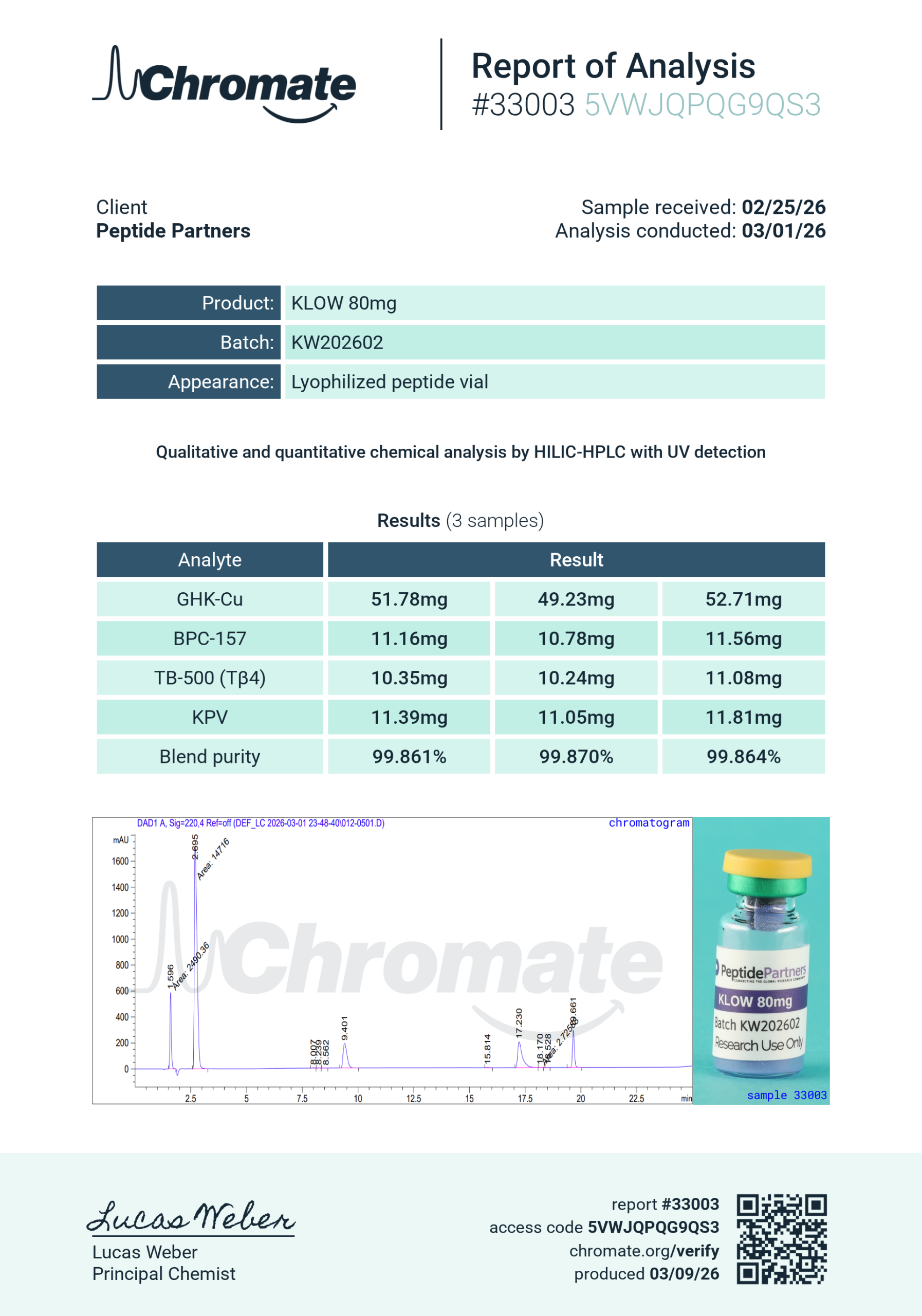
| KLOW | KW202602 | WF03 | 2026-03-01 | 99.86% | Chromate | View File |
| NAD+ | NDB202601 | VI32 | 2026-02-07 | 99.92% | Kovera | View File |
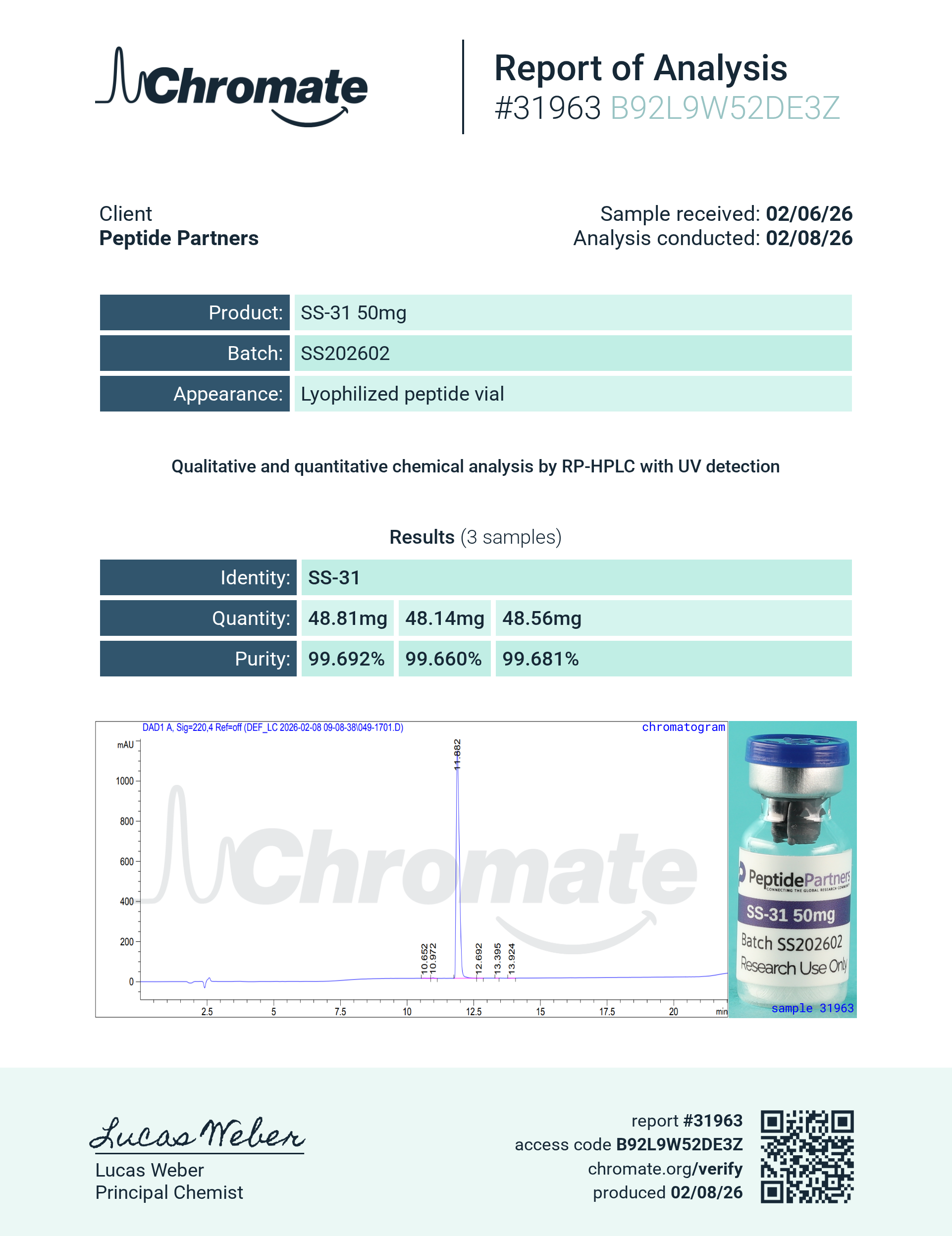
| SS-31 | SS202602 | WF03 | 2026-02-08 | 99.68% | Chromate | View File |
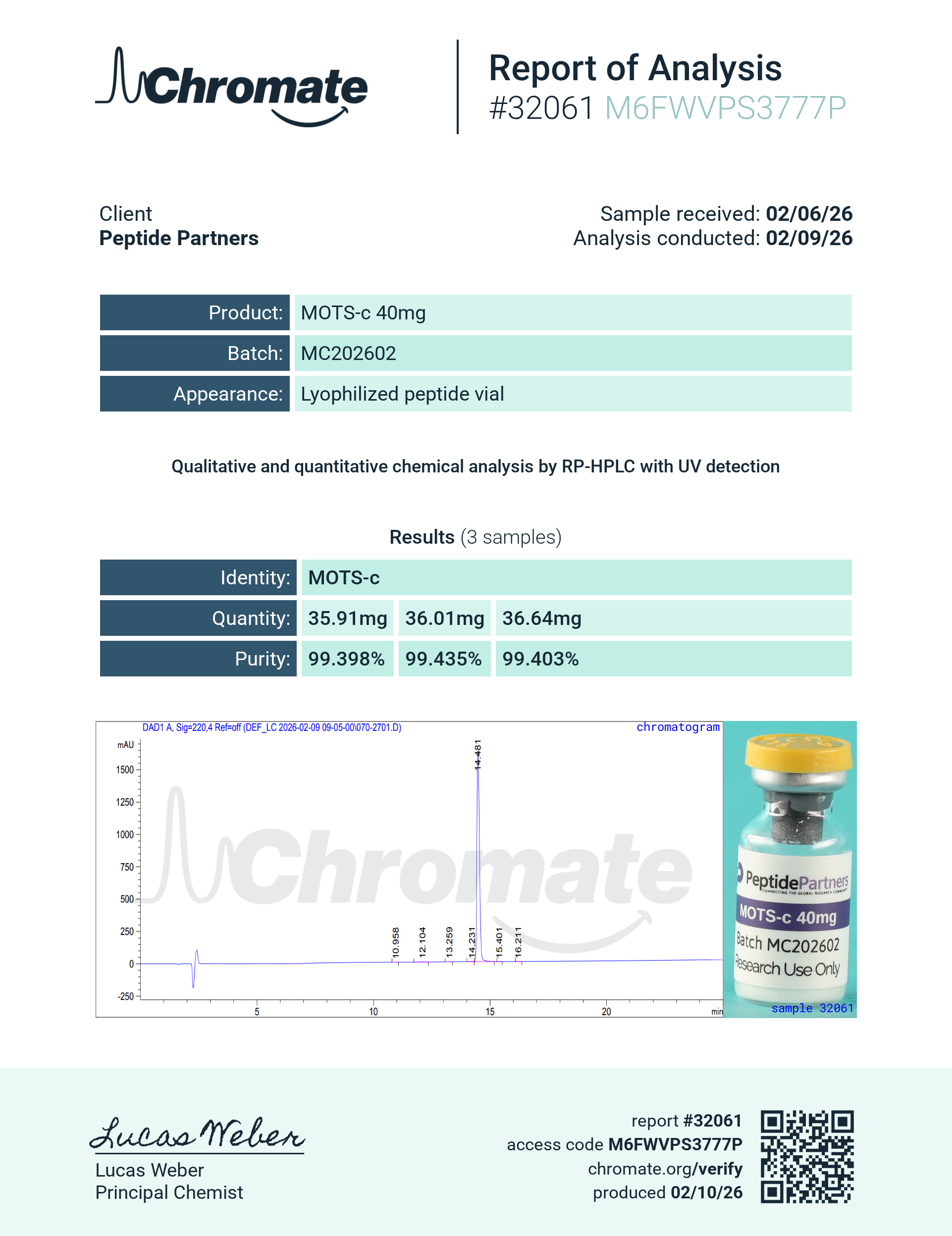
| MOTS-c | MC202602 | WF03 | 2026-02-09 | 99.41% | Chromate | View File |
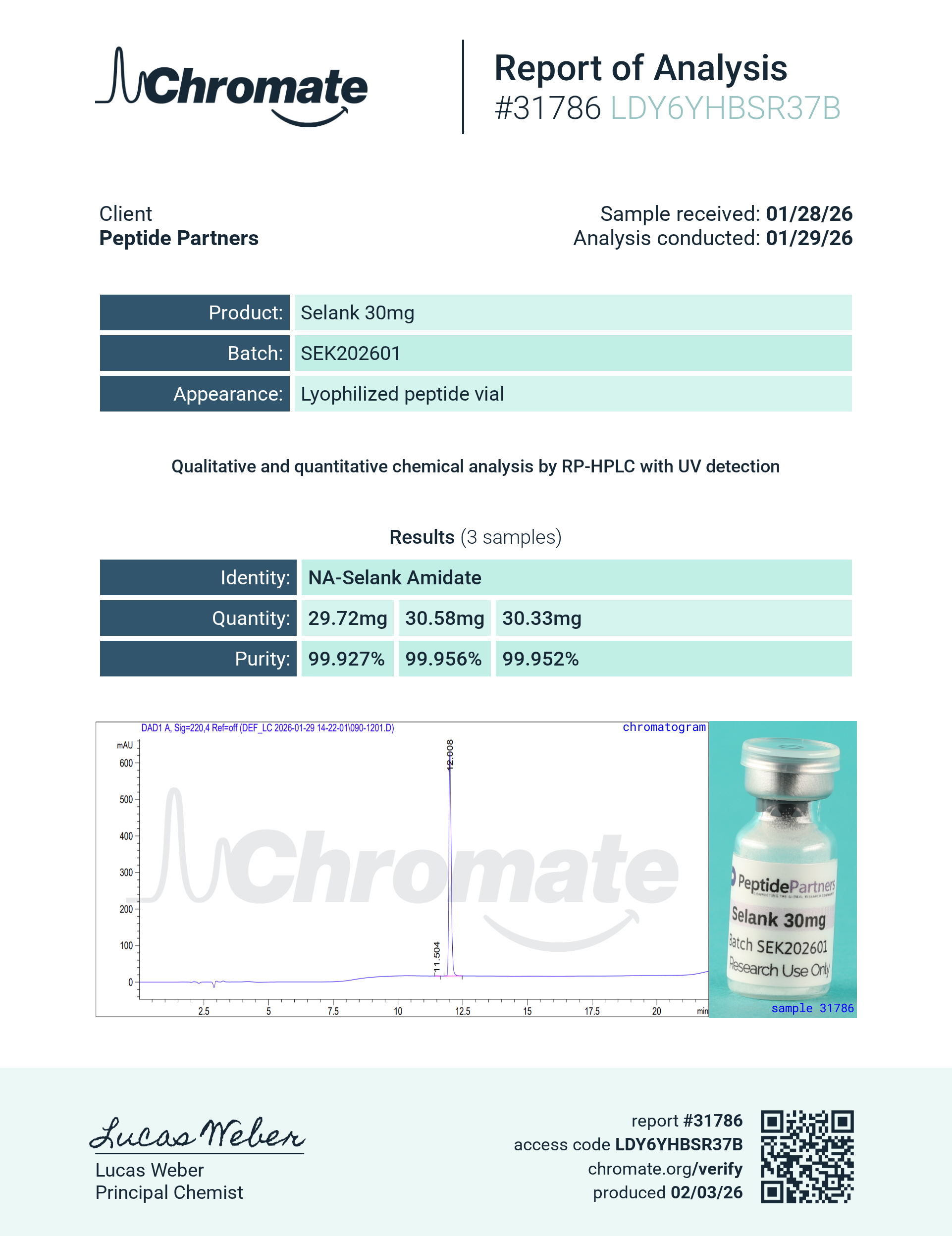
| Selank | SEK202601 | VI32 | 2026-01-29 | 99.94% | Chromate | View File |
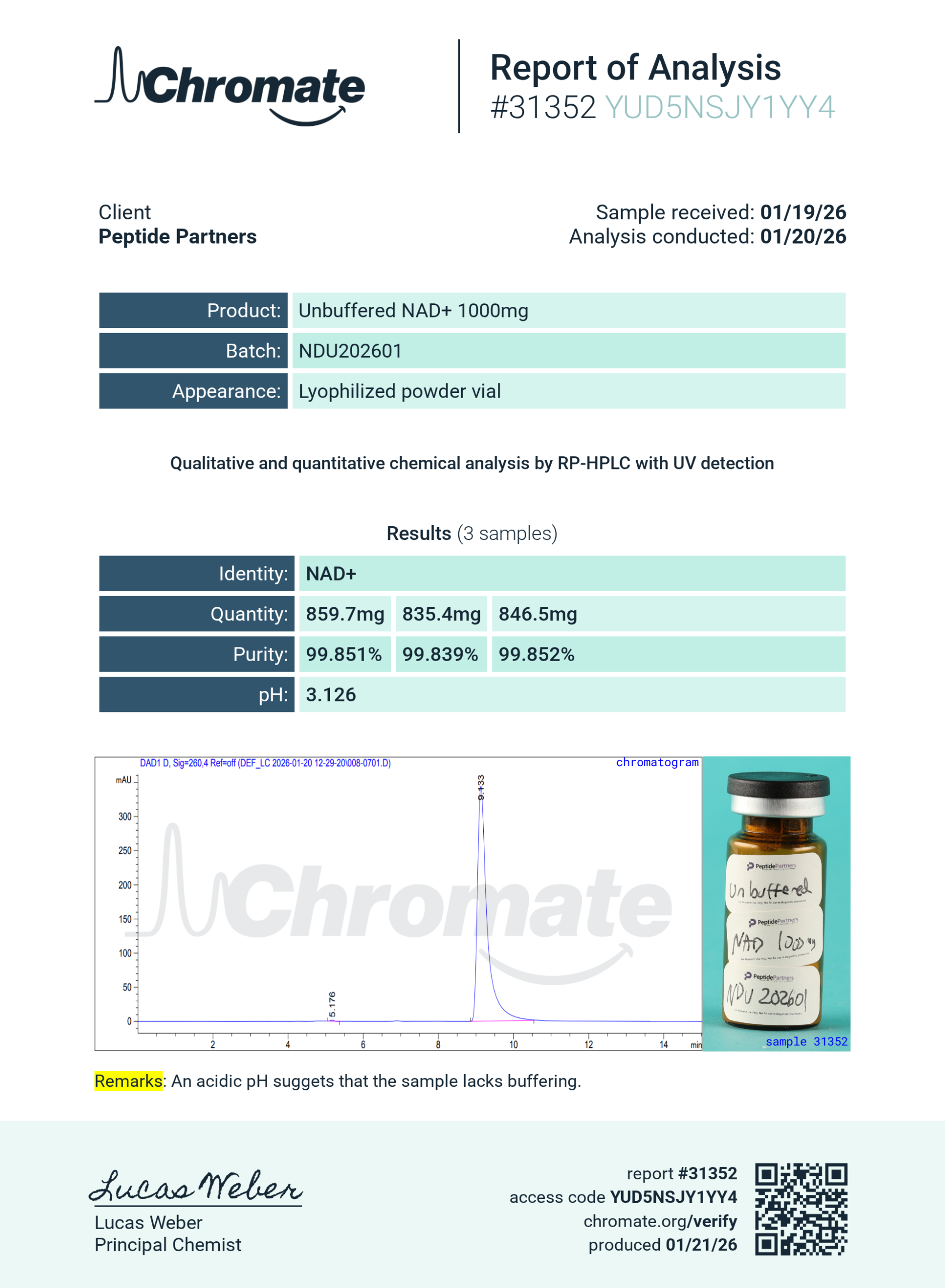
| Unbuffered NAD+ | NDU202601 | MZ21 | 2026-01-20 | 99.85% | Chromate | View File |
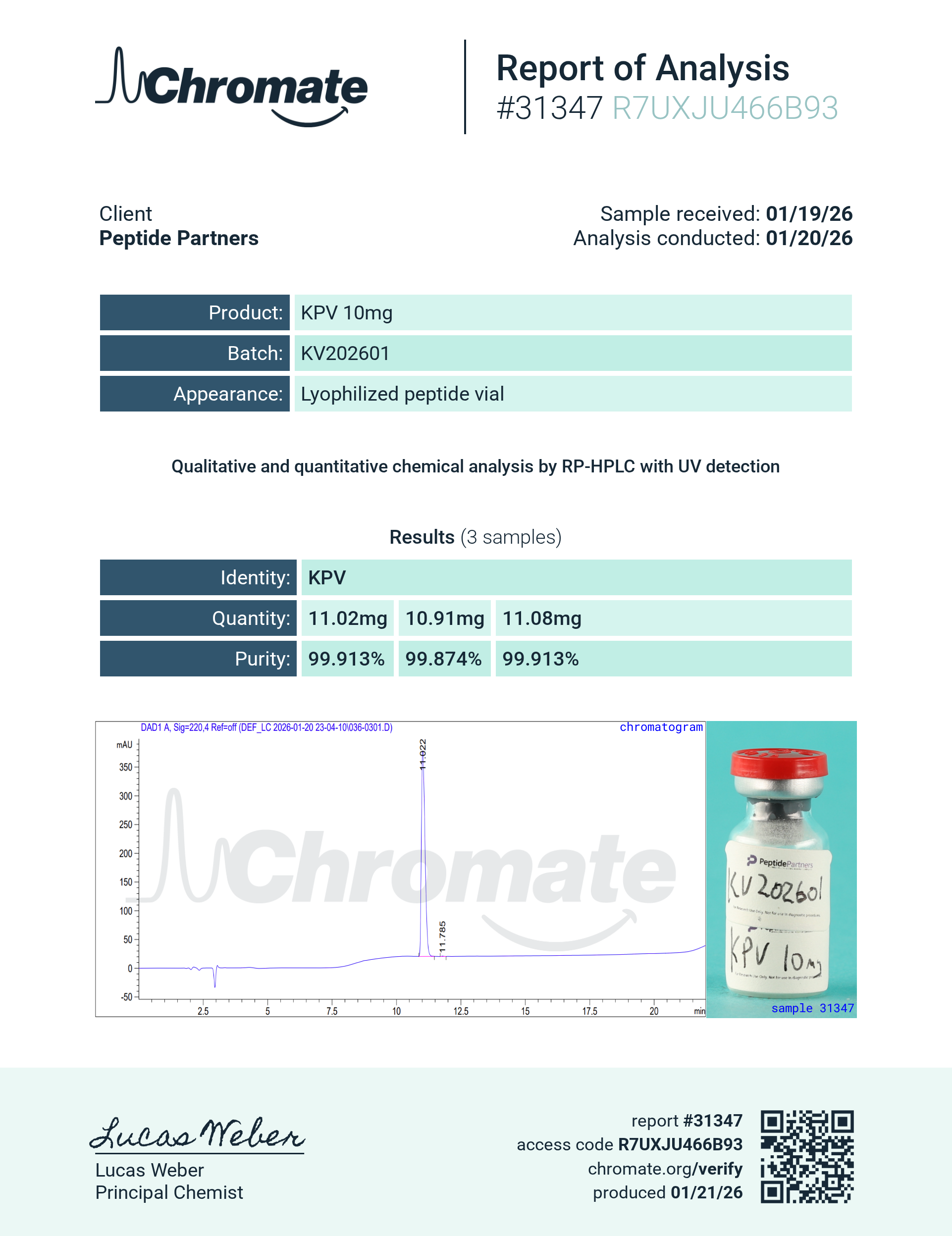
| KPV | KV202601 | VI32 | 2026-01-20 | 99.90% | Chromate | View File |
| Ipamorelin | IP202601 | WF03 | 2026-01-14 | 99.92% | TrustPointe | View File |
| TB500 (TB4) | TB202601 | WF03 | 2026-01-14 | 99.86% | TrustPointe | View File |
| Retatrutide | RT202602 | WF03 | 2026-01-13 | 99.63% | TrustPointe | View File |
| PT-141 | PT202512 | VI32 | 2026-01-12 | 99.89% | BioRegen | View File |
| Semaglutide | SM202601 | MZ21 | 2026-01-10 | 99.70% | TrustPointe | View File |
| Cagrilintide | CAG202601 | MZ21 | 2026-01-10 | 99.33% | TrustPointe | View File |
| Tesamorelin | TES202601 | WF03 | 2025-12-29 | 99.71% | TrustPointe | View File |
| BPC-157 | BP202512 | WF03 | 2025-12-29 | 99.46% | TrustPointe | View File |
| BPC-157/TB-500 | BB202512 | WF03 | 2025-12-29 | 99.64% | TrustPointe | View File |
| GHK-Cu | GK202512 | SH07 | 2025-12-19 | 99.79% | BioRegen | View File |
| MOTS-c | MC202512 | WF03 | 2025-12-22 | 99.89% | BioRegen | View File |
| Retatrutide | RP260130 | VI32 | 2025-12-22 | 99.72% | TrustPointe | View File |
| SS-31 | SS202512 | WF03 | 2025-12-19 | 99.70% | TrustPointe | View File |
| Retatrutide | RP202601 | DF05 | 2025-12-22 | 99.63% | TrustPointe | View File |
| Ipamorelin/CJC-1295 (No DAC) | CJIP202512 | WF03 | 2025-12-09 | 99.80% | TrustPointe | View File |
| Retatrutide | RP202511 | DF05 | 2025-12-19 | 99.73% | TrustPointe | View File |
| Retatrutide | RP20251020 | DF05 | 2025-11-10 | 99.33% | TrustPointe | View File |
| Retatrutide | RP20251001 | DF05 | 2025-10-13 | 99.86% | TrustPointe | View File |
| Tirzepatide | TZ20250915 | DF05 | 2025-10-03 | 99.74% | TrustPointe | View File |
| Retatrutide | RP20250929 | VI32 | 2025-10-03 | 99.47% | TrustPointe | View File |
| Humanin | HP20250805 | WF03 | 2025-09-19 | 99.92% | BioRegen | View File |
| MOTS-c | YC20250807 | WF03 | 2025-09-19 | 99.87% | BioRegen | View File |
| DSIP | DS20250820 | SH07 | 2025-09-19 | 99.88% | BioRegen | View File |
| SS-31 | SY20250806 | WF03 | 2025-09-19 | 99.70% | BioRegen | View File |
| CJC/Ipamorelin | CI20250805 | WF03 | 2025-09-11 | 99.84% | TrustPointe | View File |
| BPC-157 | BP20250808 | WF03 | 2025-09-05 | 99.99% | TrustPointe | View File |
| Sermorelin | SM20250723 | WF03 | 2025-08-27 | 99.84% | BioRegen | View File |
| Tesamorelin | TS20250722 | WF03 | 2025-08-22 | 99.10% | TrustPointe | View File |
| CJC-1295 ND | CJ20250724 | WF03 | 2025-08-20 | 99.43% | TrustPointe | View File |
| Semaglutide | SM20250801 | EJ12 | 2025-08-20 | 99.34% | TrustPointe | View File |
| Ipamorelin | IP20250721 | WF03 | 2025-08-15 | 99.64% | TrustPointe | View File |
| GHK-Cu | CU20250717 | SH07 | 2025-08-09 | 99.73% | BioRegen | View File |
| Tirzepatide | TZ20250730 | EJ12 | 2025-08-08 | 99.41% | TrustPointe | View File |
| NAD+ | ND20250503 | SH07 | 2025-07-31 | 99.76% | BioRegen | View File |
| VIP | VP20250511 | SH07 | 2025-07-31 | 99.42% | BioRegen | View File |
| Retatrutide | CD20250708 | SH07 | 2025-07-25 | 99.42% | TrustPointe | View File |
| BPC/TB500 | BB20250630 | SH07 | 2025-07-17 | 99.52% | TrustPointe | View File |
| TB500 (TB4) | TB20250614 | SH07 | 2025-07-17 | 99.68% | TrustPointe | View File |
| Peptide | Batch Id | Manufacturer | Date | USP Conformation | Laboratory | |
|---|---|---|---|---|---|---|
| GHK-Cu | CU202604 | WF03 | 2026-04-03 | Conforms | Kovera | View File |
| SS-31 | SS202601 | WF03 | 2026-04-03 | Conforms | TrustPointe | View File |
| Semax | SX202603 | WF03 | 2026-03-31 | Conforms | Kovera | View File |
| Retatrutide | RT202603 | WF03 | 2026-03-30 | Conforms | TrustPointe | View File |
| GLOW Blend | GW202603 | WF03 | 2026-03-25 | Conforms | Kovera | View File |
| Tirzepatide | TZ202603 | VI32 | 2026-03-27 | Conforms | TrustPointe | View File |
| BPC-157/TB-500 | BB202604 | WF03 | 2026-03-26 | Conforms | TrustPointe | View File |
| Tesamorelin | TES202603 | WF03 | 2026-03-25 | Conforms | TrustPointe | View File |
| BPC-157 | BC202604 | WF03 | 2026-03-17 | Conforms | Kovera | View File |
| Thymosin Alpha-1 | TA202601 | WF03 | 2026-02-25 | Conforms | Kovera | View File |
| NAD+ | NDB202601 | VI32 | 2026-02-08 | Conforms | Kovera | View File |
| Unbuffered NAD+ | NDU202601 | MZ21 | 2026-01-28 | Conforms | TrustPointe | View File |
| KPV | KV202601 | VI32 | 2026-01-28 | Conforms | TrustPointe | View File |
| Ipamorelin | IP202601 | WF03 | 2026-01-13 | Conforms | TrustPointe | View File |
| TB500 | TB202601 | WF03 | 2026-01-13 | Conforms | TrustPointe | View File |
| Retatrutide | RT202602 | WF03 | 2026-01-13 | Conforms | TrustPointe | View File |
| PT-141 | PT202512 | VI32 | 2026-01-07 | Conforms | BioRegen | View File |
| Semaglutide | SM202601 | MZ21 | 2026-01-10 | Conforms | TrustPointe | View File |
| Cagrilintide | CAG202601 | MZ21 | 2026-01-10 | Conforms | TrustPointe | View File |
| Tesamorelin | TES202601 | WF03 | 2025-01-06 | Conforms | TrustPointe | View File |
| BPC-157 | BP202512 | WF03 | 2025-12-30 | Conforms | TrustPointe | View File |
| BPC-157/TB-500 | BB202512 | WF03 | 2025-12-30 | Conforms | TrustPointe | View File |
| Retatrutide | RP260130 | DF05 | 2025-12-22 | Conforms | TrustPointe | View File |
| SS-31 | SS202512 | WF03 | 2025-12-19 | Conforms | TrustPointe | View File |
| Retatrutide | RP202601 | DF05 | 2025-12-22 | Conforms | TrustPointe | View File |
| Ipamorelin/CJC-1295 (No DAC) | CJIP202512 | WF03 | 2025-12-08 | Conforms | TrustPointe | View File |
| Retatrutide | RP202511 | DF05 | 2025-11-10 | Conforms | TrustPointe | View File |
| Retatrutide | RP20251020 | DF05 | 2025-11-10 | Conforms | TrustPointe | View File |
| Retatrutide | RP20251001 | DF05 | 2025-10-13 | Conforms | TrustPointe | View File |
| Tirzepatide | TZ20250915 | DF05 | 2025-10-03 | Conforms | TrustPointe | View File |
| Retatrutide | RP20250929 | VI32 | 2025-10-03 | Conforms | TrustPointe | View File |
| Humanin | HP20250805 | WF03 | 2025-09-19 | Conforms | BioRegen | View File |
| MOTS-c | YC20250807 | WF03 | 2025-09-19 | Conforms | BioRegen | View File |
| DSIP | DS20250820 | SH07 | 2025-09-19 | Conforms | BioRegen | View File |
| SS-31 | SY20250806 | WF03 | 2025-09-19 | Conforms | BioRegen | View File |
| CJC/Ipamorelin | CI20250805 | WF03 | 2025-09-03 | Conforms | TrustPointe | View File |
| BPC-157 | BP20250808 | WF03 | 2025-09-03 | Conforms | TrustPointe | View File |
| Bacteriostatic Water | BAC20250807 | SH07 | 2025-08-27 | Conforms | BioRegen | View File |
| Tesamorelin | TS20250722 | WF03 | 2025-08-20 | Conforms | TrustPointe | View File |
| CJC-1295 ND | CJ20250724 | WF03 | 2025-08-20 | Conforms | TrustPointe | View File |
| Sermorelin | SM20250723 | WF03 | 2025-08-20 | Conforms | TrustPointe | View File |
| Semaglutide | SM20250801 | EJ12 | 2025-08-20 | Conforms | TrustPointe | View File |
| Ipamorelin | IP20250721 | WF03 | 2025-08-11 | Conforms | TrustPointe | View File |
| GHK-Cu | CU20250717 | SH07 | 2025-08-08 | Conforms | TrustPointe | View File |
| Tirzepatide | TZ20250730 | EJ12 | 2025-08-04 | Conforms | TrustPointe | View File |
| NAD+ | ND20250503 | SH07 | 2025-07-29 | Conforms | TrustPointe | View File |
| VIP | VP20250511 | SH07 | 2025-07-29 | Conforms | TrustPointe | View File |
| Retatrutide | CD20250708 | SH07 | 2025-07-24 | Conforms | TrustPointe | View File |
| BPC/TB500 | BB20250630 | SH07 | 2025-07-17 | Conforms | TrustPointe | View File |
| TB500 (TB4) | TB20250614 | SH07 | 2025-07-17 | Conforms | TrustPointe | View File |
| Peptide | Batch Id | Manufacturer | Date | USP Conformation | Laboratory | |
|---|---|---|---|---|---|---|
| Semax | SX202603 | WF03 | 2026-03-31 | Conforms | Kovera | View File |
| GLOW Blend | GW202603 | WF03 | 2026-03-26 | Conforms | Kovera | View File |
| Tirzepatide | TZ202603 | VI32 | 2026-03-26 | Conforms | Kovera | View File |
| BPC-157 | BC202604 | WF03 | 2026-03-17 | Conforms | Kovera | View File |
| Thymosin Alpha-1 | TA202602 | WF03 | 2026-02-25 | Conforms | Kovera | View File |
| NAD+ | NDB202601 | VI32 | 2026-02-08 | Conforms | Kovera | View File |
| Ipamorelin | IP202601 | WF03 | 2026-01-26 | Conforms | TrustPointe | View File |
| TB500 | TB202601 | WF03 | 2026-01-26 | Conforms | TrustPointe | View File |
| Retatrutide | RT202602 | WF03 | 2026-01-26 | Conforms | TrustPointe | View File |
| Semaglutide | SM202601 | MZ21 | 2026-01-19 | Conforms | TrustPointe | View File |
| Cagrilintide | CAG202601 | MZ21 | 2026-01-19 | Conforms | TrustPointe | View File |
| Tesamorelin | TES202601 | WF03 | 2026-01-19 | Conforms | TrustPointe | View File |
| BPC-157 | BP202512 | WF03 | 2026-01-08 | Conforms | TrustPointe | View File |
| BPC-157/TB-500 | BB202512 | WF03 | 2026-01-08 | Conforms | TrustPointe | View File |
| Tirzepatide | TZ20250915 | DF05 | 2025-12-03 | Conforms | TrustPointe | View File |
| TB500 (TB4) | TB20250614 | SH07 | 2025-11-24 | Conforms | TrustPointe | View File |
| BPC-157 | BP20250808 | WF03 | 2025-11-12 | Conforms | TrustPointe | View File |
| BPC/TB500 | BB20250630 | SH07 | 2025-11-12 | Conforms | TrustPointe | View File |
| CJC-1295 ND | CJ20250724 | WF03 | 2025-11-12 | Conforms | TrustPointe | View File |
| GHK-Cu | CU20250717 | SH07 | 2025-11-12 | Conforms | TrustPointe | View File |
| Ipamorelin | IP20250721 | WF03 | 2025-11-12 | Conforms | TrustPointe | View File |
| Retatrutide | RP20251020 | DF05 | 2025-11-12 | Conforms | TrustPointe | View File |
| Sermorelin | SM20250723 | WF03 | 2025-11-12 | Conforms | TrustPointe | View File |
| SS-31 | SY20250806 | WF03 | 2025-11-12 | Conforms | TrustPointe | View File |
| TB500 (TB4) | TB20250614 | SH07 | 2025-11-12 | Conforms | TrustPointe | View File |
| Tesamorelin | TS20250722 | WF03 | 2025-11-12 | Conforms | TrustPointe | View File |
| Tirzepatide | TZ20250730 | EJ12 | 2025-11-12 | Conforms | TrustPointe | View File |
When obtaining research peptides, it is essential to validate the authenticity of the Certificate of Analysis (COA). Certificate fraud runs rampant throughout the research peptide supply community. The two most common forms are doctored images and stolen certificates. You can check for these two by making sure the third-party laboratory’s website shows that the certificate belongs to the supplier and the values haven’t been doctored. TrustPointe Analytics provides a few simple rules for verification:
Not only must one remain vigilant about potentially fraudulent certificates, one must also be aware that there are third-party laboratories whose results cannot be considered reliable or scientifically valid. Unfortunately, there is significant evidence to suggest that one of the most popular third-party testing labs does not use scientifically sound methodologies and, in some cases, has fabricated results. There isn’t an easy remedy for this problem, but when labs are particularly bad, there tend to be a lot of discussion threads on various social platforms.
Our friends at TrustPointe have provided the following detailed explanation to help interpret the results of the endotoxin testing.
We use the Charles River Endosafe PTS system to test for bacterial endotoxins following USP <85> guidelines:
The following are suitability parameters that verify the system was working properly and the sample prep dilution is appropriate for accurate results. Peptides often interfere with endotoxin detection due to their tendency to bind or mask endotoxins, which can lead to inaccurate low results. To overcome this, samples are typically tested at a large dilution to reduce matrix interference and ensure reliable recovery and detection in compliance with USP <85>. If the dilution is not correct, the run will fail suitability and we’ll need to adjust the dilution to ensure accurate results. We provide the suitability data to customers for transparency and so they can be confident in the results.
USP <85> Sample CV %:
USP <85> Spike CV %:
USP <85> Spike Recovery
Thank you for choosing Peptide Partners.
NOTICE: All information provided above is strictly intended for educational and informational purposes. Our products are designed for research use solely and are not approved for human consumption. Please refrain from any form of ingestion.
By making a purchase from Peptide Partners, you acknowledge that you are acquiring Research Chemicals. Our products are exclusively intended for laboratory research purposes.
It is imperative that only qualified and licensed professionals handle this product. Under no circumstances should it be utilized as a drug, agricultural or pesticide product, food additive, or household chemical. Misrepresentation of this product for such purposes is strictly prohibited by law. All content on our website is provided for educational use exclusively. Any form of introduction into the human or animal body is illegal.