This product is solely intended for research purposes as a chemical compound. Its designation permits its use exclusively for in vitro testing and laboratory experimentation. All information regarding this product provided on our website is purely educational. By law, any form of bodily introduction of this product into humans or animals is strictly prohibited. It should only be handled by professionals who are licensed and qualified. This product is neither a drug, food, nor cosmetic, and must not be misrepresented, misused, or mislabeled as such.
In stock
Swipe right to view full table →
Save over 80%!
 |
|
| Cost per milligram | $3.50 – $5.70 |
| Purity | 99.62% |
| Certified Endotoxin-safe | Yes |
| Independently Tested | Yes |
Authors: Wenzhuo Li, Qingtong Zhou, Zhaotong Cong, Qingning Yuan, Wenxin Li, Fenghui Zhao, H. Eric Xu, Li-Hua Zhao, Dehua Yang & Ming-Wei Wang
Source: https://www.nature.com/articles/s41421-024-00700-0
This study utilized cryo-electron microscopy to elucidate the structural basis of Retatrutide’s triple agonism at the GLP-1, GIP, and GCG receptors. The researchers determined the structures of Retatrutide in complex with each of the three receptors, revealing that the peptide adopts a single continuous helix. The triple agonism is achieved through a combination of conserved interactions and receptor-specific contacts within the transmembrane domain. The study identified key residues and structural features, such as the conformation of extracellular loop 1 (ECL1) in GIPR, that contribute to the differential binding and activation of the receptors. Mutagenesis and cAMP signaling assays confirmed the functional importance of these interactions, providing a molecular blueprint for Retatrutide’s potent and balanced activity.
Scientists have figured out how the new weight-loss drug, Retatrutide, works at a molecular level. This drug is unique because it can activate three different hormone receptors in the body that control appetite and metabolism. Using powerful microscopes, the researchers took detailed 3D pictures of Retatrutide as it was bound to each of these three receptors. They discovered that the drug uses a clever strategy of both sticking to parts that all three receptors have in common and also making specific connections with unique parts of each receptor. This allows it to effectively ‘talk’ to all three at once, leading to its powerful effects on weight loss and blood sugar control. Understanding this mechanism helps to explain why Retatrutide is so effective and can guide the development of even better medicines in the future.
Authors: Yi Wen, Deven Lemen, Yanzhu Lin, Yan Q Chen, Ajit Regmi, William C Roell, Melissa K Thomas, Mark L Hartman, Tamer Coskun, Zvonko Milicevic, Axel Haupt, Giacomo Ruotolo, Robert J Konrad
Source: https://pubmed.ncbi.nlm.nih.gov/40726454/
This study investigated the effect of Retatrutide on circulating concentrations of the angiopoietin-like protein 3/8 complex (ANGPTL3/8) and its relationship with serum lipid levels. The study included both in vivo analysis from two phase 2 clinical trials and in vitro experiments using primary human hepatocytes. The in vitro component demonstrated that both glucagon and Retatrutide directly decreased ANGPTL3/8 secretion from hepatocytes, and this effect was blocked by a glucagon receptor (GCGR) antagonist. These findings suggest that the GCGR agonism of Retatrutide contributes to the reduction in circulating ANGPTL3/8, which in turn may lead to lower triglyceride and LDL-cholesterol levels.
Researchers explored how Retatrutide, a new drug for diabetes and obesity, helps lower bad fats in the blood. They found that Retatrutide reduces the levels of a protein complex called ANGPTL3/8, which is known to increase fats like triglycerides and LDL cholesterol. To understand how this happens, they conducted experiments on human liver cells in a lab dish. They discovered that Retatrutide directly acts on these cells to decrease the secretion of ANGPTL3/8. This suggests that part of Retatrutide’s effectiveness in improving cholesterol levels comes from its direct action on the liver, providing a clearer picture of how this promising new drug works.
Authors: Xin Cui, Yueming Zhu, Lidan Zeng, Mengyuan Zhang, Amad Uddin, Theresa W Gillespie, Lauren E McCullough, Shaying Zhao, Mylin A Torres, Yong Wan
Source: https://pubmed.ncbi.nlm.nih.gov/39868848/
This study elucidates a molecular mechanism by which Retatrutide overcomes therapeutic resistance in obese triple-negative breast cancer (TNBC). The research identifies a dysfunctional EIF3H/YAP proteolytic axis as a key mediator between cancer-associated adipocytes and drug response. In vitro experiments demonstrated that cancer-associated adipocytes upregulate the hexosamine biosynthetic pathway (HBP), leading to O-GlcNAcylation and stabilization of the YAP protein. Retatrutide was found to inhibit the HBP, thereby preventing YAP O-GlcNAcylation and promoting its degradation. This, in turn, suppresses tumor growth and enhances chemotherapy efficacy. The study provides a detailed mechanistic insight into the interplay between metabolic reprogramming, protein stability, and drug response in the context of obesity and cancer.
Scientists have discovered how the weight-loss drug Retatrutide can also help treat a type of breast cancer that is more common in obese patients. They found that fat cells near the tumor can make the cancer cells resistant to treatment. These fat cells cause a change in the cancer cells’ metabolism, which leads to the buildup of a protein called YAP that helps the cancer grow. The researchers showed that Retatrutide can reverse this process. In lab experiments, Retatrutide blocked the metabolic changes caused by the fat cells and caused the YAP protein to be destroyed. This made the cancer cells more sensitive to chemotherapy. This research uncovers a new way that obesity affects cancer and suggests that drugs like Retatrutide could be used to improve cancer treatment in obese patients.
Storage:
All of our manufacturing partners produce peptides using the Lyophilization (Freeze Drying) process, ensuring products maintain stability for shipping and storage for 12+ months.
In lyophilized form, they are shelf-stable for many weeks. However, for long-term storage, it is recommended to store them in the freezer.
We often hear concerns about the standard “discard after 28 days of first use” disclaimer. Don’t worry, this has nothing to do with studies regarding the efficacy of specific peptides. 28 days is the FDA requirement for producers of multi-use vials to prove their bacteriostatic maintains efficacy. This minimum requirement becomes the de facto standard.
In our experience, if you use proper sterile procedures and refrigerated storage, you can continue sampling from the same reconstituted vial for 3+ months.
Peptide Partners is committed to providing high-purity peptides at wholesale prices by frequently auditing its manufacturing partners using third-party laboratories. Independent analysis is vital to ensuring the quality and authenticity of your research peptides. Never trust a supplier that doesn’t submit to third-party testing. Never trust a certification that cannot be independently verified. All of the certificates that we provide can be validated on the third-party laboratory’s website.
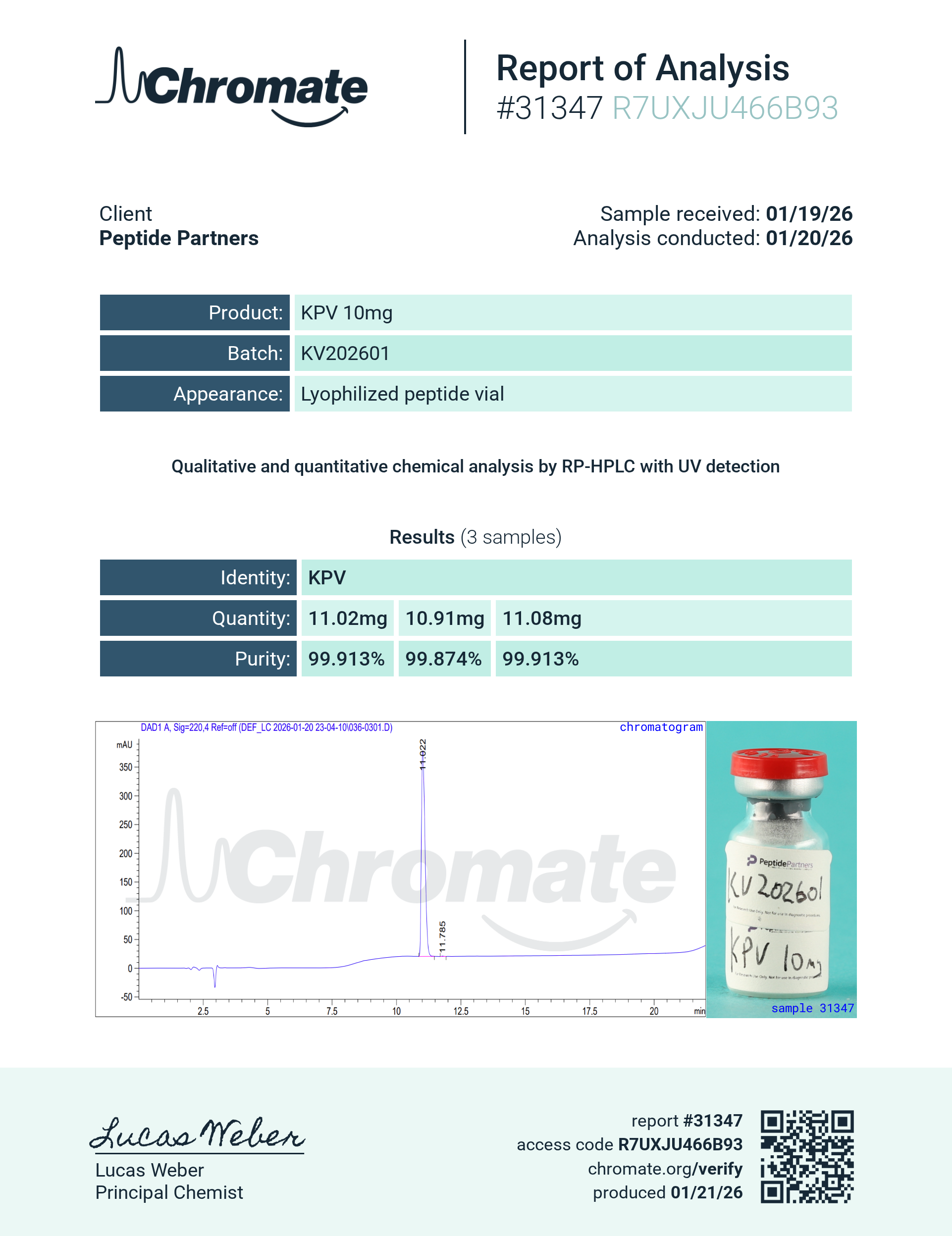
Each product description contains a Manufacturer ID corresponding to the producer of that product. The table below contains the most recent third-party analyses for all manufacturers and peptides listed on Peptide Partners.
| Peptide | Batch Id | Manufacturer | Date | Purity | Laboratory | |
|---|---|---|---|---|---|---|
| NAD+ | NDB202601 | VI32 | 2026-02-07 | 99.92% | Kovera | View File |
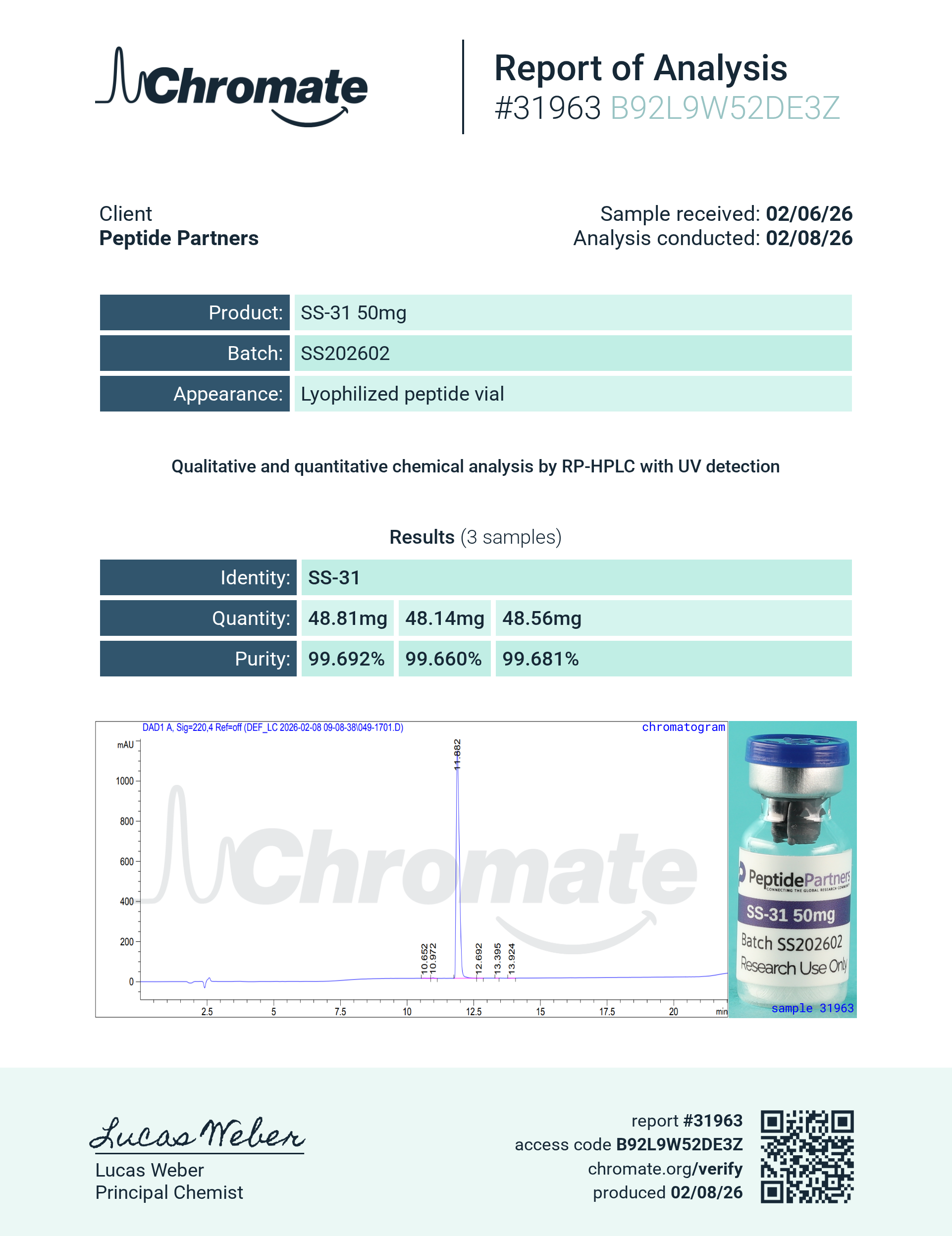
| SS-31 | SS202602 | WF03 | 2026-02-08 | 99.68% | Chromate | View File |
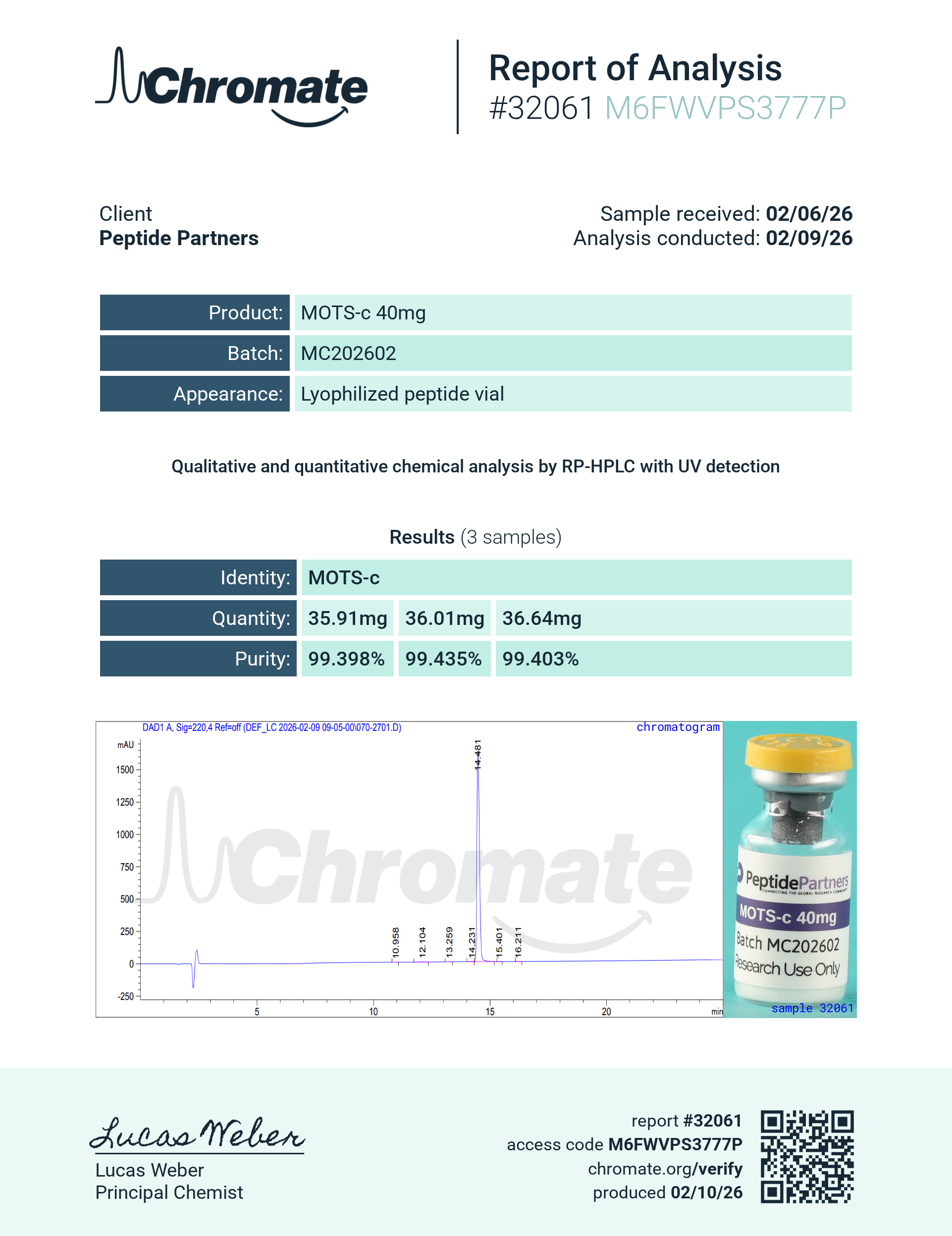
| MOTS-c | MC202602 | WF03 | 2026-02-09 | 99.41% | Chromate | View File |
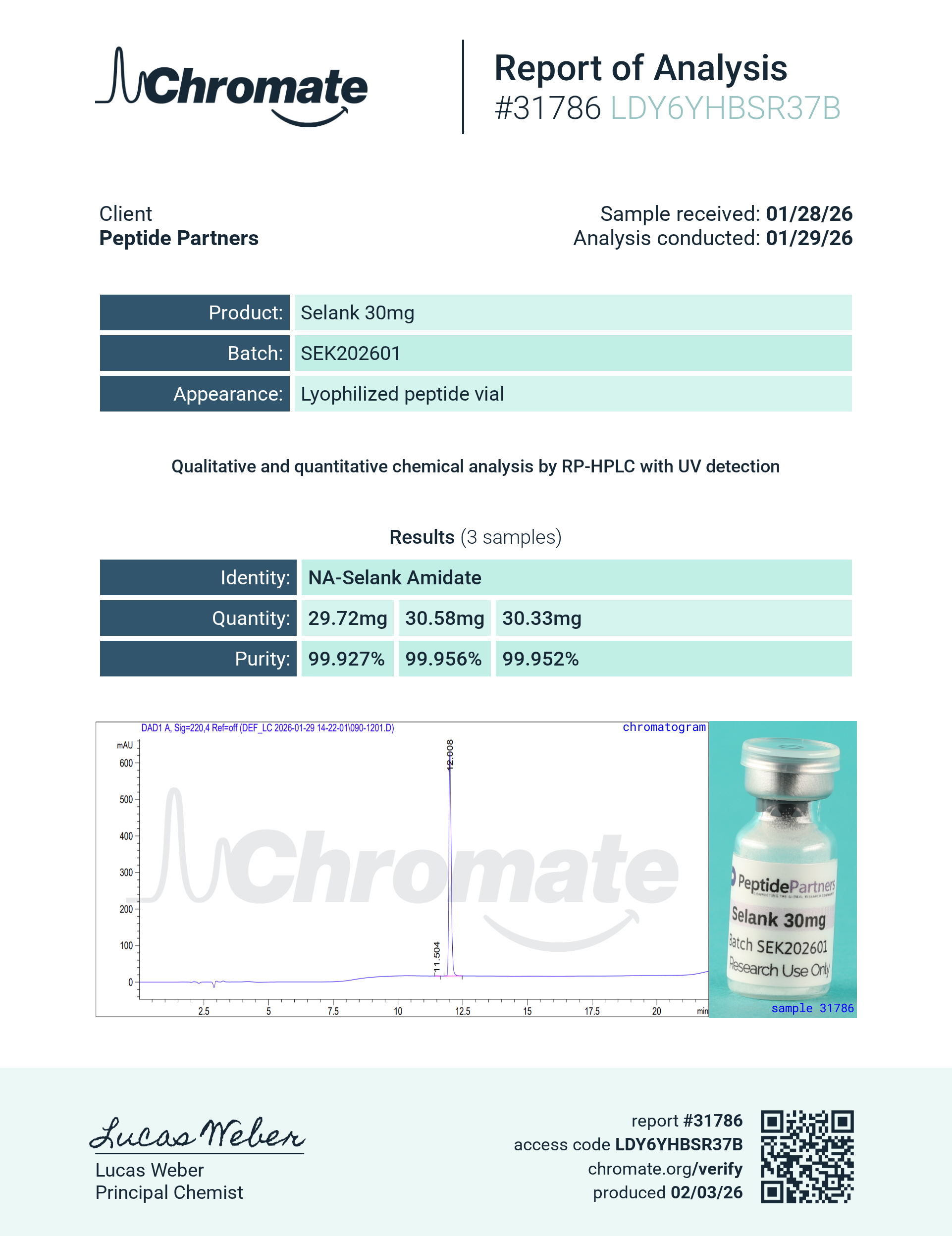
| Selank | SEK202601 | VI32 | 2026-01-29 | 99.94% | Chromate | View File |
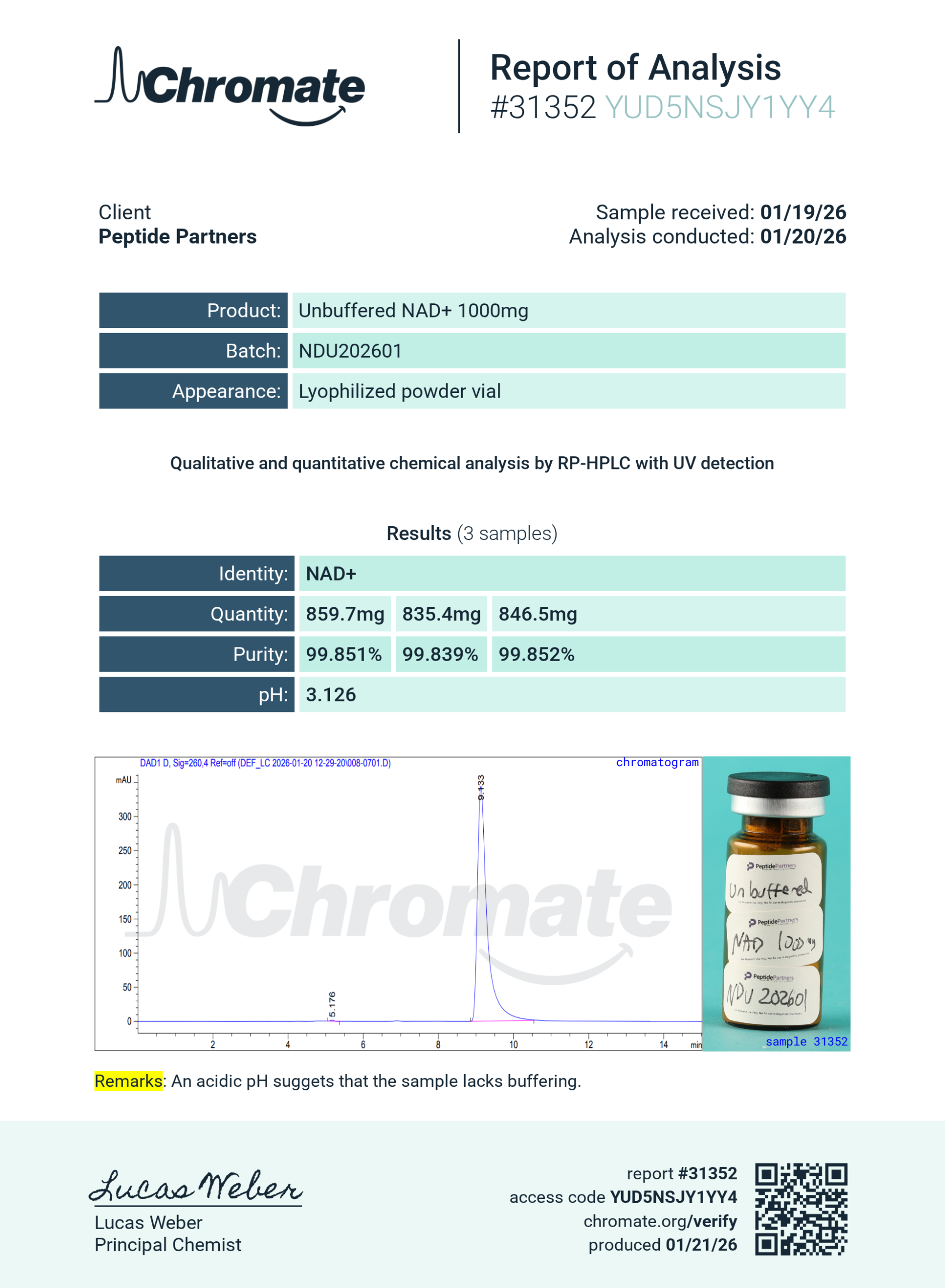
| Unbuffered NAD+ | NDU202601 | MZ21 | 2026-01-20 | 99.85% | Chromate | View File |
| KPV | KV202601 | VI32 | 2026-01-20 | 99.90% | Chromate | View File |
| Ipamorelin | TB202601 | WF03 | 2026-01-14 | 99.92% | TrustPointe | View File |
| TB500 (TB4) | TB202601 | WF03 | 2026-01-14 | 99.86% | TrustPointe | View File |
| Retatrutide | RT202602 | WF03 | 2026-01-13 | 99.63% | TrustPointe | View File |
| PT-141 | PT202512 | VI32 | 2026-01-12 | 99.89% | BioRegen | View File |
| Semaglutide | SM202601 | MZ21 | 2026-01-10 | 99.70% | TrustPointe | View File |
| Cagrilintide | CAG202601 | MZ21 | 2026-01-10 | 99.33% | TrustPointe | View File |
| Tesamorelin | TES202601 | WF03 | 2025-12-29 | 99.71% | TrustPointe | View File |
| BPC-157 | BP202512 | WF03 | 2025-12-29 | 99.46% | TrustPointe | View File |
| BPC-157/TB-500 | BB202512 | WF03 | 2025-12-29 | 99.64% | TrustPointe | View File |
| GHK-Cu | GK202512 | SH07 | 2025-12-19 | 99.79% | BioRegen | View File |
| MOTS-c | MC202512 | WF03 | 2025-12-22 | 99.89% | BioRegen | View File |
| Retatrutide | RP260130 | VI32 | 2025-12-22 | 99.72% | TrustPointe | View File |
| SS-31 | SS202512 | WF03 | 2025-12-19 | 99.70% | TrustPointe | View File |
| Retatrutide | RP202601 | DF05 | 2025-12-22 | 99.63% | TrustPointe | View File |
| Ipamorelin/CJC-1295 (No DAC) | CJIP202512 | WF03 | 2025-12-09 | 99.80% | TrustPointe | View File |
| Retatrutide | RP202511 | DF05 | 2025-12-19 | 99.73% | TrustPointe | View File |
| Retatrutide | RP20251020 | DF05 | 2025-11-10 | 99.33% | TrustPointe | View File |
| Retatrutide | RP20251001 | DF05 | 2025-10-13 | 99.86% | TrustPointe | View File |
| Tirzepatide | TZ20250915 | DF05 | 2025-10-03 | 99.74% | TrustPointe | View File |
| Retatrutide | RP20250929 | VI32 | 2025-10-03 | 99.47% | TrustPointe | View File |
| Humanin | HP20250805 | WF03 | 2025-09-19 | 99.92% | BioRegen | View File |
| MOTS-c | YC20250807 | WF03 | 2025-09-19 | 99.87% | BioRegen | View File |
| DSIP | DS20250820 | SH07 | 2025-09-19 | 99.88% | BioRegen | View File |
| SS-31 | SY20250806 | WF03 | 2025-09-19 | 99.70% | BioRegen | View File |
| CJC/Ipamorelin | CI20250805 | WF03 | 2025-09-11 | 99.84% | TrustPointe | View File |
| BPC-157 | BP20250808 | WF03 | 2025-09-05 | 99.99% | TrustPointe | View File |
| Sermorelin | SM20250723 | WF03 | 2025-08-27 | 99.84% | BioRegen | View File |
| Tesamorelin | TS20250722 | WF03 | 2025-08-22 | 99.10% | TrustPointe | View File |
| CJC-1295 ND | CJ20250724 | WF03 | 2025-08-20 | 99.43% | TrustPointe | View File |
| Semaglutide | SM20250801 | EJ12 | 2025-08-20 | 99.34% | TrustPointe | View File |
| Ipamorelin | IP20250721 | WF03 | 2025-08-15 | 99.64% | TrustPointe | View File |
| GHK-Cu | CU20250717 | SH07 | 2025-08-09 | 99.73% | BioRegen | View File |
| Tirzepatide | TZ20250730 | EJ12 | 2025-08-08 | 99.41% | TrustPointe | View File |
| NAD+ | ND20250503 | SH07 | 2025-07-31 | 99.76% | BioRegen | View File |
| VIP | VP20250511 | SH07 | 2025-07-31 | 99.42% | BioRegen | View File |
| Retatrutide | CD20250708 | SH07 | 2025-07-25 | 99.42% | TrustPointe | View File |
| BPC/TB500 | BB20250630 | SH07 | 2025-07-17 | 99.52% | TrustPointe | View File |
| TB500 (TB4) | TB20250614 | SH07 | 2025-07-17 | 99.68% | TrustPointe | View File |
| Peptide | Batch Id | Manufacturer | Date | USP Conformation | Laboratory | |
|---|---|---|---|---|---|---|
| NAD+ | NDB202601 | VI32 | 2026-02-08 | Conforms | Kovera | View File |
| Unbuffered NAD+ | NDU202601 | MZ21 | 2026-01-28 | Conforms | TrustPointe | View File |
| KPV | KV202601 | VI32 | 2026-01-28 | Conforms | TrustPointe | View File |
| Ipamorelin | IP202601 | WF03 | 2026-01-13 | Conforms | TrustPointe | View File |
| TB500 | TB202601 | WF03 | 2026-01-13 | Conforms | TrustPointe | View File |
| Retatrutide | RT202602 | WF03 | 2026-01-13 | Conforms | TrustPointe | View File |
| PT-141 | PT202512 | VI32 | 2026-01-07 | Conforms | BioRegen | View File |
| Semaglutide | SM202601 | MZ21 | 2026-01-10 | Conforms | TrustPointe | View File |
| Cagrilintide | CAG202601 | MZ21 | 2026-01-10 | Conforms | TrustPointe | View File |
| Tesamorelin | TES202601 | WF03 | 2025-01-06 | Conforms | TrustPointe | View File |
| BPC-157 | BP202512 | WF03 | 2025-12-30 | Conforms | TrustPointe | View File |
| BPC-157/TB-500 | BB202512 | WF03 | 2025-12-30 | Conforms | TrustPointe | View File |
| Retatrutide | RP260130 | DF05 | 2025-12-22 | Conforms | TrustPointe | View File |
| SS-31 | SS202512 | WF03 | 2025-12-19 | Conforms | TrustPointe | View File |
| Retatrutide | RP202601 | DF05 | 2025-12-22 | Conforms | TrustPointe | View File |
| Ipamorelin/CJC-1295 (No DAC) | CJIP202512 | WF03 | 2025-12-08 | Conforms | TrustPointe | View File |
| Retatrutide | RP202511 | DF05 | 2025-11-10 | Conforms | TrustPointe | View File |
| Retatrutide | RP20251020 | DF05 | 2025-11-10 | Conforms | TrustPointe | View File |
| Retatrutide | RP20251001 | DF05 | 2025-10-13 | Conforms | TrustPointe | View File |
| Tirzepatide | TZ20250915 | DF05 | 2025-10-03 | Conforms | TrustPointe | View File |
| Retatrutide | RP20250929 | VI32 | 2025-10-03 | Conforms | TrustPointe | View File |
| Humanin | HP20250805 | WF03 | 2025-09-19 | Conforms | BioRegen | View File |
| MOTS-c | YC20250807 | WF03 | 2025-09-19 | Conforms | BioRegen | View File |
| DSIP | DS20250820 | SH07 | 2025-09-19 | Conforms | BioRegen | View File |
| SS-31 | SY20250806 | WF03 | 2025-09-19 | Conforms | BioRegen | View File |
| CJC/Ipamorelin | CI20250805 | WF03 | 2025-09-03 | Conforms | TrustPointe | View File |
| BPC-157 | BP20250808 | WF03 | 2025-09-03 | Conforms | TrustPointe | View File |
| Bacteriostatic Water | BAC20250807 | SH07 | 2025-08-27 | Conforms | BioRegen | View File |
| Tesamorelin | TS20250722 | WF03 | 2025-08-20 | Conforms | TrustPointe | View File |
| CJC-1295 ND | CJ20250724 | WF03 | 2025-08-20 | Conforms | TrustPointe | View File |
| Sermorelin | SM20250723 | WF03 | 2025-08-20 | Conforms | TrustPointe | View File |
| Semaglutide | SM20250801 | EJ12 | 2025-08-20 | Conforms | TrustPointe | View File |
| Ipamorelin | IP20250721 | WF03 | 2025-08-11 | Conforms | TrustPointe | View File |
| GHK-Cu | CU20250717 | SH07 | 2025-08-08 | Conforms | TrustPointe | View File |
| Tirzepatide | TZ20250730 | EJ12 | 2025-08-04 | Conforms | TrustPointe | View File |
| NAD+ | ND20250503 | SH07 | 2025-07-29 | Conforms | TrustPointe | View File |
| VIP | VP20250511 | SH07 | 2025-07-29 | Conforms | TrustPointe | View File |
| Retatrutide | CD20250708 | SH07 | 2025-07-24 | Conforms | TrustPointe | View File |
| BPC/TB500 | BB20250630 | SH07 | 2025-07-17 | Conforms | TrustPointe | View File |
| TB500 (TB4) | TB20250614 | SH07 | 2025-07-17 | Conforms | TrustPointe | View File |
| Peptide | Batch Id | Manufacturer | Date | USP Conformation | Laboratory | |
|---|---|---|---|---|---|---|
| NAD+ | NDB202601 | VI32 | 2026-02-08 | Conforms | Kovera | View File |
| Ipamorelin | IP202601 | WF03 | 2026-01-26 | Conforms | TrustPointe | View File |
| TB500 | TB202601 | WF03 | 2026-01-26 | Conforms | TrustPointe | View File |
| Retatrutide | RT202602 | WF03 | 2026-01-26 | Conforms | TrustPointe | View File |
| Semaglutide | SM202601 | MZ21 | 2026-01-19 | Conforms | TrustPointe | View File |
| Cagrilintide | CAG202601 | MZ21 | 2026-01-19 | Conforms | TrustPointe | View File |
| Tesamorelin | TES202601 | WF03 | 2026-01-19 | Conforms | TrustPointe | View File |
| BPC-157 | BP202512 | WF03 | 2026-01-08 | Conforms | TrustPointe | View File |
| BPC-157/TB-500 | BB202512 | WF03 | 2026-01-08 | Conforms | TrustPointe | View File |
| Tirzepatide | TZ20250915 | DF05 | 2025-12-03 | Conforms | TrustPointe | View File |
| TB500 (TB4) | TB20250614 | SH07 | 2025-11-24 | Conforms | TrustPointe | View File |
| BPC-157 | BP20250808 | WF03 | 2025-11-12 | Conforms | TrustPointe | View File |
| BPC/TB500 | BB20250630 | SH07 | 2025-11-12 | Conforms | TrustPointe | View File |
| CJC-1295 ND | CJ20250724 | WF03 | 2025-11-12 | Conforms | TrustPointe | View File |
| GHK-Cu | CU20250717 | SH07 | 2025-11-12 | Conforms | TrustPointe | View File |
| Ipamorelin | IP20250721 | WF03 | 2025-11-12 | Conforms | TrustPointe | View File |
| Retatrutide | RP20251020 | DF05 | 2025-11-12 | Conforms | TrustPointe | View File |
| Sermorelin | SM20250723 | WF03 | 2025-11-12 | Conforms | TrustPointe | View File |
| SS-31 | SY20250806 | WF03 | 2025-11-12 | Conforms | TrustPointe | View File |
| TB500 (TB4) | TB20250614 | SH07 | 2025-11-12 | Conforms | TrustPointe | View File |
| Tesamorelin | TS20250722 | WF03 | 2025-11-12 | Conforms | TrustPointe | View File |
| Tirzepatide | TZ20250730 | EJ12 | 2025-11-12 | Conforms | TrustPointe | View File |
When obtaining research peptides, it is essential to validate the authenticity of the Certificate of Analysis (COA). Certificate fraud runs rampant throughout the research peptide supply community. The two most common forms are doctored images and stolen certificates. You can check for these two by making sure the third-party laboratory’s website shows that the certificate belongs to the supplier and the values haven’t been doctored. TrustPointe Analytics provides a few simple rules for verification:
Not only must one remain vigilant about potentially fraudulent certificates, one must also be aware that there are third-party laboratories whose results cannot be considered reliable or scientifically valid. Unfortunately, there is significant evidence to suggest that one of the most popular third-party testing labs does not use scientifically sound methodologies and, in some cases, has fabricated results. There isn’t an easy remedy for this problem, but when labs are particularly bad, there tend to be a lot of discussion threads on various social platforms.
Our friends at TrustPointe have provided the following detailed explanation to help interpret the results of the endotoxin testing.
We use the Charles River Endosafe PTS system to test for bacterial endotoxins following USP <85> guidelines:
The following are suitability parameters that verify the system was working properly and the sample prep dilution is appropriate for accurate results. Peptides often interfere with endotoxin detection due to their tendency to bind or mask endotoxins, which can lead to inaccurate low results. To overcome this, samples are typically tested at a large dilution to reduce matrix interference and ensure reliable recovery and detection in compliance with USP <85>. If the dilution is not correct, the run will fail suitability and we’ll need to adjust the dilution to ensure accurate results. We provide the suitability data to customers for transparency and so they can be confident in the results.
USP <85> Sample CV %:
USP <85> Spike CV %:
USP <85> Spike Recovery
Thank you for choosing Peptide Partners.
NOTICE: All information provided above is strictly intended for educational and informational purposes. Our products are designed for research use solely and are not approved for human consumption. Please refrain from any form of ingestion.
By making a purchase from Peptide Partners, you acknowledge that you are acquiring Research Chemicals. Our products are exclusively intended for laboratory research purposes.
It is imperative that only qualified and licensed professionals handle this product. Under no circumstances should it be utilized as a drug, agricultural or pesticide product, food additive, or household chemical. Misrepresentation of this product for such purposes is strictly prohibited by law. All content on our website is provided for educational use exclusively. Any form of introduction into the human or animal body is illegal.