This product is solely intended for research purposes as a chemical compound. Its designation permits its use exclusively for in vitro testing and laboratory experimentation. All information regarding this product provided on our website is purely educational. By law, any form of bodily introduction of this product into humans or animals is strictly prohibited. It should only be handled by professionals who are licensed and qualified. This product is neither a drug, food, nor cosmetic, and must not be misrepresented, misused, or mislabeled as such.
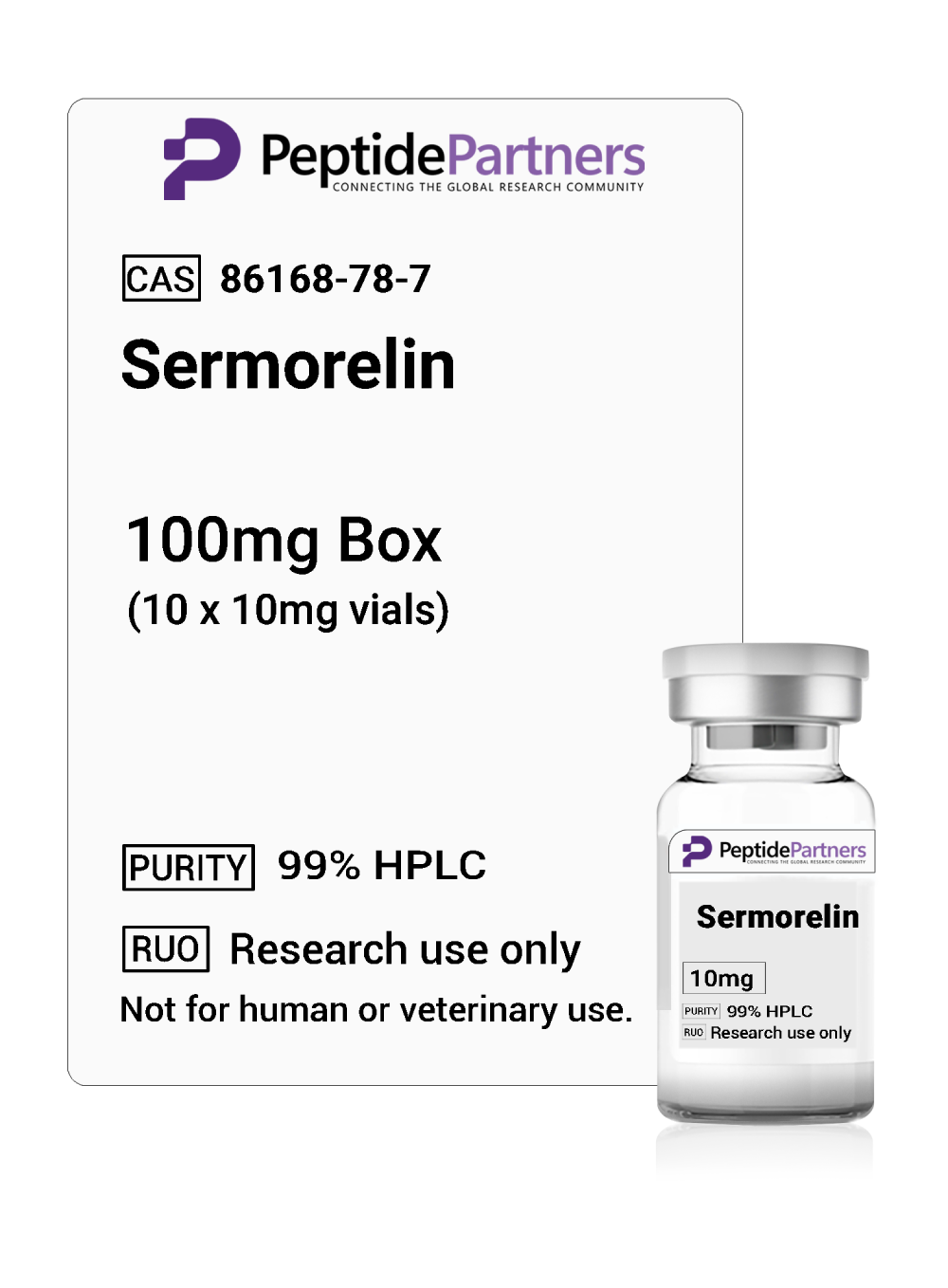
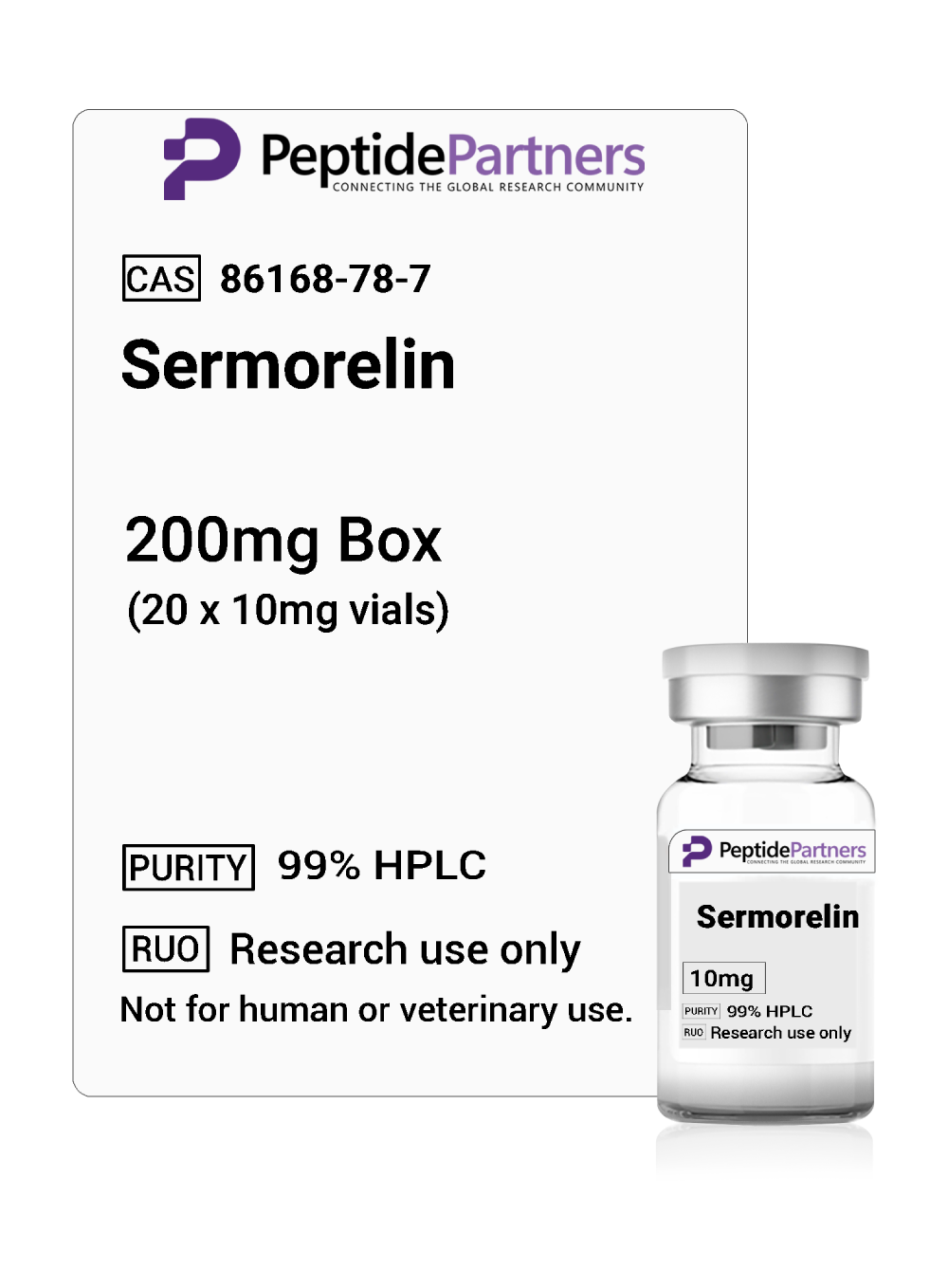
Swipe right to view full table →
Save over 70%!
 |
|
| Cost per milligram | $4.15 – $5.70 |
| Purity | 99.84% |
| Certified Endotoxin-safe | Yes |
| Independently Tested | Yes |
Authors: Chang Y, Huang R, Zhai Y, Huang L, Feng Y, Wang D, Chai R, Zhang W, Hu H.
Source: https://pmc.ncbi.nlm.nih.gov/articles/PMC8033379/
The study investigated the effect of sermorelin on glioma cell lines U87 and LN229. The results showed that sermorelin inhibited the proliferation of these cells in a dose-dependent manner. The study suggests that sermorelin may inhibit tumor cell proliferation by blocking the cell cycle. Gene ontology (GO) and Kyoto encyclopedia of genes and genomes (KEGG) analyses found that the Drug Resistance Score (DRS) of sermorelin was negatively correlated with cell proliferation and immune function.
This research explored whether the peptide Sermorelin could be a potential treatment for a type of brain tumor called glioma. The scientists tested Sermorelin on cancer cells in a lab dish and found that it could stop the cancer cells from growing. The study suggests that Sermorelin might work by interfering with the cancer cells’ ability to divide and multiply. It also seems to boost the immune system’s ability to fight the cancer. This is an early-stage study, but it suggests that Sermorelin could be a promising new drug for patients with recurrent glioma.
Authors: Memdouh S, Gavrilović I, Ng K, Cowan D, Abbate V.
Source: https://analyticalsciencejournals.onlinelibrary.wiley.com/doi/10.1002/dta.3183
This study investigates the in vitro metabolism of four growth hormone-releasing hormone (GHRH) synthetic analogs, including sermorelin, in fortified urine for anti-doping purposes. The researchers identified nineteen major in vitro metabolites of these GHRH analogs. For sermorelin, several degradation products were identified, which will aid in the development of more effective detection methods for its misuse in sports.
Scientists in this study were looking for a way to detect if athletes are illegally using substances like Sermorelin to enhance their performance. They developed a method to find these substances in urine. In the lab, they mixed Sermorelin with urine and observed how it breaks down. They identified several smaller pieces, or ‘metabolites’. Knowing what these metabolites look like is crucial for creating a reliable drug test, because the test can then look for these specific markers.
Authors: Knoop A, Thomas A, Fichant E, Delahaut P, Schänzer W, Thevis M.
Source: https://pmc.ncbi.nlm.nih.gov/articles/PMC4830873/
This study aimed to develop a method for detecting various growth hormone-releasing hormones (GHRHs), including Sermorelin, in human plasma for anti-doping purposes. In an in-vitro experiment, Sermorelin was incubated in human plasma. The researchers observed that Sermorelin was completely degraded after 4 hours. They identified a metabolite, GRF(3-29), which results from the cleavage of the N-terminal Tyr-Ala-residue by the enzyme dipeptidyl peptidase-IV (DPP-IV). This finding is important for developing effective anti-doping tests, as it’s often the metabolites of a substance, rather than the substance itself, that are detected in biological samples.
Scientists in this study were looking for a way to detect if athletes are illegally using substances like Sermorelin to enhance their performance. They developed a method to find these substances in blood. In the lab, they mixed Sermorelin with human blood plasma and observed how it breaks down. They found that Sermorelin is broken down into a smaller piece, a ‘metabolite’. Knowing what this metabolite looks like is crucial for creating a reliable drug test, because the test can then look for this specific marker.
Storage:
All of our manufacturing partners produce peptides using the Lyophilization (Freeze Drying) process, ensuring products maintain stability for shipping and storage for 12+ months.
In lyophilized form, they are shelf-stable for many weeks. However, for long-term storage, it is recommended to store them in the freezer.
We often hear concerns about the standard “discard after 28 days of first use” disclaimer. Don’t worry, this has nothing to do with studies regarding the efficacy of specific peptides. 28 days is the FDA requirement for producers of multi-use vials to prove their bacteriostatic maintains efficacy. This minimum requirement becomes the de facto standard.
In our experience, if you use proper sterile procedures and refrigerated storage, you can continue sampling from the same reconstituted vial for 3+ months.
Peptide Partners is committed to providing high-purity peptides at wholesale prices by frequently auditing its manufacturing partners using third-party laboratories. Independent analysis is vital to ensuring the quality and authenticity of your research peptides. Never trust a supplier that doesn’t submit to third-party testing. Never trust a certification that cannot be independently verified. All of the certificates that we provide can be validated on the third-party laboratory’s website.
Each product description contains a Manufacturer ID corresponding to the producer of that product. The table below contains the most recent third-party analyses for all manufacturers and peptides listed on Peptide Partners.
| Peptide | Batch Id | Manufacturer | Date | Purity | Laboratory | |
|---|---|---|---|---|---|---|
| GHK-Cu | CU202604 | WF03 | 2026-04-03 | 99.93% | Kovera | View File |
| SS-31 | SS202601 | WF03 | 2026-04-03 | 99.82% | TrustPointe | View File |
| Semax | SX202603 | WF03 | 2026-03-31 | 99.91% | Kovera | View File |
| Retatrutide | RT202603 | WF03 | 2026-03-30 | 99.40% | TrustPointe | View File |
| GLOW Blend | GW202603 | WF03 | 2026-03-25 | 99.88% | Kovera | View File |
| Tirzepatide | TZ202603 | VI32 | 2026-03-27 | 99.89% | TrustPointe | View File |
| BPC-157/TB-500 | BB202604 | WF03 | 2026-03-27 | 99.63% | TrustPointe | View File |
| Tesamorelin | TES202603 | WF03 | 2026-03-25 | 99.52% | TrustPointe | View File |
| BPC-157 | BC202604 | VI32 | 2026-03-18 | 99.60% | TrustPointe | View File |
| Ipamorelin/CJC-1295 (No DAC) | CJIP202602 | WF03 | 2026-02-27 | 99.92% | TrustPointe | View File |
| Thymosin Alpha-1 | TA202602 | WF03 | 2026-02-25 | 99.95% | Kovera | View File |
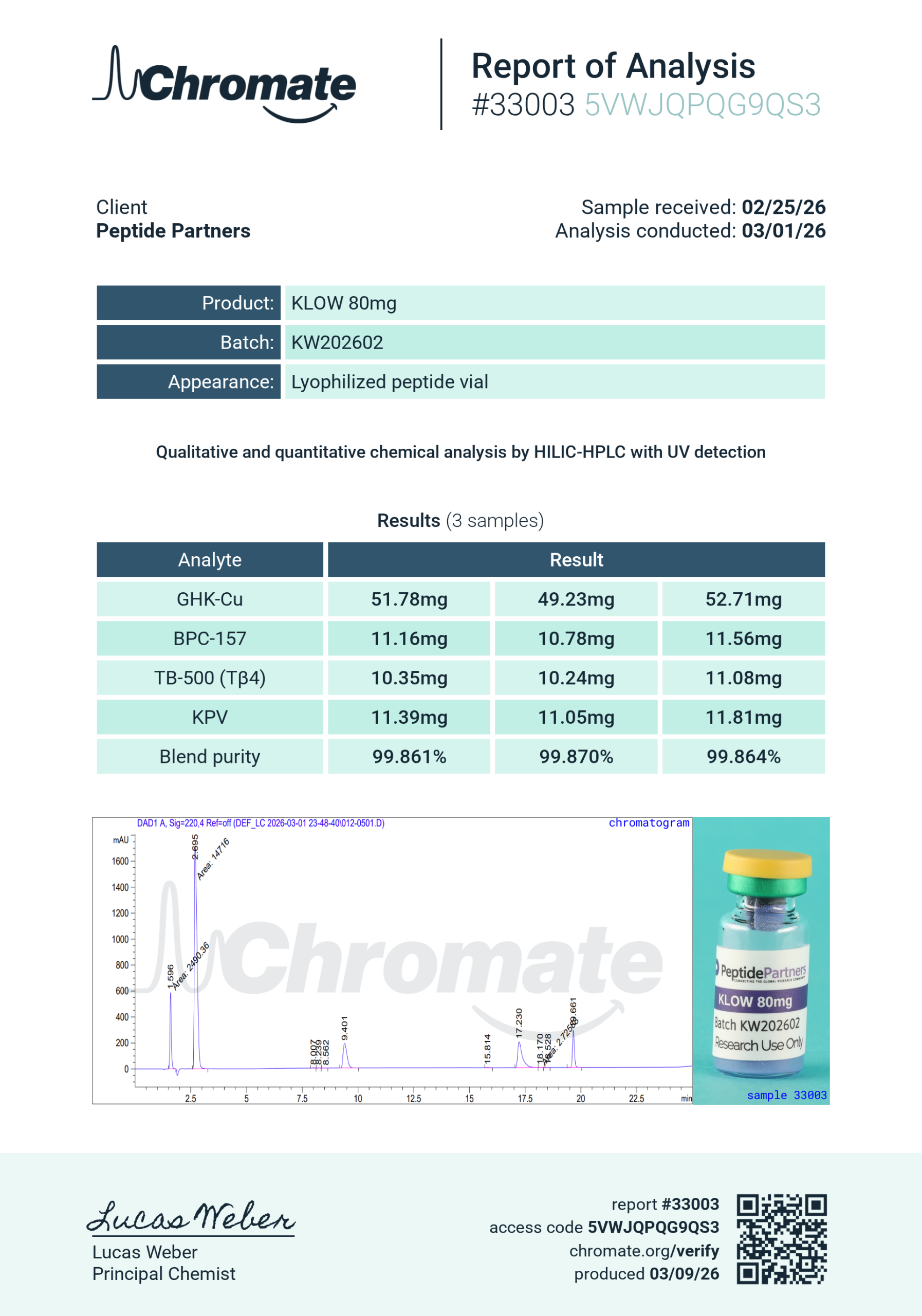
| KLOW | KW202602 | WF03 | 2026-03-01 | 99.86% | Chromate | View File |
| NAD+ | NDB202601 | VI32 | 2026-02-07 | 99.92% | Kovera | View File |
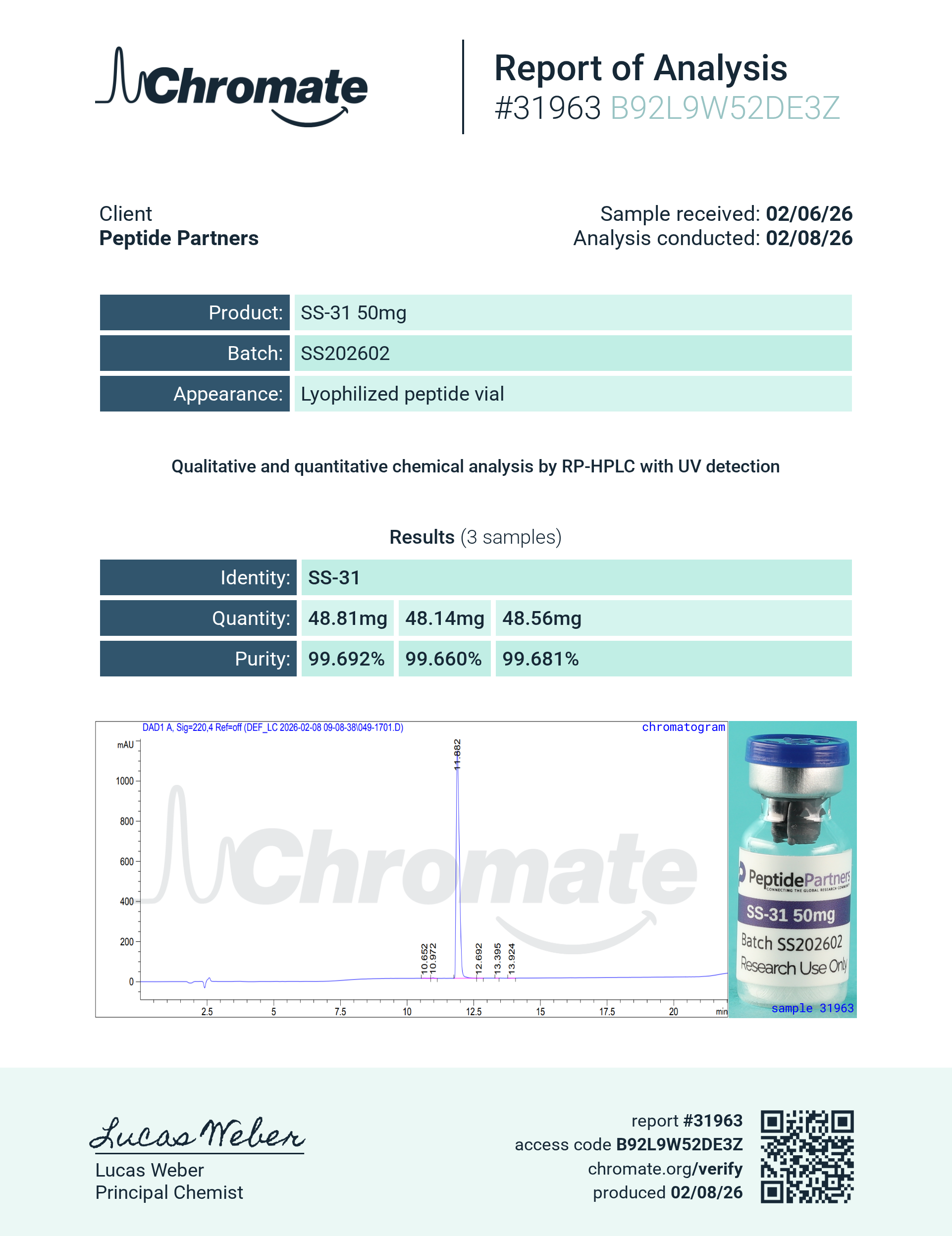
| SS-31 | SS202602 | WF03 | 2026-02-08 | 99.68% | Chromate | View File |
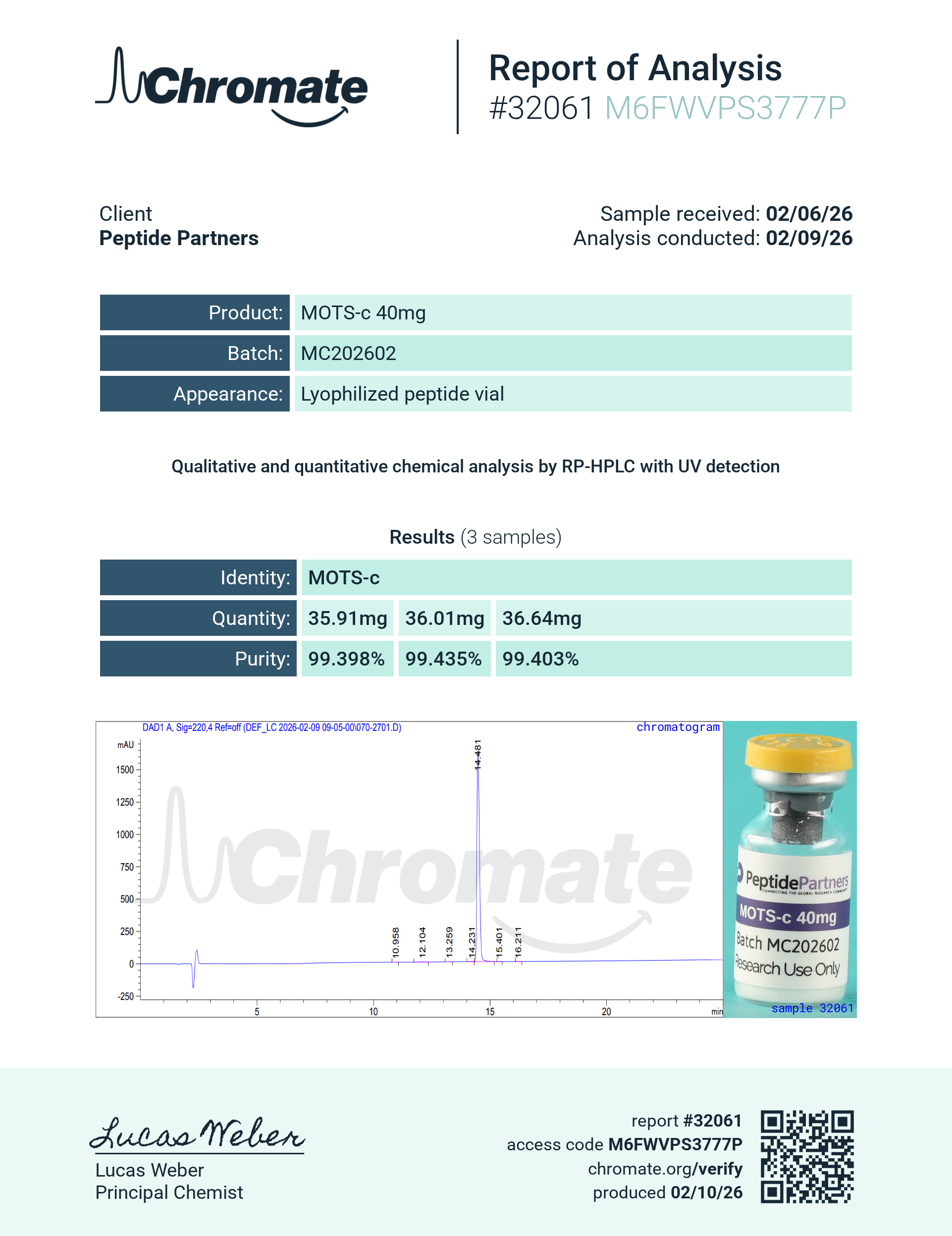
| MOTS-c | MC202602 | WF03 | 2026-02-09 | 99.41% | Chromate | View File |
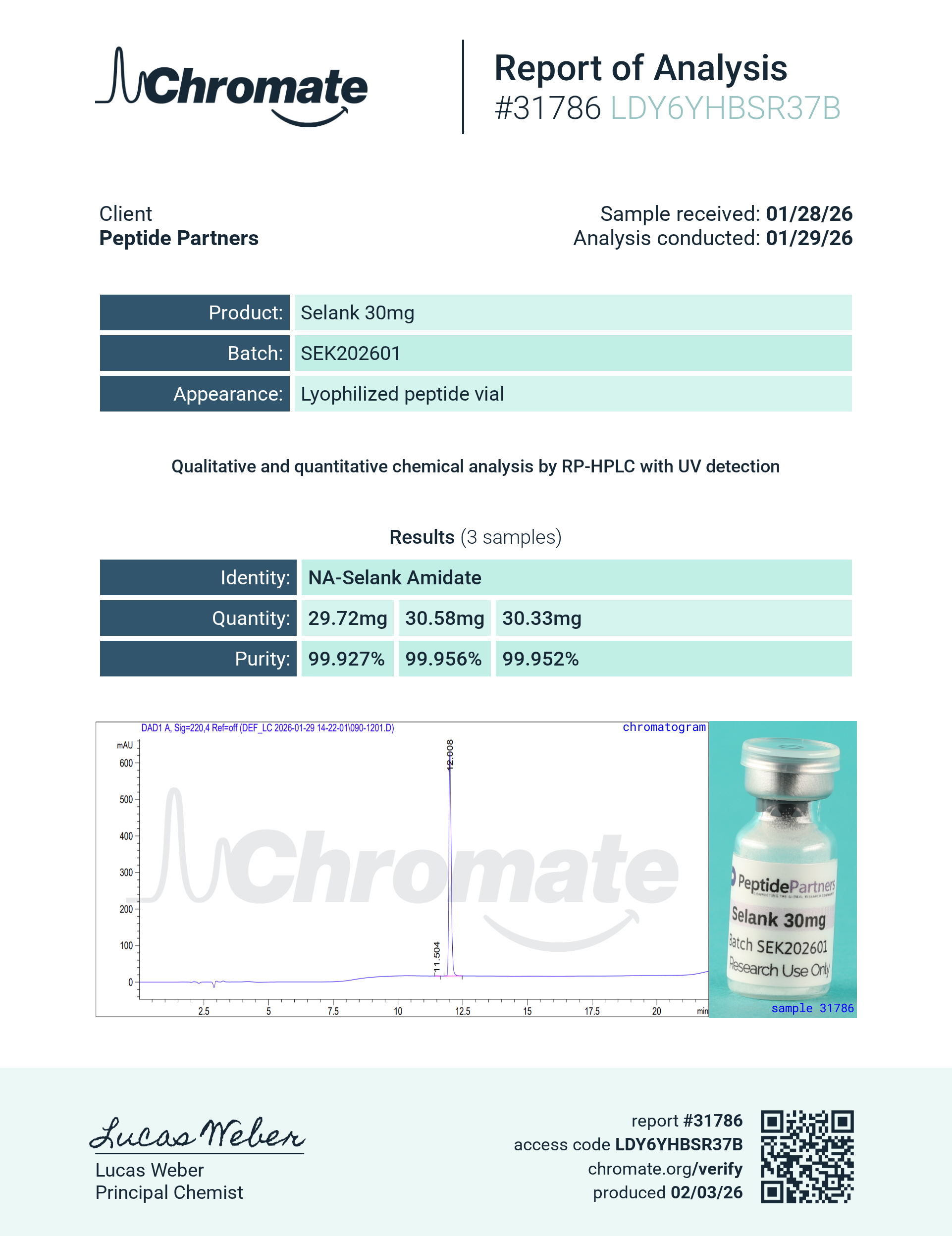
| Selank | SEK202601 | VI32 | 2026-01-29 | 99.94% | Chromate | View File |
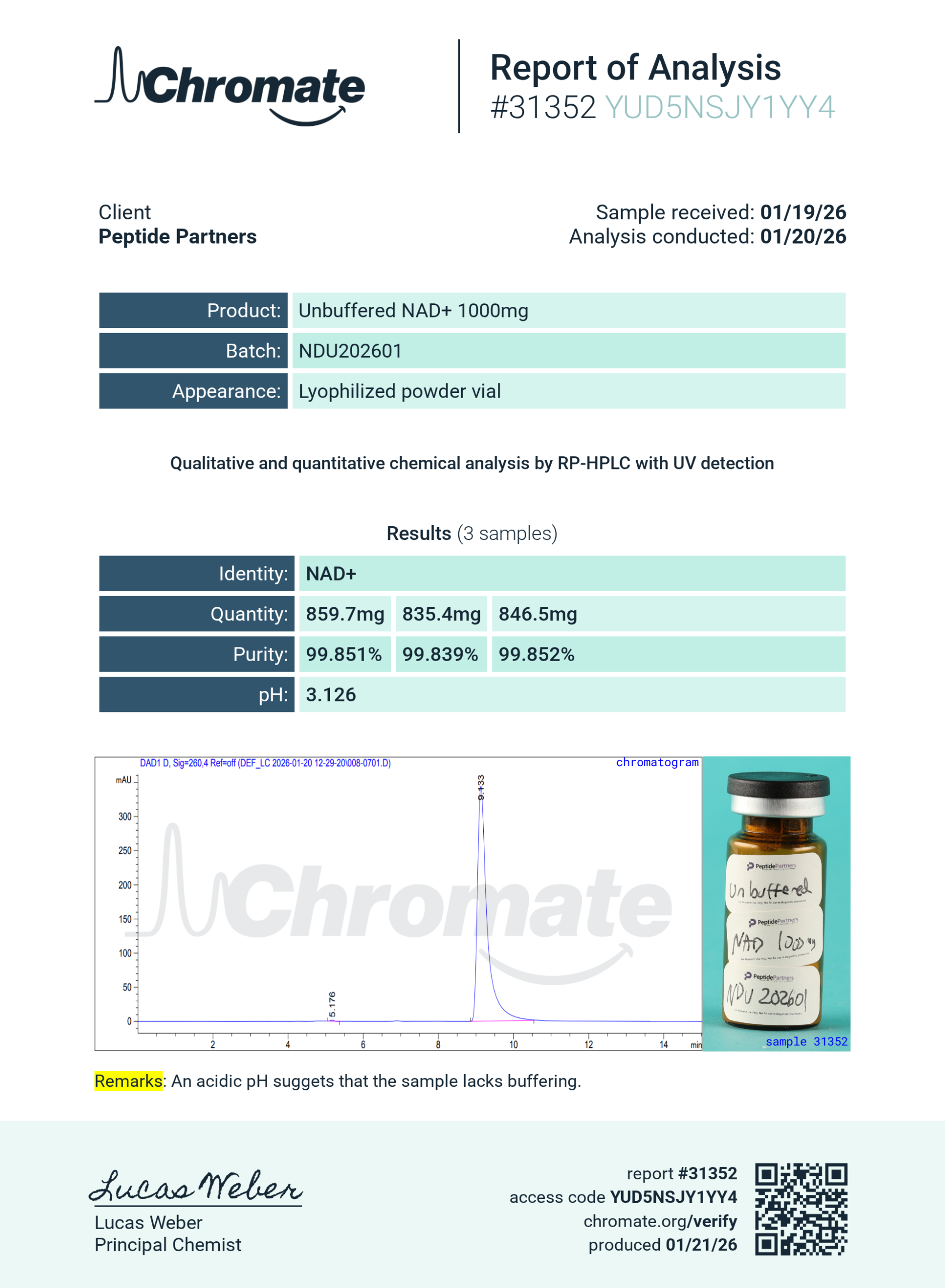
| Unbuffered NAD+ | NDU202601 | MZ21 | 2026-01-20 | 99.85% | Chromate | View File |
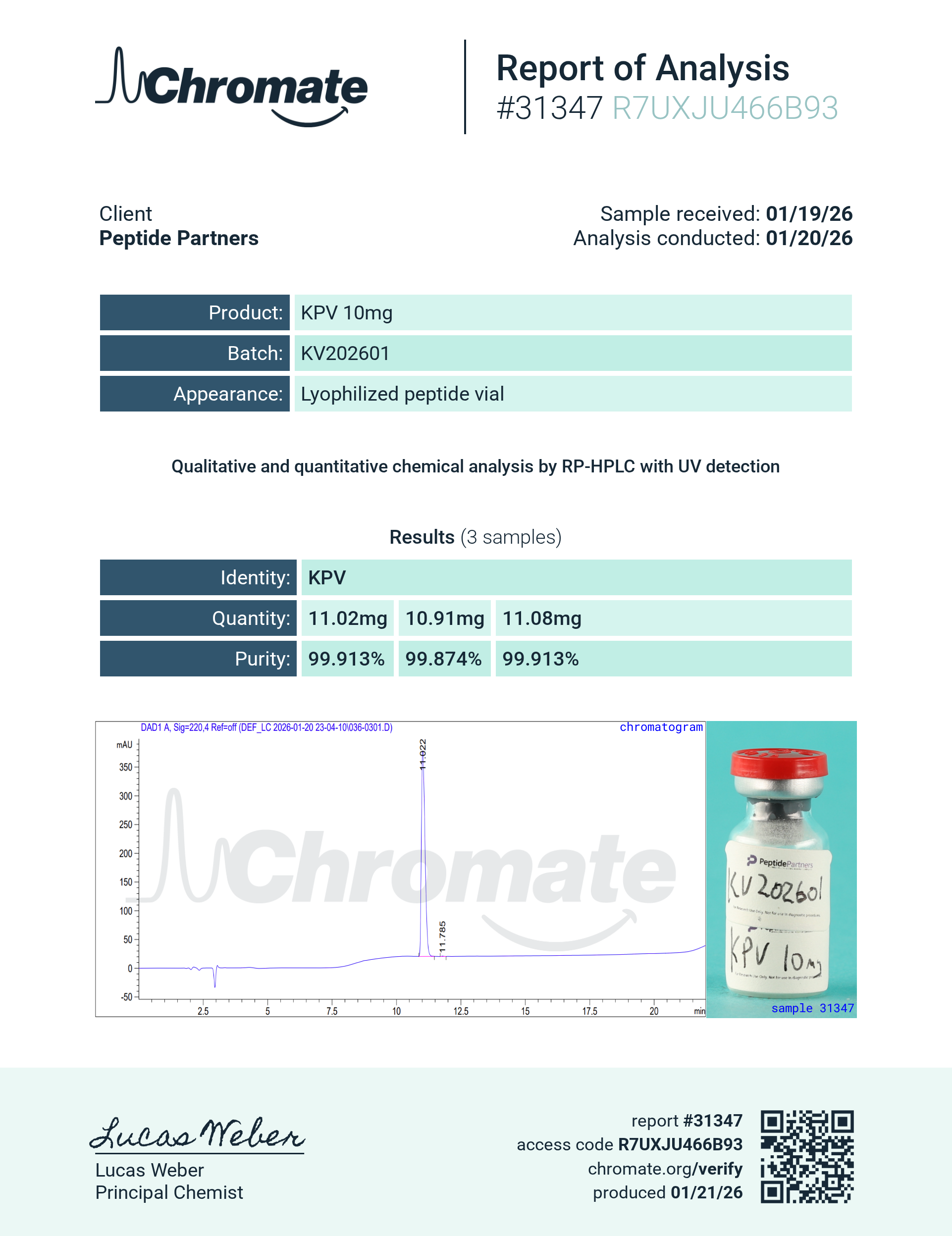
| KPV | KV202601 | VI32 | 2026-01-20 | 99.90% | Chromate | View File |
| Ipamorelin | IP202601 | WF03 | 2026-01-14 | 99.92% | TrustPointe | View File |
| TB500 (TB4) | TB202601 | WF03 | 2026-01-14 | 99.86% | TrustPointe | View File |
| Retatrutide | RT202602 | WF03 | 2026-01-13 | 99.63% | TrustPointe | View File |
| PT-141 | PT202512 | VI32 | 2026-01-12 | 99.89% | BioRegen | View File |
| Semaglutide | SM202601 | MZ21 | 2026-01-10 | 99.70% | TrustPointe | View File |
| Cagrilintide | CAG202601 | MZ21 | 2026-01-10 | 99.33% | TrustPointe | View File |
| Tesamorelin | TES202601 | WF03 | 2025-12-29 | 99.71% | TrustPointe | View File |
| BPC-157 | BP202512 | WF03 | 2025-12-29 | 99.46% | TrustPointe | View File |
| BPC-157/TB-500 | BB202512 | WF03 | 2025-12-29 | 99.64% | TrustPointe | View File |
| GHK-Cu | GK202512 | SH07 | 2025-12-19 | 99.79% | BioRegen | View File |
| MOTS-c | MC202512 | WF03 | 2025-12-22 | 99.89% | BioRegen | View File |
| Retatrutide | RP260130 | VI32 | 2025-12-22 | 99.72% | TrustPointe | View File |
| SS-31 | SS202512 | WF03 | 2025-12-19 | 99.70% | TrustPointe | View File |
| Retatrutide | RP202601 | DF05 | 2025-12-22 | 99.63% | TrustPointe | View File |
| Ipamorelin/CJC-1295 (No DAC) | CJIP202512 | WF03 | 2025-12-09 | 99.80% | TrustPointe | View File |
| Retatrutide | RP202511 | DF05 | 2025-12-19 | 99.73% | TrustPointe | View File |
| Retatrutide | RP20251020 | DF05 | 2025-11-10 | 99.33% | TrustPointe | View File |
| Retatrutide | RP20251001 | DF05 | 2025-10-13 | 99.86% | TrustPointe | View File |
| Tirzepatide | TZ20250915 | DF05 | 2025-10-03 | 99.74% | TrustPointe | View File |
| Retatrutide | RP20250929 | VI32 | 2025-10-03 | 99.47% | TrustPointe | View File |
| Humanin | HP20250805 | WF03 | 2025-09-19 | 99.92% | BioRegen | View File |
| MOTS-c | YC20250807 | WF03 | 2025-09-19 | 99.87% | BioRegen | View File |
| DSIP | DS20250820 | SH07 | 2025-09-19 | 99.88% | BioRegen | View File |
| SS-31 | SY20250806 | WF03 | 2025-09-19 | 99.70% | BioRegen | View File |
| CJC/Ipamorelin | CI20250805 | WF03 | 2025-09-11 | 99.84% | TrustPointe | View File |
| BPC-157 | BP20250808 | WF03 | 2025-09-05 | 99.99% | TrustPointe | View File |
| Sermorelin | SM20250723 | WF03 | 2025-08-27 | 99.84% | BioRegen | View File |
| Tesamorelin | TS20250722 | WF03 | 2025-08-22 | 99.10% | TrustPointe | View File |
| CJC-1295 ND | CJ20250724 | WF03 | 2025-08-20 | 99.43% | TrustPointe | View File |
| Semaglutide | SM20250801 | EJ12 | 2025-08-20 | 99.34% | TrustPointe | View File |
| Ipamorelin | IP20250721 | WF03 | 2025-08-15 | 99.64% | TrustPointe | View File |
| GHK-Cu | CU20250717 | SH07 | 2025-08-09 | 99.73% | BioRegen | View File |
| Tirzepatide | TZ20250730 | EJ12 | 2025-08-08 | 99.41% | TrustPointe | View File |
| NAD+ | ND20250503 | SH07 | 2025-07-31 | 99.76% | BioRegen | View File |
| VIP | VP20250511 | SH07 | 2025-07-31 | 99.42% | BioRegen | View File |
| Retatrutide | CD20250708 | SH07 | 2025-07-25 | 99.42% | TrustPointe | View File |
| BPC/TB500 | BB20250630 | SH07 | 2025-07-17 | 99.52% | TrustPointe | View File |
| TB500 (TB4) | TB20250614 | SH07 | 2025-07-17 | 99.68% | TrustPointe | View File |
| Peptide | Batch Id | Manufacturer | Date | USP Conformation | Laboratory | |
|---|---|---|---|---|---|---|
| GHK-Cu | CU202604 | WF03 | 2026-04-03 | Conforms | Kovera | View File |
| SS-31 | SS202601 | WF03 | 2026-04-03 | Conforms | TrustPointe | View File |
| Semax | SX202603 | WF03 | 2026-03-31 | Conforms | Kovera | View File |
| Retatrutide | RT202603 | WF03 | 2026-03-30 | Conforms | TrustPointe | View File |
| GLOW Blend | GW202603 | WF03 | 2026-03-25 | Conforms | Kovera | View File |
| Tirzepatide | TZ202603 | VI32 | 2026-03-27 | Conforms | TrustPointe | View File |
| BPC-157/TB-500 | BB202604 | WF03 | 2026-03-26 | Conforms | TrustPointe | View File |
| Tesamorelin | TES202603 | WF03 | 2026-03-25 | Conforms | TrustPointe | View File |
| BPC-157 | BC202604 | WF03 | 2026-03-17 | Conforms | Kovera | View File |
| Thymosin Alpha-1 | TA202601 | WF03 | 2026-02-25 | Conforms | Kovera | View File |
| NAD+ | NDB202601 | VI32 | 2026-02-08 | Conforms | Kovera | View File |
| Unbuffered NAD+ | NDU202601 | MZ21 | 2026-01-28 | Conforms | TrustPointe | View File |
| KPV | KV202601 | VI32 | 2026-01-28 | Conforms | TrustPointe | View File |
| Ipamorelin | IP202601 | WF03 | 2026-01-13 | Conforms | TrustPointe | View File |
| TB500 | TB202601 | WF03 | 2026-01-13 | Conforms | TrustPointe | View File |
| Retatrutide | RT202602 | WF03 | 2026-01-13 | Conforms | TrustPointe | View File |
| PT-141 | PT202512 | VI32 | 2026-01-07 | Conforms | BioRegen | View File |
| Semaglutide | SM202601 | MZ21 | 2026-01-10 | Conforms | TrustPointe | View File |
| Cagrilintide | CAG202601 | MZ21 | 2026-01-10 | Conforms | TrustPointe | View File |
| Tesamorelin | TES202601 | WF03 | 2025-01-06 | Conforms | TrustPointe | View File |
| BPC-157 | BP202512 | WF03 | 2025-12-30 | Conforms | TrustPointe | View File |
| BPC-157/TB-500 | BB202512 | WF03 | 2025-12-30 | Conforms | TrustPointe | View File |
| Retatrutide | RP260130 | DF05 | 2025-12-22 | Conforms | TrustPointe | View File |
| SS-31 | SS202512 | WF03 | 2025-12-19 | Conforms | TrustPointe | View File |
| Retatrutide | RP202601 | DF05 | 2025-12-22 | Conforms | TrustPointe | View File |
| Ipamorelin/CJC-1295 (No DAC) | CJIP202512 | WF03 | 2025-12-08 | Conforms | TrustPointe | View File |
| Retatrutide | RP202511 | DF05 | 2025-11-10 | Conforms | TrustPointe | View File |
| Retatrutide | RP20251020 | DF05 | 2025-11-10 | Conforms | TrustPointe | View File |
| Retatrutide | RP20251001 | DF05 | 2025-10-13 | Conforms | TrustPointe | View File |
| Tirzepatide | TZ20250915 | DF05 | 2025-10-03 | Conforms | TrustPointe | View File |
| Retatrutide | RP20250929 | VI32 | 2025-10-03 | Conforms | TrustPointe | View File |
| Humanin | HP20250805 | WF03 | 2025-09-19 | Conforms | BioRegen | View File |
| MOTS-c | YC20250807 | WF03 | 2025-09-19 | Conforms | BioRegen | View File |
| DSIP | DS20250820 | SH07 | 2025-09-19 | Conforms | BioRegen | View File |
| SS-31 | SY20250806 | WF03 | 2025-09-19 | Conforms | BioRegen | View File |
| CJC/Ipamorelin | CI20250805 | WF03 | 2025-09-03 | Conforms | TrustPointe | View File |
| BPC-157 | BP20250808 | WF03 | 2025-09-03 | Conforms | TrustPointe | View File |
| Bacteriostatic Water | BAC20250807 | SH07 | 2025-08-27 | Conforms | BioRegen | View File |
| Tesamorelin | TS20250722 | WF03 | 2025-08-20 | Conforms | TrustPointe | View File |
| CJC-1295 ND | CJ20250724 | WF03 | 2025-08-20 | Conforms | TrustPointe | View File |
| Sermorelin | SM20250723 | WF03 | 2025-08-20 | Conforms | TrustPointe | View File |
| Semaglutide | SM20250801 | EJ12 | 2025-08-20 | Conforms | TrustPointe | View File |
| Ipamorelin | IP20250721 | WF03 | 2025-08-11 | Conforms | TrustPointe | View File |
| GHK-Cu | CU20250717 | SH07 | 2025-08-08 | Conforms | TrustPointe | View File |
| Tirzepatide | TZ20250730 | EJ12 | 2025-08-04 | Conforms | TrustPointe | View File |
| NAD+ | ND20250503 | SH07 | 2025-07-29 | Conforms | TrustPointe | View File |
| VIP | VP20250511 | SH07 | 2025-07-29 | Conforms | TrustPointe | View File |
| Retatrutide | CD20250708 | SH07 | 2025-07-24 | Conforms | TrustPointe | View File |
| BPC/TB500 | BB20250630 | SH07 | 2025-07-17 | Conforms | TrustPointe | View File |
| TB500 (TB4) | TB20250614 | SH07 | 2025-07-17 | Conforms | TrustPointe | View File |
| Peptide | Batch Id | Manufacturer | Date | USP Conformation | Laboratory | |
|---|---|---|---|---|---|---|
| Semax | SX202603 | WF03 | 2026-03-31 | Conforms | Kovera | View File |
| GLOW Blend | GW202603 | WF03 | 2026-03-26 | Conforms | Kovera | View File |
| Tirzepatide | TZ202603 | VI32 | 2026-03-26 | Conforms | Kovera | View File |
| BPC-157 | BC202604 | WF03 | 2026-03-17 | Conforms | Kovera | View File |
| Thymosin Alpha-1 | TA202602 | WF03 | 2026-02-25 | Conforms | Kovera | View File |
| NAD+ | NDB202601 | VI32 | 2026-02-08 | Conforms | Kovera | View File |
| Ipamorelin | IP202601 | WF03 | 2026-01-26 | Conforms | TrustPointe | View File |
| TB500 | TB202601 | WF03 | 2026-01-26 | Conforms | TrustPointe | View File |
| Retatrutide | RT202602 | WF03 | 2026-01-26 | Conforms | TrustPointe | View File |
| Semaglutide | SM202601 | MZ21 | 2026-01-19 | Conforms | TrustPointe | View File |
| Cagrilintide | CAG202601 | MZ21 | 2026-01-19 | Conforms | TrustPointe | View File |
| Tesamorelin | TES202601 | WF03 | 2026-01-19 | Conforms | TrustPointe | View File |
| BPC-157 | BP202512 | WF03 | 2026-01-08 | Conforms | TrustPointe | View File |
| BPC-157/TB-500 | BB202512 | WF03 | 2026-01-08 | Conforms | TrustPointe | View File |
| Tirzepatide | TZ20250915 | DF05 | 2025-12-03 | Conforms | TrustPointe | View File |
| TB500 (TB4) | TB20250614 | SH07 | 2025-11-24 | Conforms | TrustPointe | View File |
| BPC-157 | BP20250808 | WF03 | 2025-11-12 | Conforms | TrustPointe | View File |
| BPC/TB500 | BB20250630 | SH07 | 2025-11-12 | Conforms | TrustPointe | View File |
| CJC-1295 ND | CJ20250724 | WF03 | 2025-11-12 | Conforms | TrustPointe | View File |
| GHK-Cu | CU20250717 | SH07 | 2025-11-12 | Conforms | TrustPointe | View File |
| Ipamorelin | IP20250721 | WF03 | 2025-11-12 | Conforms | TrustPointe | View File |
| Retatrutide | RP20251020 | DF05 | 2025-11-12 | Conforms | TrustPointe | View File |
| Sermorelin | SM20250723 | WF03 | 2025-11-12 | Conforms | TrustPointe | View File |
| SS-31 | SY20250806 | WF03 | 2025-11-12 | Conforms | TrustPointe | View File |
| TB500 (TB4) | TB20250614 | SH07 | 2025-11-12 | Conforms | TrustPointe | View File |
| Tesamorelin | TS20250722 | WF03 | 2025-11-12 | Conforms | TrustPointe | View File |
| Tirzepatide | TZ20250730 | EJ12 | 2025-11-12 | Conforms | TrustPointe | View File |
When obtaining research peptides, it is essential to validate the authenticity of the Certificate of Analysis (COA). Certificate fraud runs rampant throughout the research peptide supply community. The two most common forms are doctored images and stolen certificates. You can check for these two by making sure the third-party laboratory’s website shows that the certificate belongs to the supplier and the values haven’t been doctored. TrustPointe Analytics provides a few simple rules for verification:
Not only must one remain vigilant about potentially fraudulent certificates, one must also be aware that there are third-party laboratories whose results cannot be considered reliable or scientifically valid. Unfortunately, there is significant evidence to suggest that one of the most popular third-party testing labs does not use scientifically sound methodologies and, in some cases, has fabricated results. There isn’t an easy remedy for this problem, but when labs are particularly bad, there tend to be a lot of discussion threads on various social platforms.
Our friends at TrustPointe have provided the following detailed explanation to help interpret the results of the endotoxin testing.
We use the Charles River Endosafe PTS system to test for bacterial endotoxins following USP <85> guidelines:
The following are suitability parameters that verify the system was working properly and the sample prep dilution is appropriate for accurate results. Peptides often interfere with endotoxin detection due to their tendency to bind or mask endotoxins, which can lead to inaccurate low results. To overcome this, samples are typically tested at a large dilution to reduce matrix interference and ensure reliable recovery and detection in compliance with USP <85>. If the dilution is not correct, the run will fail suitability and we’ll need to adjust the dilution to ensure accurate results. We provide the suitability data to customers for transparency and so they can be confident in the results.
USP <85> Sample CV %:
USP <85> Spike CV %:
USP <85> Spike Recovery
Thank you for choosing Peptide Partners.
NOTICE: All information provided above is strictly intended for educational and informational purposes. Our products are designed for research use solely and are not approved for human consumption. Please refrain from any form of ingestion.
By making a purchase from Peptide Partners, you acknowledge that you are acquiring Research Chemicals. Our products are exclusively intended for laboratory research purposes.
It is imperative that only qualified and licensed professionals handle this product. Under no circumstances should it be utilized as a drug, agricultural or pesticide product, food additive, or household chemical. Misrepresentation of this product for such purposes is strictly prohibited by law. All content on our website is provided for educational use exclusively. Any form of introduction into the human or animal body is illegal.