This product is solely intended for research purposes as a chemical compound. Its designation permits its use exclusively for in vitro testing and laboratory experimentation. All information regarding this product provided on our website is purely educational. By law, any form of bodily introduction of this product into humans or animals is strictly prohibited. It should only be handled by professionals who are licensed and qualified. This product is neither a drug, food, nor cosmetic, and must not be misrepresented, misused, or mislabeled as such.
In stock
Swipe right to view full table →
Save over 90%!
 |
|
| Cost per milligram | $0.075 |
Authors: Billon C, et al.
URL: https://pmc.ncbi.nlm.nih.gov/articles/PMC10801787/
This study introduces SLU-PP-332 as a novel pan-agonist for the estrogen-related receptors (ERRα, β, and γ), a class of nuclear receptors that are key regulators of energy metabolism. Through a series of in vitro and in vivo experiments, the authors demonstrate that SLU-PP-332 effectively mimics the physiological benefits of aerobic exercise. In cell-based assays, the compound was shown to activate all three ERR isoforms, with a slight preference for ERRα. This activation leads to an increase in the expression of genes involved in fatty acid oxidation and mitochondrial biogenesis. When administered to mouse models of obesity and metabolic syndrome, SLU-PP-332 increased energy expenditure, promoted the burning of fat, reduced overall fat mass, and improved insulin sensitivity. These findings suggest that pharmacological activation of ERRs with compounds like SLU-PP-332 could be a promising therapeutic strategy for treating metabolic diseases.
Scientists have developed a new drug called SLU-PP-332 that can trick the body into thinking it has exercised. It works by activating special sensors in our cells that are normally turned on during physical activity. In lab experiments, this drug was shown to boost the body’s ability to burn fat and increase energy use, just like a good workout. When given to obese mice, the drug helped them lose weight and become more sensitive to insulin, which is important for preventing diabetes. This research opens up the possibility of using a pill to get some of the health benefits of exercise, which could be a game-changer for people who are unable to exercise due to health reasons.
Authors: Cyrielle Billon, Sadichha Sitaula, Subhashis Banerjee, et al.
URL: https://pmc.ncbi.nlm.nih.gov/articles/PMC11584170/
This paper provides a detailed characterization of SLU-PP-332, a synthetic pan-agonist of the estrogen-related receptors (ERRs) with a notable potency for ERRα (EC50 = 98 nM). The development of SLU-PP-332 was achieved through a rational drug design approach, which involved modifying an existing ERRβ/γ agonist to enhance its activity at ERRα. In vitro experiments using the C2C12 skeletal muscle cell line demonstrated that SLU-PP-332 significantly increases the expression of ERR target genes, such as Pdk4, enhances mitochondrial respiration, and promotes mitochondrial biogenesis. These cellular effects translate to improved physical performance in vivo, as mice treated with SLU-PP-332 showed an increase in oxidative muscle fibers and enhanced exercise endurance. The study also established that the beneficial effects of SLU-PP-332 on exercise capacity are primarily mediated through the activation of ERRα.
This research delves into how the exercise-mimicking drug, SLU-PP-332, works at a cellular level. Scientists found that this drug is particularly good at activating a specific sensor in our cells called ERRα. In lab experiments on muscle cells, they observed that SLU-PP-332 revs up the cells’ energy-producing machinery, the mitochondria, making them work more efficiently. This is similar to what happens when we exercise. When they gave the drug to mice, they found that the mice could run for longer and had more of the muscle fibers that are associated with endurance. This study confirms that SLU-PP-332 can indeed mimic the effects of exercise and that it does so mainly by targeting the ERRα sensor.
Authors: Weiyi Xu, Angelica Hamilton, Aijun Bhagat, et al.
URL: https://www.ahajournals.org/doi/10.1161/CIRCULATIONAHA.123.066542
This study investigates the therapeutic potential of two pan-ERR agonists, SLU-PP-332 and SLU-PP-915, in a preclinical model of heart failure. The researchers found that both compounds significantly improved cardiac function, reduced fibrosis, and increased survival in mice with pressure overload-induced heart failure. The beneficial effects were attributed to the ability of the ERR agonists to enhance cardiac fatty acid metabolism and mitochondrial function. In vitro experiments using neonatal rat ventricular myocytes (NRVMs) and isolated adult mouse cardiomyocytes confirmed that these compounds increase mitochondrial oxidative capacity and fatty acid utilization. Through a series of genetic knockdown experiments, the study identified ERRγ as the primary mediator of the cardioprotective effects of these agonists. The findings provide strong evidence that pharmacological activation of ERRs could be a novel therapeutic strategy for heart failure.
This study explored whether the exercise-mimicking drugs, SLU-PP-332 and a similar compound, could be used to treat heart failure. In experiments with mice that had heart failure, both drugs were found to improve the heart’s pumping ability, reduce scarring, and help the mice live longer. The drugs worked by boosting the heart’s energy production and its ability to use fat for fuel. The scientists also tested the drugs on isolated heart cells in the lab and confirmed that they improve the function of the cells’ powerhouses, the mitochondria. They also discovered that a specific sensor in the heart cells, called ERRγ, is the main target for these drugs’ beneficial effects. This research suggests that drugs like SLU-PP-332 could one day be used to treat heart failure in humans.
Storage:
All of our manufacturing partners produce peptides using the Lyophilization (Freeze Drying) process, ensuring products maintain stability for shipping and storage for 12+ months.
In lyophilized form, they are shelf-stable for many weeks. However, for long-term storage, it is recommended to store them in the freezer.
We often hear concerns about the standard “discard after 28 days of first use” disclaimer. Don’t worry, this has nothing to do with studies regarding the efficacy of specific peptides. 28 days is the FDA requirement for producers of multi-use vials to prove their bacteriostatic maintains efficacy. This minimum requirement becomes the de facto standard.
In our experience, if you use proper sterile procedures and refrigerated storage, you can continue sampling from the same reconstituted vial for 3+ months.
Peptide Partners is committed to providing high-purity peptides at wholesale prices by frequently auditing its manufacturing partners using third-party laboratories. Independent analysis is vital to ensuring the quality and authenticity of your research peptides. Never trust a supplier that doesn’t submit to third-party testing. Never trust a certification that cannot be independently verified. All of the certificates that we provide can be validated on the third-party laboratory’s website.
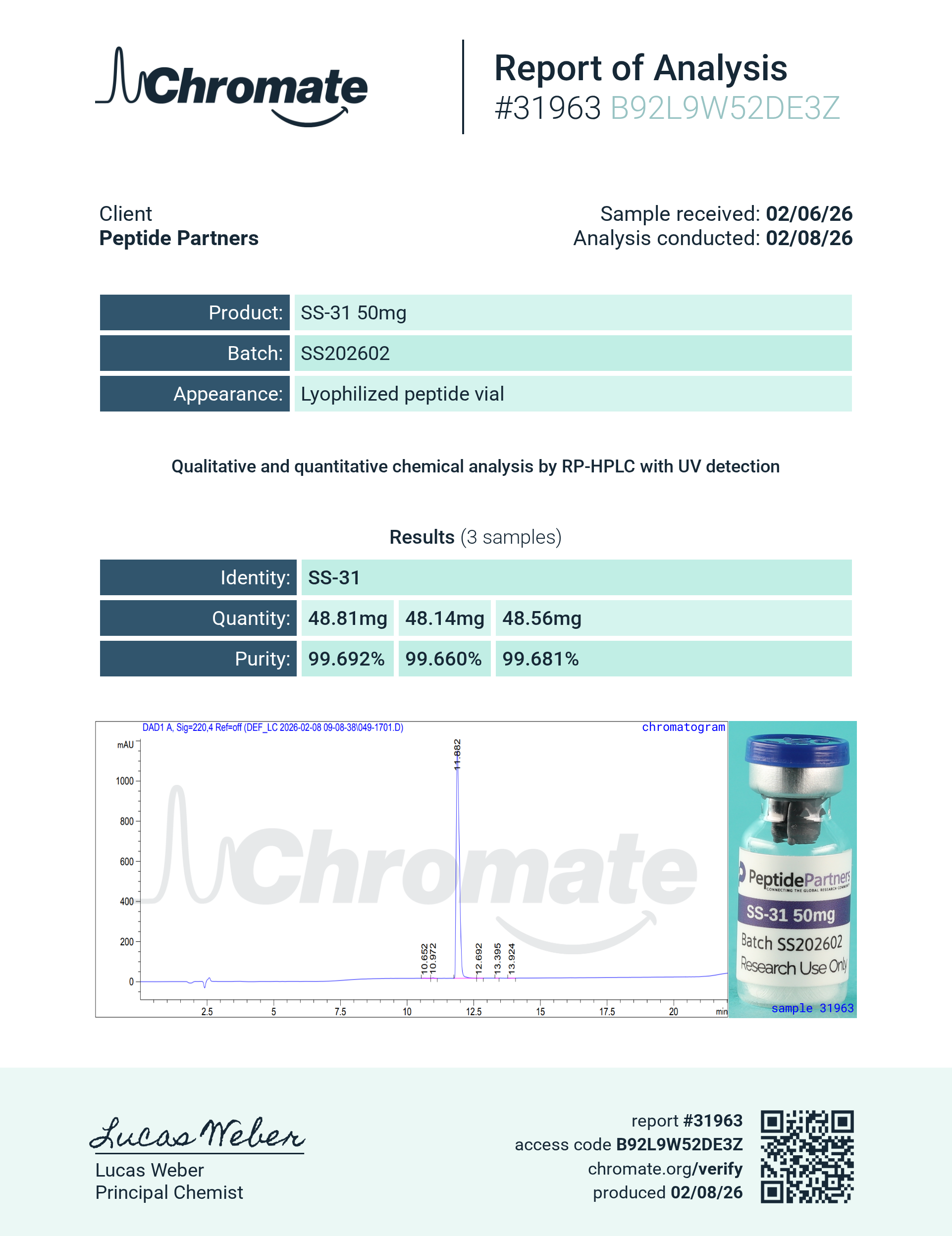
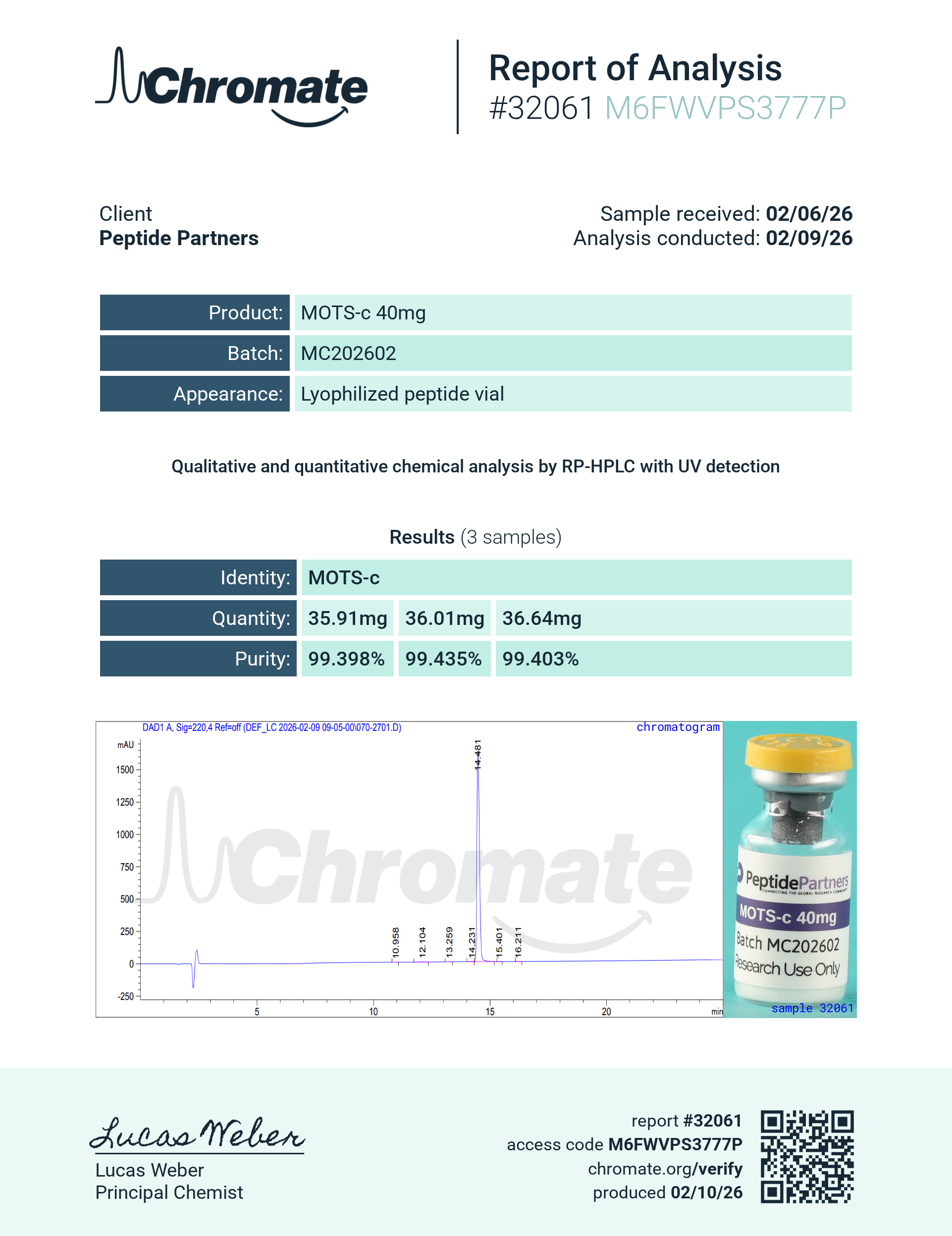
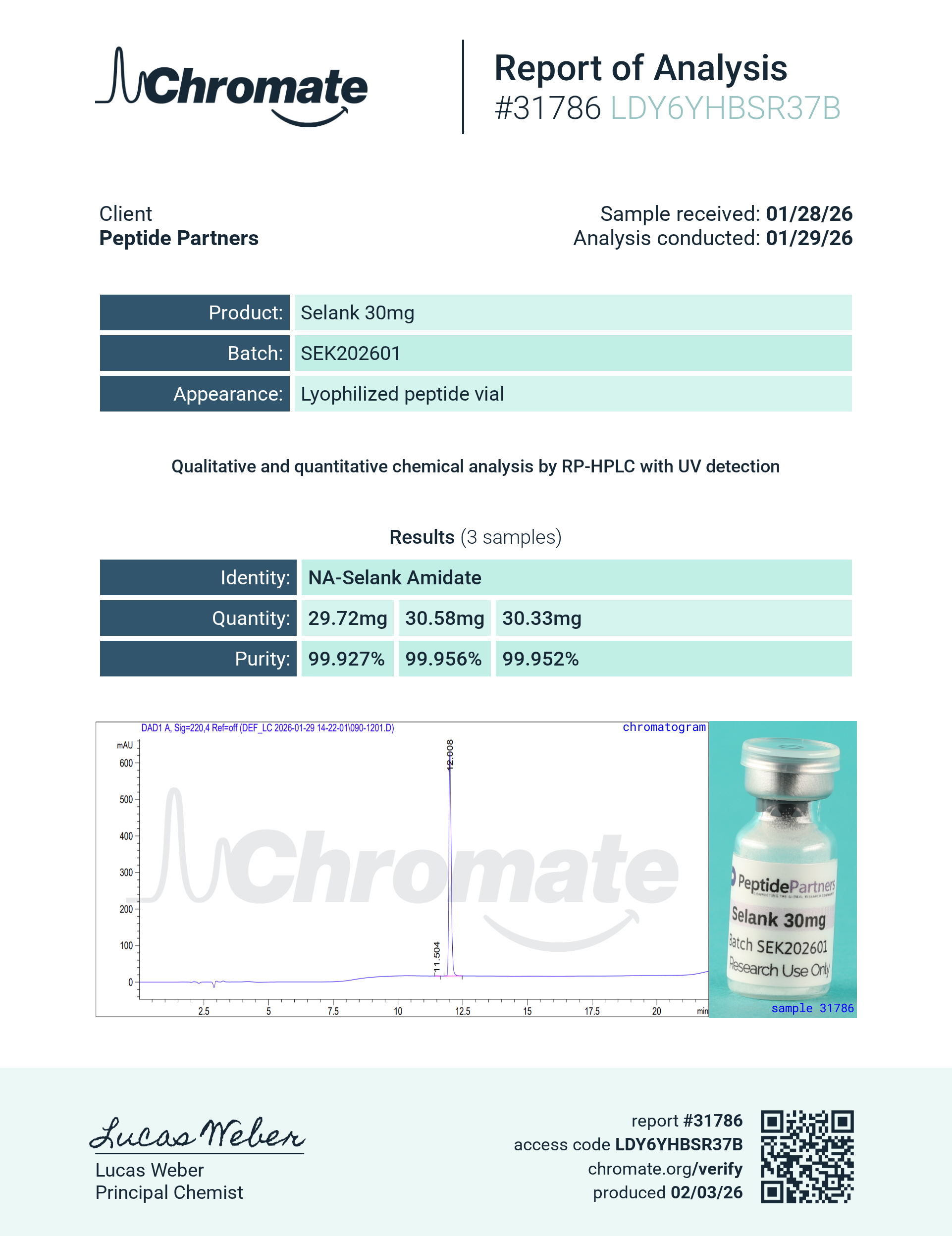
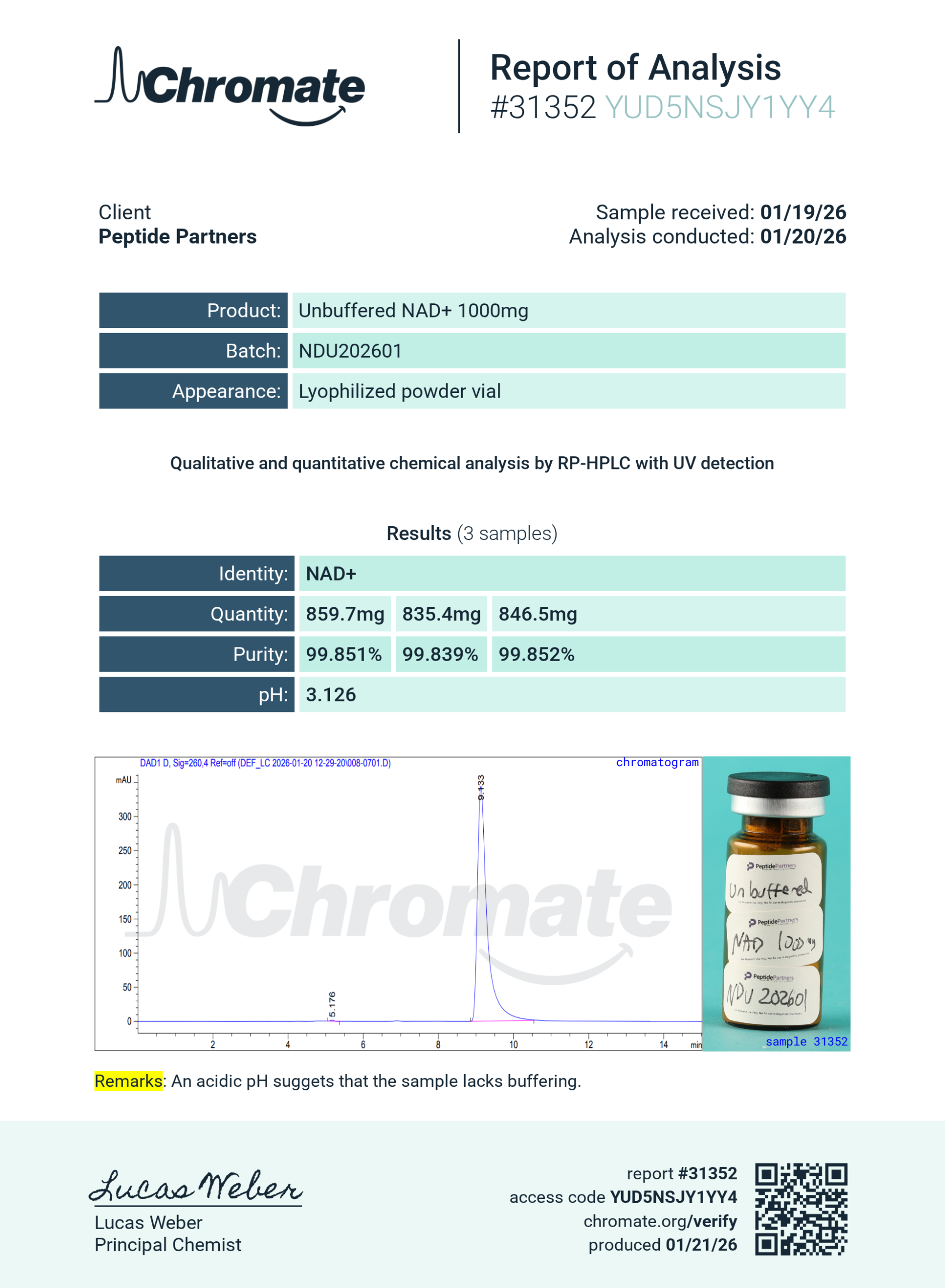
Each product description contains a Manufacturer ID corresponding to the producer of that product. The table below contains the most recent third-party analyses for all manufacturers and peptides listed on Peptide Partners.
| Peptide | Batch Id | Manufacturer | Date | Purity | Laboratory | |
|---|---|---|---|---|---|---|
| NAD+ | NDB202601 | VI32 | 2026-02-07 | 99.92% | Kovera | View File |
| SS-31 | SS202602 | WF03 | 2026-02-08 | 99.68% | Chromate | View File |
| MOTS-c | MC202602 | WF03 | 2026-02-09 | 99.41% | Chromate | View File |
| Selank | SEK202601 | VI32 | 2026-01-29 | 99.94% | Chromate | View File |
| Unbuffered NAD+ | NDU202601 | MZ21 | 2026-01-20 | 99.85% | Chromate | View File |
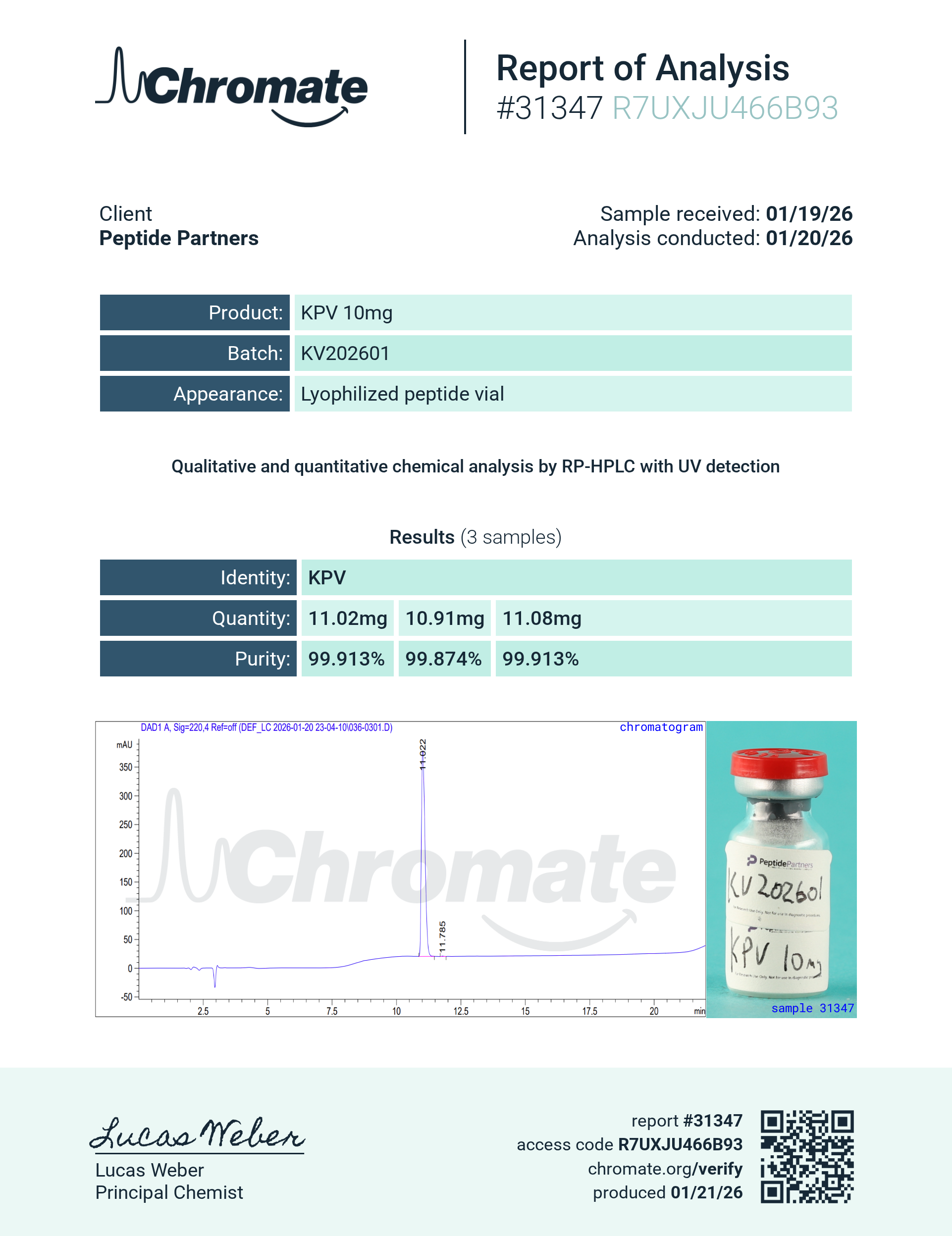
| KPV | KV202601 | VI32 | 2026-01-20 | 99.90% | Chromate | View File |
| Ipamorelin | TB202601 | WF03 | 2026-01-14 | 99.92% | TrustPointe | View File |
| TB500 (TB4) | TB202601 | WF03 | 2026-01-14 | 99.86% | TrustPointe | View File |
| Retatrutide | RT202602 | WF03 | 2026-01-13 | 99.63% | TrustPointe | View File |
| PT-141 | PT202512 | VI32 | 2026-01-12 | 99.89% | BioRegen | View File |
| Semaglutide | SM202601 | MZ21 | 2026-01-10 | 99.70% | TrustPointe | View File |
| Cagrilintide | CAG202601 | MZ21 | 2026-01-10 | 99.33% | TrustPointe | View File |
| Tesamorelin | TES202601 | WF03 | 2025-12-29 | 99.71% | TrustPointe | View File |
| BPC-157 | BP202512 | WF03 | 2025-12-29 | 99.46% | TrustPointe | View File |
| BPC-157/TB-500 | BB202512 | WF03 | 2025-12-29 | 99.64% | TrustPointe | View File |
| GHK-Cu | GK202512 | SH07 | 2025-12-19 | 99.79% | BioRegen | View File |
| MOTS-c | MC202512 | WF03 | 2025-12-22 | 99.89% | BioRegen | View File |
| Retatrutide | RP260130 | VI32 | 2025-12-22 | 99.72% | TrustPointe | View File |
| SS-31 | SS202512 | WF03 | 2025-12-19 | 99.70% | TrustPointe | View File |
| Retatrutide | RP202601 | DF05 | 2025-12-22 | 99.63% | TrustPointe | View File |
| Ipamorelin/CJC-1295 (No DAC) | CJIP202512 | WF03 | 2025-12-09 | 99.80% | TrustPointe | View File |
| Retatrutide | RP202511 | DF05 | 2025-12-19 | 99.73% | TrustPointe | View File |
| Retatrutide | RP20251020 | DF05 | 2025-11-10 | 99.33% | TrustPointe | View File |
| Retatrutide | RP20251001 | DF05 | 2025-10-13 | 99.86% | TrustPointe | View File |
| Tirzepatide | TZ20250915 | DF05 | 2025-10-03 | 99.74% | TrustPointe | View File |
| Retatrutide | RP20250929 | VI32 | 2025-10-03 | 99.47% | TrustPointe | View File |
| Humanin | HP20250805 | WF03 | 2025-09-19 | 99.92% | BioRegen | View File |
| MOTS-c | YC20250807 | WF03 | 2025-09-19 | 99.87% | BioRegen | View File |
| DSIP | DS20250820 | SH07 | 2025-09-19 | 99.88% | BioRegen | View File |
| SS-31 | SY20250806 | WF03 | 2025-09-19 | 99.70% | BioRegen | View File |
| CJC/Ipamorelin | CI20250805 | WF03 | 2025-09-11 | 99.84% | TrustPointe | View File |
| BPC-157 | BP20250808 | WF03 | 2025-09-05 | 99.99% | TrustPointe | View File |
| Sermorelin | SM20250723 | WF03 | 2025-08-27 | 99.84% | BioRegen | View File |
| Tesamorelin | TS20250722 | WF03 | 2025-08-22 | 99.10% | TrustPointe | View File |
| CJC-1295 ND | CJ20250724 | WF03 | 2025-08-20 | 99.43% | TrustPointe | View File |
| Semaglutide | SM20250801 | EJ12 | 2025-08-20 | 99.34% | TrustPointe | View File |
| Ipamorelin | IP20250721 | WF03 | 2025-08-15 | 99.64% | TrustPointe | View File |
| GHK-Cu | CU20250717 | SH07 | 2025-08-09 | 99.73% | BioRegen | View File |
| Tirzepatide | TZ20250730 | EJ12 | 2025-08-08 | 99.41% | TrustPointe | View File |
| NAD+ | ND20250503 | SH07 | 2025-07-31 | 99.76% | BioRegen | View File |
| VIP | VP20250511 | SH07 | 2025-07-31 | 99.42% | BioRegen | View File |
| Retatrutide | CD20250708 | SH07 | 2025-07-25 | 99.42% | TrustPointe | View File |
| BPC/TB500 | BB20250630 | SH07 | 2025-07-17 | 99.52% | TrustPointe | View File |
| TB500 (TB4) | TB20250614 | SH07 | 2025-07-17 | 99.68% | TrustPointe | View File |
| Peptide | Batch Id | Manufacturer | Date | USP Conformation | Laboratory | |
|---|---|---|---|---|---|---|
| NAD+ | NDB202601 | VI32 | 2026-02-08 | Conforms | Kovera | View File |
| Unbuffered NAD+ | NDU202601 | MZ21 | 2026-01-28 | Conforms | TrustPointe | View File |
| KPV | KV202601 | VI32 | 2026-01-28 | Conforms | TrustPointe | View File |
| Ipamorelin | IP202601 | WF03 | 2026-01-13 | Conforms | TrustPointe | View File |
| TB500 | TB202601 | WF03 | 2026-01-13 | Conforms | TrustPointe | View File |
| Retatrutide | RT202602 | WF03 | 2026-01-13 | Conforms | TrustPointe | View File |
| PT-141 | PT202512 | VI32 | 2026-01-07 | Conforms | BioRegen | View File |
| Semaglutide | SM202601 | MZ21 | 2026-01-10 | Conforms | TrustPointe | View File |
| Cagrilintide | CAG202601 | MZ21 | 2026-01-10 | Conforms | TrustPointe | View File |
| Tesamorelin | TES202601 | WF03 | 2025-01-06 | Conforms | TrustPointe | View File |
| BPC-157 | BP202512 | WF03 | 2025-12-30 | Conforms | TrustPointe | View File |
| BPC-157/TB-500 | BB202512 | WF03 | 2025-12-30 | Conforms | TrustPointe | View File |
| Retatrutide | RP260130 | DF05 | 2025-12-22 | Conforms | TrustPointe | View File |
| SS-31 | SS202512 | WF03 | 2025-12-19 | Conforms | TrustPointe | View File |
| Retatrutide | RP202601 | DF05 | 2025-12-22 | Conforms | TrustPointe | View File |
| Ipamorelin/CJC-1295 (No DAC) | CJIP202512 | WF03 | 2025-12-08 | Conforms | TrustPointe | View File |
| Retatrutide | RP202511 | DF05 | 2025-11-10 | Conforms | TrustPointe | View File |
| Retatrutide | RP20251020 | DF05 | 2025-11-10 | Conforms | TrustPointe | View File |
| Retatrutide | RP20251001 | DF05 | 2025-10-13 | Conforms | TrustPointe | View File |
| Tirzepatide | TZ20250915 | DF05 | 2025-10-03 | Conforms | TrustPointe | View File |
| Retatrutide | RP20250929 | VI32 | 2025-10-03 | Conforms | TrustPointe | View File |
| Humanin | HP20250805 | WF03 | 2025-09-19 | Conforms | BioRegen | View File |
| MOTS-c | YC20250807 | WF03 | 2025-09-19 | Conforms | BioRegen | View File |
| DSIP | DS20250820 | SH07 | 2025-09-19 | Conforms | BioRegen | View File |
| SS-31 | SY20250806 | WF03 | 2025-09-19 | Conforms | BioRegen | View File |
| CJC/Ipamorelin | CI20250805 | WF03 | 2025-09-03 | Conforms | TrustPointe | View File |
| BPC-157 | BP20250808 | WF03 | 2025-09-03 | Conforms | TrustPointe | View File |
| Bacteriostatic Water | BAC20250807 | SH07 | 2025-08-27 | Conforms | BioRegen | View File |
| Tesamorelin | TS20250722 | WF03 | 2025-08-20 | Conforms | TrustPointe | View File |
| CJC-1295 ND | CJ20250724 | WF03 | 2025-08-20 | Conforms | TrustPointe | View File |
| Sermorelin | SM20250723 | WF03 | 2025-08-20 | Conforms | TrustPointe | View File |
| Semaglutide | SM20250801 | EJ12 | 2025-08-20 | Conforms | TrustPointe | View File |
| Ipamorelin | IP20250721 | WF03 | 2025-08-11 | Conforms | TrustPointe | View File |
| GHK-Cu | CU20250717 | SH07 | 2025-08-08 | Conforms | TrustPointe | View File |
| Tirzepatide | TZ20250730 | EJ12 | 2025-08-04 | Conforms | TrustPointe | View File |
| NAD+ | ND20250503 | SH07 | 2025-07-29 | Conforms | TrustPointe | View File |
| VIP | VP20250511 | SH07 | 2025-07-29 | Conforms | TrustPointe | View File |
| Retatrutide | CD20250708 | SH07 | 2025-07-24 | Conforms | TrustPointe | View File |
| BPC/TB500 | BB20250630 | SH07 | 2025-07-17 | Conforms | TrustPointe | View File |
| TB500 (TB4) | TB20250614 | SH07 | 2025-07-17 | Conforms | TrustPointe | View File |
| Peptide | Batch Id | Manufacturer | Date | USP Conformation | Laboratory | |
|---|---|---|---|---|---|---|
| NAD+ | NDB202601 | VI32 | 2026-02-08 | Conforms | Kovera | View File |
| Ipamorelin | IP202601 | WF03 | 2026-01-26 | Conforms | TrustPointe | View File |
| TB500 | TB202601 | WF03 | 2026-01-26 | Conforms | TrustPointe | View File |
| Retatrutide | RT202602 | WF03 | 2026-01-26 | Conforms | TrustPointe | View File |
| Semaglutide | SM202601 | MZ21 | 2026-01-19 | Conforms | TrustPointe | View File |
| Cagrilintide | CAG202601 | MZ21 | 2026-01-19 | Conforms | TrustPointe | View File |
| Tesamorelin | TES202601 | WF03 | 2026-01-19 | Conforms | TrustPointe | View File |
| BPC-157 | BP202512 | WF03 | 2026-01-08 | Conforms | TrustPointe | View File |
| BPC-157/TB-500 | BB202512 | WF03 | 2026-01-08 | Conforms | TrustPointe | View File |
| Tirzepatide | TZ20250915 | DF05 | 2025-12-03 | Conforms | TrustPointe | View File |
| TB500 (TB4) | TB20250614 | SH07 | 2025-11-24 | Conforms | TrustPointe | View File |
| BPC-157 | BP20250808 | WF03 | 2025-11-12 | Conforms | TrustPointe | View File |
| BPC/TB500 | BB20250630 | SH07 | 2025-11-12 | Conforms | TrustPointe | View File |
| CJC-1295 ND | CJ20250724 | WF03 | 2025-11-12 | Conforms | TrustPointe | View File |
| GHK-Cu | CU20250717 | SH07 | 2025-11-12 | Conforms | TrustPointe | View File |
| Ipamorelin | IP20250721 | WF03 | 2025-11-12 | Conforms | TrustPointe | View File |
| Retatrutide | RP20251020 | DF05 | 2025-11-12 | Conforms | TrustPointe | View File |
| Sermorelin | SM20250723 | WF03 | 2025-11-12 | Conforms | TrustPointe | View File |
| SS-31 | SY20250806 | WF03 | 2025-11-12 | Conforms | TrustPointe | View File |
| TB500 (TB4) | TB20250614 | SH07 | 2025-11-12 | Conforms | TrustPointe | View File |
| Tesamorelin | TS20250722 | WF03 | 2025-11-12 | Conforms | TrustPointe | View File |
| Tirzepatide | TZ20250730 | EJ12 | 2025-11-12 | Conforms | TrustPointe | View File |
When obtaining research peptides, it is essential to validate the authenticity of the Certificate of Analysis (COA). Certificate fraud runs rampant throughout the research peptide supply community. The two most common forms are doctored images and stolen certificates. You can check for these two by making sure the third-party laboratory’s website shows that the certificate belongs to the supplier and the values haven’t been doctored. TrustPointe Analytics provides a few simple rules for verification:
Not only must one remain vigilant about potentially fraudulent certificates, one must also be aware that there are third-party laboratories whose results cannot be considered reliable or scientifically valid. Unfortunately, there is significant evidence to suggest that one of the most popular third-party testing labs does not use scientifically sound methodologies and, in some cases, has fabricated results. There isn’t an easy remedy for this problem, but when labs are particularly bad, there tend to be a lot of discussion threads on various social platforms.
Our friends at TrustPointe have provided the following detailed explanation to help interpret the results of the endotoxin testing.
We use the Charles River Endosafe PTS system to test for bacterial endotoxins following USP <85> guidelines:
The following are suitability parameters that verify the system was working properly and the sample prep dilution is appropriate for accurate results. Peptides often interfere with endotoxin detection due to their tendency to bind or mask endotoxins, which can lead to inaccurate low results. To overcome this, samples are typically tested at a large dilution to reduce matrix interference and ensure reliable recovery and detection in compliance with USP <85>. If the dilution is not correct, the run will fail suitability and we’ll need to adjust the dilution to ensure accurate results. We provide the suitability data to customers for transparency and so they can be confident in the results.
USP <85> Sample CV %:
USP <85> Spike CV %:
USP <85> Spike Recovery
Thank you for choosing Peptide Partners.
NOTICE: All information provided above is strictly intended for educational and informational purposes. Our products are designed for research use solely and are not approved for human consumption. Please refrain from any form of ingestion.
By making a purchase from Peptide Partners, you acknowledge that you are acquiring Research Chemicals. Our products are exclusively intended for laboratory research purposes.
It is imperative that only qualified and licensed professionals handle this product. Under no circumstances should it be utilized as a drug, agricultural or pesticide product, food additive, or household chemical. Misrepresentation of this product for such purposes is strictly prohibited by law. All content on our website is provided for educational use exclusively. Any form of introduction into the human or animal body is illegal.