This product is solely intended for research purposes as a chemical compound. Its designation permits its use exclusively for in vitro testing and laboratory experimentation. All information regarding this product provided on our website is purely educational. By law, any form of bodily introduction of this product into humans or animals is strictly prohibited. It should only be handled by professionals who are licensed and qualified. This product is neither a drug, food, nor cosmetic, and must not be misrepresented, misused, or mislabeled as such.
In stock
Swipe right to view full table →
Cost per milligram |
$3.70 – $4.90 |
Purity |
99.95% |
Certified Endotoxin-safe |
Yes |
Independently Tested |
Yes |
Peptide Partners Manufacturer Id: WF03
Batch Id: TA202602
Title: Thymosin Alpha 1 Mitigates Cytokine Storm in Blood Cells From Coronavirus Disease 2019 Patients
Authors: Claudia Matteucci, Antonella Minutolo, Emanuela Balestrieri, Vita Petrone, Marialaura Fanelli, Vincenzo Malagnino, Marco Ianetta, Alessandro Giovinazzo, Filippo Barreca, Silvia Di Cesare, Patrizia De Marco, Martino Tony Miele, Nicola Toschi, Antonio Mastino, Paola Sinibaldi Vallebona, Sergio Bernardini, Paola Rogliani, Loredana Sarmati, Massimo Andreoni, Sandro Grelli, Enrico Garaci
URL: https://pmc.ncbi.nlm.nih.gov/articles/PMC7798699/
Published: Open Forum Infectious Diseases, Volume 8, Issue 1, January 2021, ofaa588
Blood cells from patients with COVID-19 were analyzed to evaluate the biological processes regulated by thymosin alpha 1 (Tα1) under inflammatory conditions using ex vivo treatment and enrichment pathway analysis. Genes associated with cytokine signaling and production were found to be significantly upregulated in blood cells from COVID-19 patients, consistent with the characteristic cytokine storm observed in severe disease. Ex vivo treatment with Tα1 mitigated cytokine gene expression and specifically inhibited lymphocyte activation in a CD8+ T-cell subset. The study demonstrated that Tα1 interacts with Toll-like receptor (TLR) signaling pathways, including TLR3, TLR4, and TLR9, activating downstream IRF3 and NF-κB signaling to modulate immune cell activity. Tα1 was shown to restore homeostasis of the immune system by reversing T-cell exhaust
htmlion, reducing pro-inflammatory cytokine expression including interleukin-6 (IL-6), and modulating CD38 expression on CD8+ T cells in a manner dependent on disease severity. The findings support the potential role of Tα1 in controlling immune dysregulation and cytokine storm in SARS-CoV-2 infection in vivo.
This research examined how TA-1, a peptide derived from the thymus gland, affects immune cells taken directly from COVID-19 patients. COVID-19 can trigger what’s called a cytokine storm — an out-of-control inflammatory response where immune cells flood the body with signaling chemicals that cause severe tissue damage. The researchers found that when they treated these patient blood cells with TA-1 in the laboratory, the peptide significantly dialed down the overactive immune response, particularly in a type of immune cell called CD8+ T cells. TA-1 essentially helped the immune system find its balance again rather than going into overdrive. These findings help explain why TA-1 has been used clinically to manage COVID-19 in several countries and suggest it works by targeting the key signaling pathways that drive dangerous immune overactivation.
Title: Thymosin α1 Activates Complement Receptor-Mediated Phagocytosis in Human Monocyte-Derived Macrophages
Authors: Annalucia Serafino, Fabrizio Pica, Francesca Andreola, Roberta Gaziano, Nadia Moroni, Gianluca Moroni, Manuela Zonfrillo, Pasquale Pierimarchi, Paola Sinibaldi-Vallebona, Enrico Garaci
URL: https://pmc.ncbi.nlm.nih.gov/articles/PMC6741600/</spa htmln>
Published: Journal of Innate Immunity, 2014; 6(1):72–88
Human monocyte-derived macrophages (MDMs) were exposed to Tα1 in vitro to investigate its effects on innate immune cell activation and pathogen clearance. Tα1-treated MDMs assumed an activated morphology comparable to lipopolysaccharide (LPS)-treated cells but demonstrated a significantly greater ability to internalize fluorescent beads and zymosan particles. Tα1 exposure stimulated MDM phagocytosis and killing of Aspergillus niger conidia in a dose-dependent manner, with effects observable as early as 30 minutes after challenge. The enhanced phagocytic activity occurred through a complement receptor-mediated mechanism, requiring intact microtubule network integrity and protein kinase C activity, with recruitment of vinculin and actin at the phagosome. Crucially, this heightened phagocytic response was coupled with low transcription of pro-inflammatory cytokines tumor necrosis factor alpha (TNFα) and interleukin-6 (IL-6), indicating that Tα1 boosts pathogen clearance without triggering excessive inflammation. The findings demonstrate that Tα1 acts as a potent and early activator of innate immunity while maintaining an anti-inflammatory cytokine profile.
This study looked at how TA-1 affects macrophages — the immune system’s front-line “cleanup crew” responsible for swallowing and destroying pathogens and cellular debris. The researchers found that treating macrophages with TA-1 dramatically increased their ability to engulf and kill fungal particles, with the effect kicking in within just 30 minutes. What makes this particularly notable is that TA-1 accomplished this without triggering the inflammatory chemical signals that normally accompany immune activation — the macrophages became more effective killers while
html simultaneously keeping inflammation low. This dual effect (better pathogen clearance + reduced inflammatory signaling) could explain why TA-1 is considered a balancing or “smart” immune modulator rather than a blunt immune stimulant, making it valuable for situations where immune function needs to be enhanced without causing collateral inflammatory damage.
Title: Thymosin Alpha 1 Alleviates Inflammation and Prevents Infection in Patients with Severe Acute Pancreatitis Through Immune Regulation: A Systematic Review and Meta-Analysis
Authors: Ye Tian, Jie Yao, Yulong Ma, Pengfei Zhang, Xinyi Zhou, Wenlong Xie, Wei Tang
URL: https://pmc.ncbi.nlm.nih.gov/articles/PMC12208829/
Published: Frontiers in Immunology, May 28, 2025; doi: 10.3389/fimmu.2025.1571456
A systematic review and meta-analysis was performed by searching PubMed, Embase, Web of Science, Cochrane Library, and the China National Knowledge Infrastructure (CNKI) through February 2025, identifying five randomized controlled trials comprising 706 patients with severe acute pancreatitis (SAP). Tα1 treatment significantly increased the percentage of CD4+ T cells (mean difference=4.53, 95% CI [3.02, 6.04], P<0.00001) and improved the CD4+/CD8+ ratio (mean difference=0.42, 95% CI [0.26, 0.58], P<0.00001), indicating restoration of immune cell balance. Lower-dose Tα1 significantly reduced C-reactive protein (CRP) levels (mean difference=−30.12 mg/L, 95% CI [−35.75, −24.49], P<0.00001
html), a key marker of systemic inflammation. Tα1 treatment reduced the overall incidence of extrapancreatic infections by 44% (RR=0.56, 95% CI [0.40, 0.78], P=0.0005), with significant reductions in both bloodstream (RR=0.60) and abdominal (RR=0.38) infections. Tα1 also significantly reduced APACHE II scores (mean difference=−1.52, 95% CI [−2.22, −0.83], P<0.0001), a standardized measure of illness severity. These results indicate that Tα1 can regulate immune cell balance, alleviate inflammatory burden, and reduce infectious complications in patients with severe systemic inflammation.
This study pooled data from five separate clinical trials involving 706 patients with severe acute pancreatitis — a life-threatening condition where the pancreas begins attacking itself and triggers a dangerous full-body inflammatory response. The researchers found that patients treated with TA-1 showed meaningful improvements across several measures: their immune cell ratios normalized (indicating better immune balance), their blood levels of C-reactive protein — a standard marker doctors use to measure inflammation — dropped significantly, and their risk of developing dangerous secondary infections fell by nearly half. Patients also scored lower on a standardized medical severity scale, suggesting their overall condition improved more than those who didn’t receive TA-1. This meta-analysis provides some of the strongest clinical evidence that TA-1 can modulate the immune system in real patients facing severe inflammatory conditions, not just in laboratory settings.
Storage:
All of our manufacturing partners produce peptides using the Lyophilization (Freeze Drying) process, ensuring products maintain stability for shipping and storage for 12+ months.
In lyophilized form, they are shelf-stable for many weeks. However, for long-term storage, it is recommended to store them in the freezer.
We often hear concerns about the standard “discard after 28 days of first use” disclaimer. Don’t worry, this has nothing to do with studies regarding the efficacy of specific peptides. 28 days is the FDA requirement for producers of multi-use vials to prove their bacteriostatic maintains efficacy. This minimum requirement becomes the de facto standard.
In our experience, if you use proper sterile procedures and refrigerated storage, you can continue sampling from the same reconstituted vial for 3+ months.
Peptide Partners is committed to providing high-purity peptides at wholesale prices by frequently auditing its manufacturing partners using third-party laboratories. Independent analysis is vital to ensuring the quality and authenticity of your research peptides. Never trust a supplier that doesn’t submit to third-party testing. Never trust a certification that cannot be independently verified. All of the certificates that we provide can be validated on the third-party laboratory’s website.
Each product description contains a Manufacturer ID corresponding to the producer of that product. The table below contains the most recent third-party analyses for all manufacturers and peptides listed on Peptide Partners.
| Peptide | Batch Id | Manufacturer | Date | Purity | Laboratory | |
|---|---|---|---|---|---|---|
| Tesamorelin | TES202603 | WF03 | 2026-03-25 | 99.52% | TrustPointe | View File |
| BPC-157 | BC202604 | VI32 | 2026-03-18 | 99.60% | TrustPointe | View File |
| Ipamorelin/CJC-1295 (No DAC) | CJIP202602 | WF03 | 2026-02-27 | 99.92% | TrustPointe | View File |
| Thymosin Alpha-1 | TA202602 | WF03 | 2026-02-25 | 99.95% | Kovera | View File |
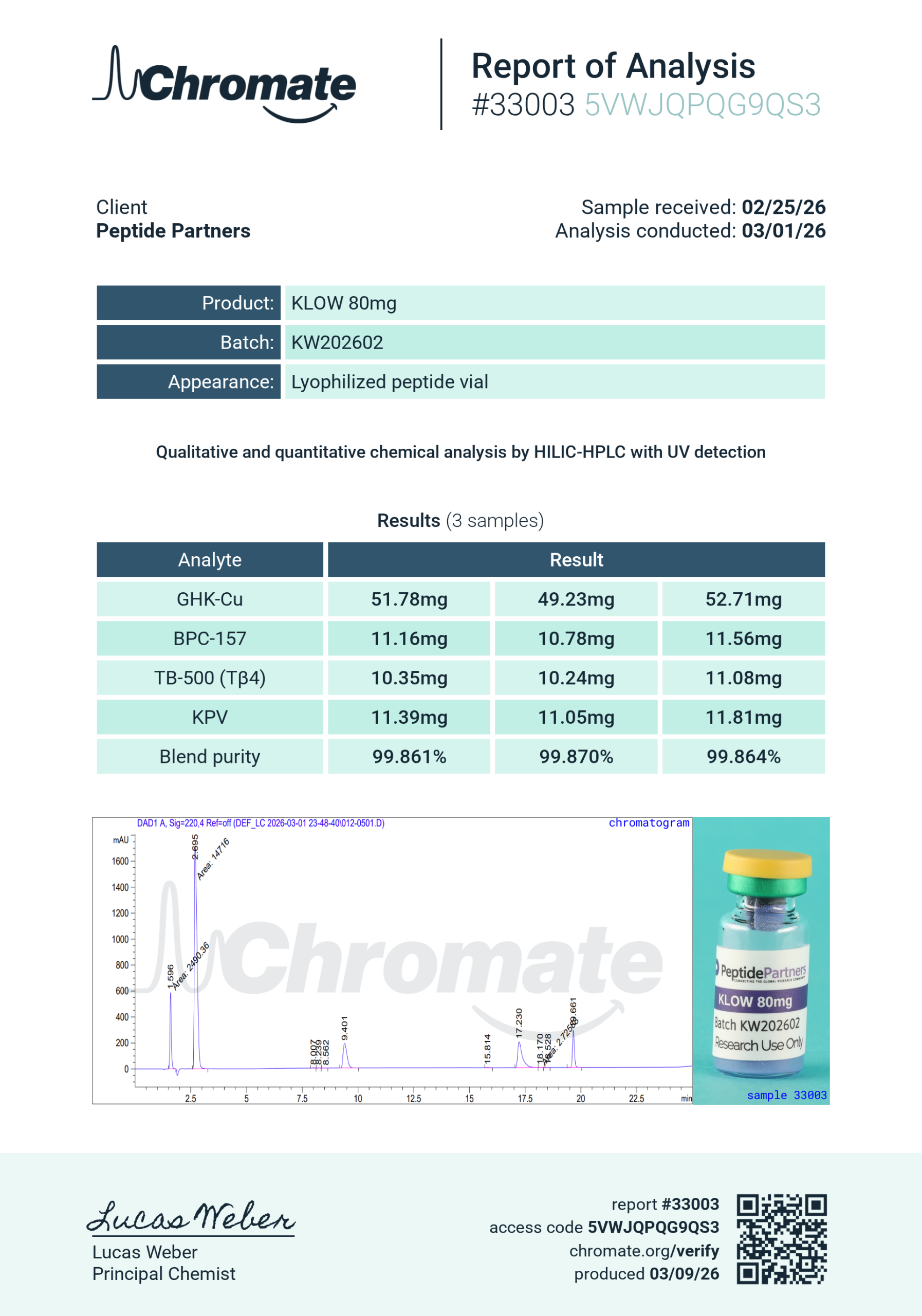
| KLOW | KW202602 | WF03 | 2026-03-01 | 99.86% | Chromate | View File |
| NAD+ | NDB202601 | VI32 | 2026-02-07 | 99.92% | Kovera | View File |
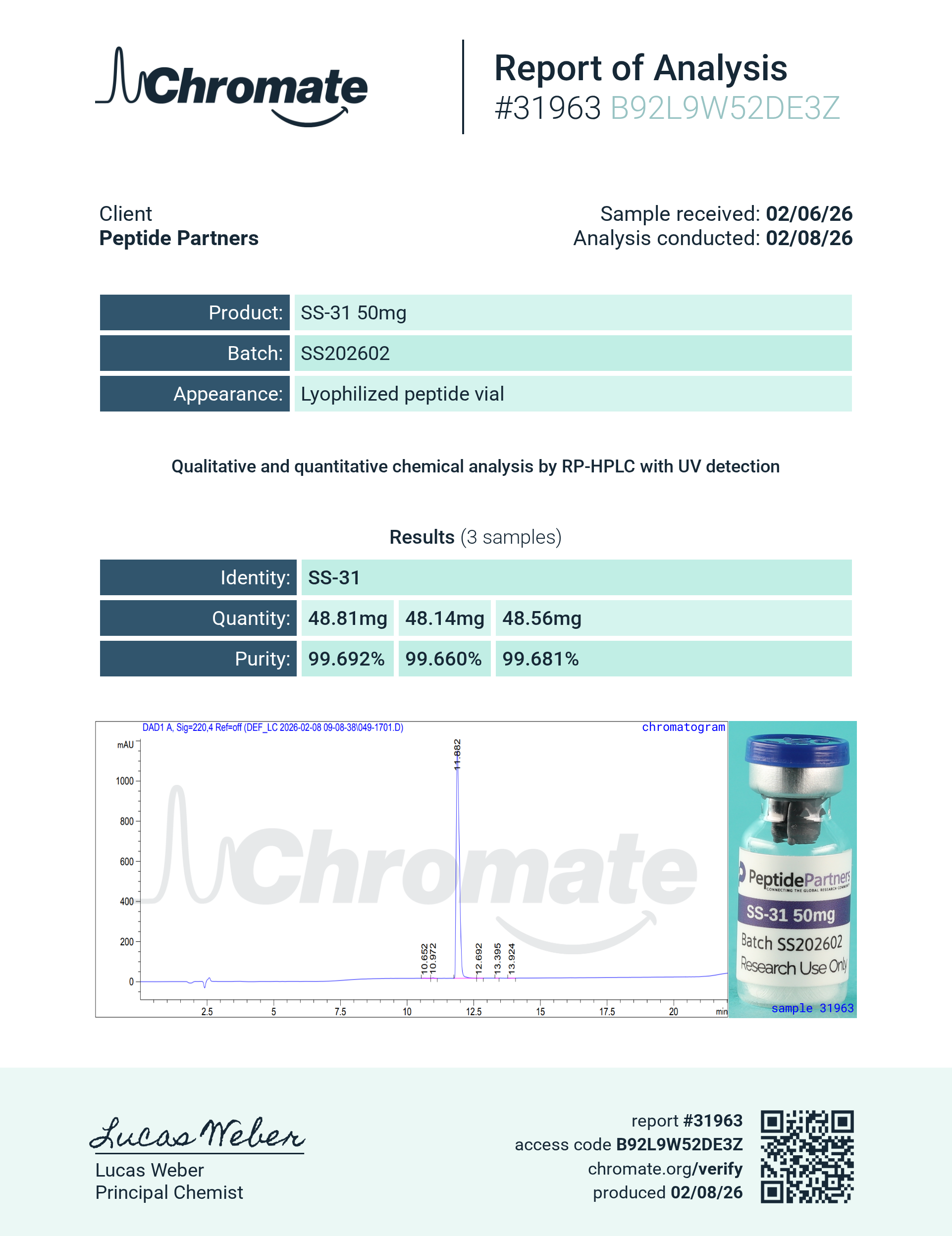
| SS-31 | SS202602 | WF03 | 2026-02-08 | 99.68% | Chromate | View File |
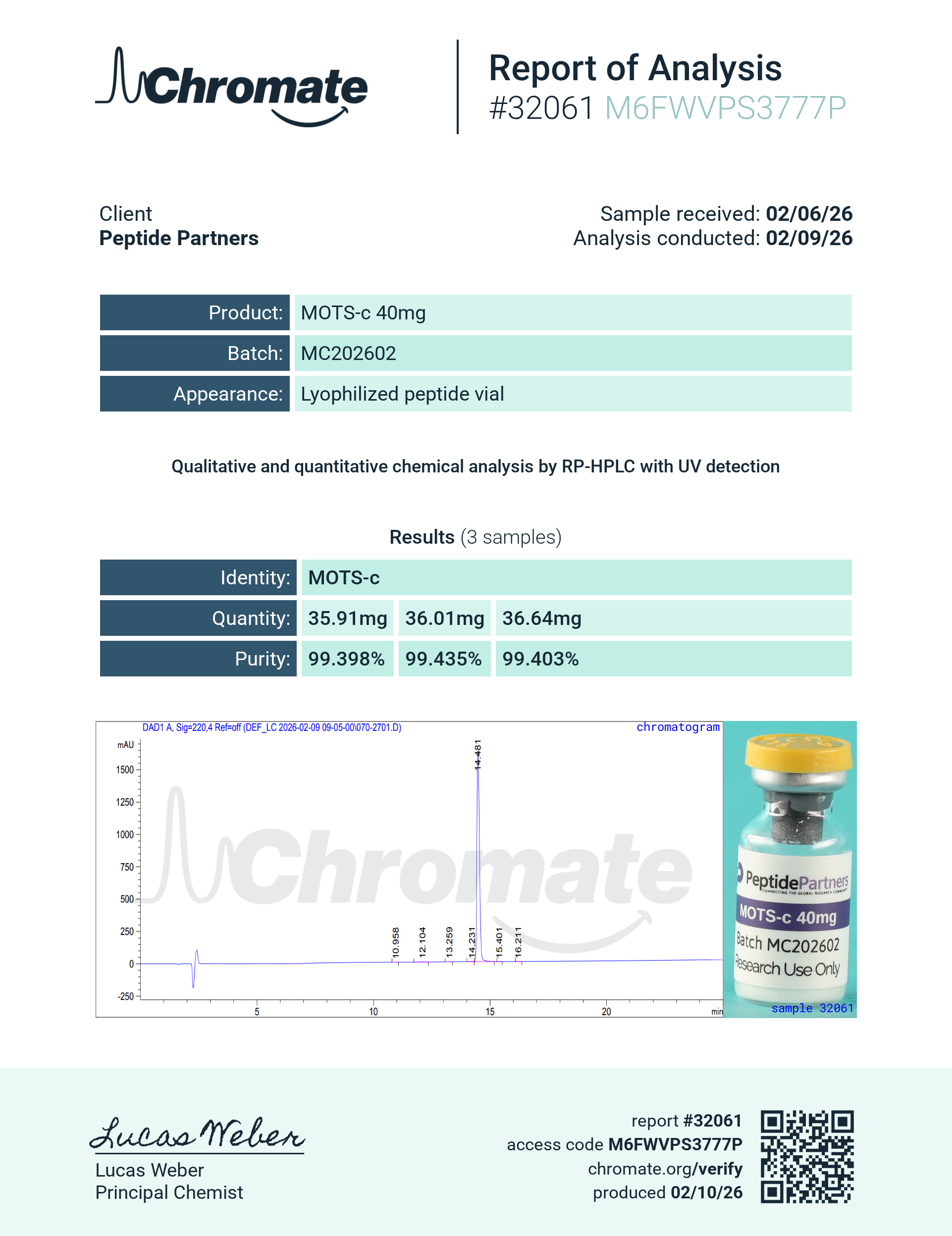
| MOTS-c | MC202602 | WF03 | 2026-02-09 | 99.41% | Chromate | View File |
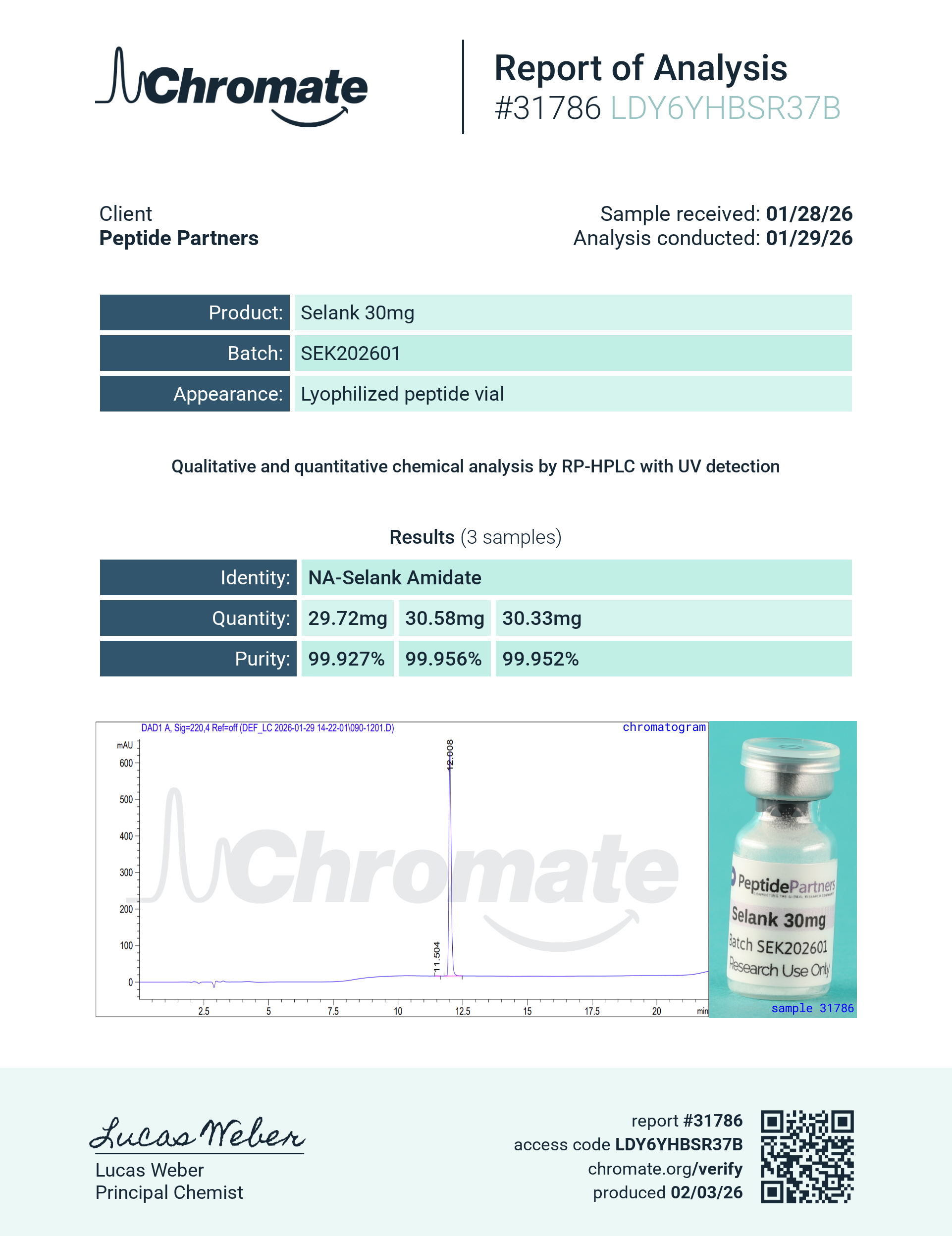
| Selank | SEK202601 | VI32 | 2026-01-29 | 99.94% | Chromate | View File |
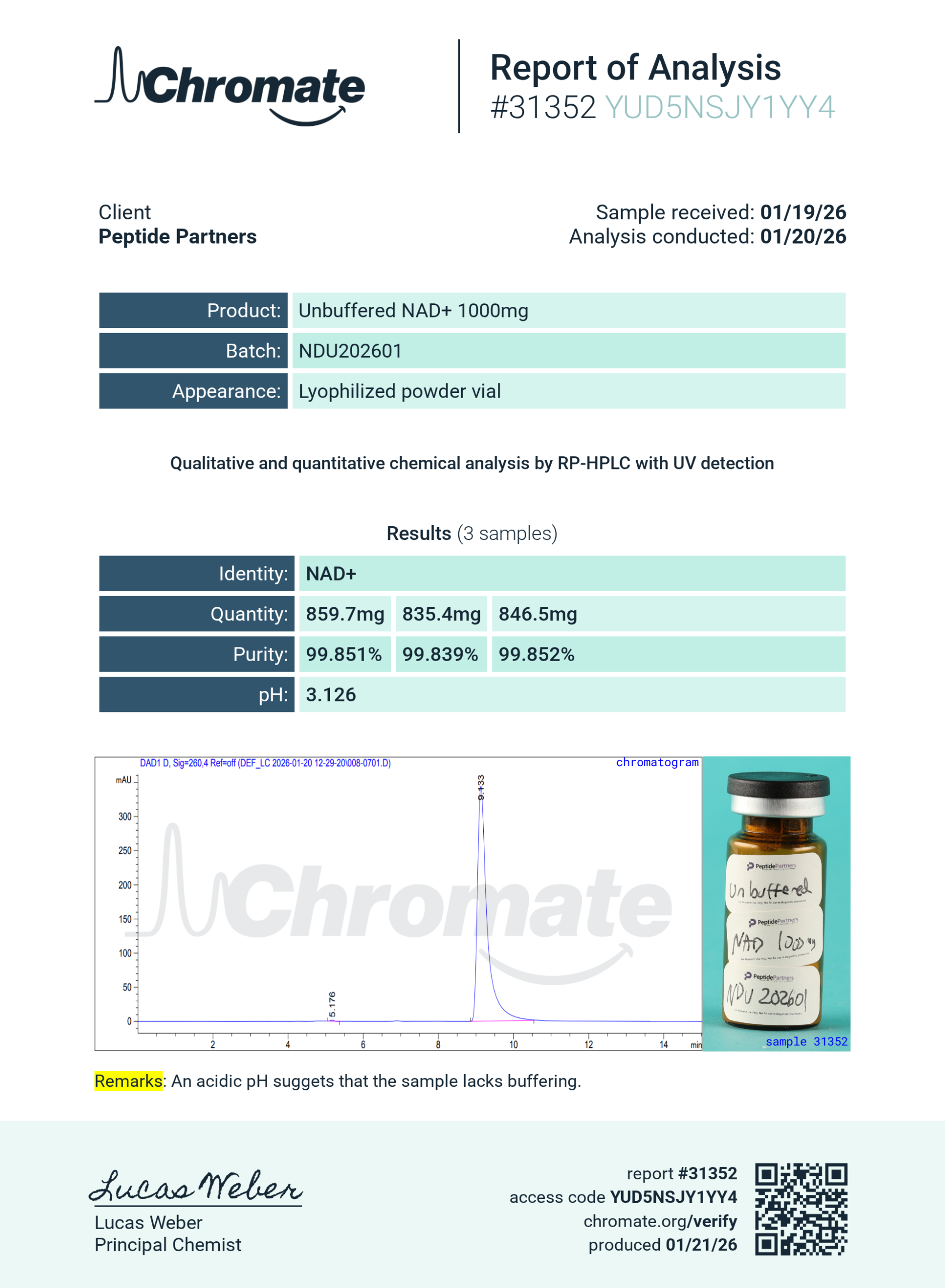
| Unbuffered NAD+ | NDU202601 | MZ21 | 2026-01-20 | 99.85% | Chromate | View File |
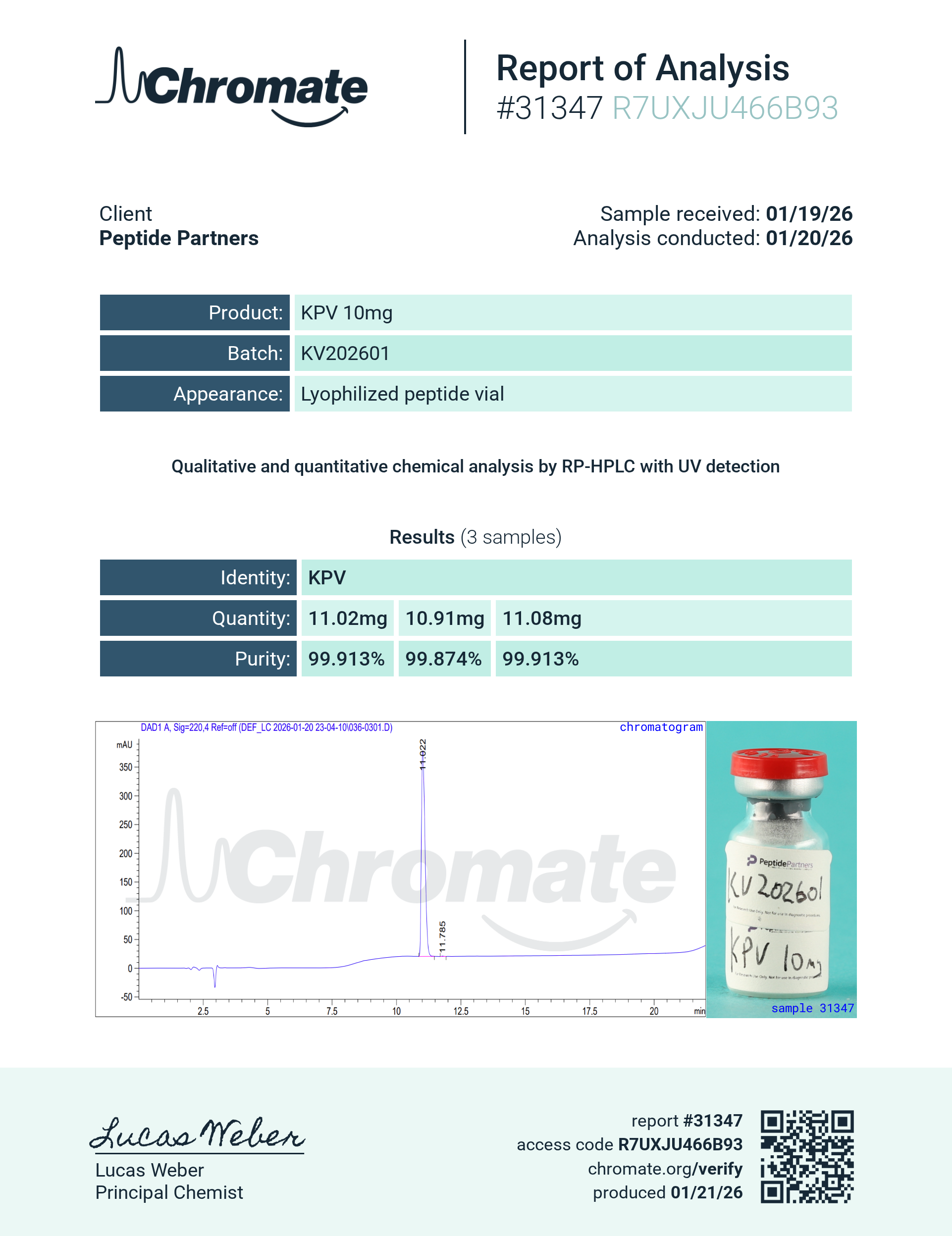
| KPV | KV202601 | VI32 | 2026-01-20 | 99.90% | Chromate | View File |
| Ipamorelin | IP202601 | WF03 | 2026-01-14 | 99.92% | TrustPointe | View File |
| TB500 (TB4) | TB202601 | WF03 | 2026-01-14 | 99.86% | TrustPointe | View File |
| Retatrutide | RT202602 | WF03 | 2026-01-13 | 99.63% | TrustPointe | View File |
| PT-141 | PT202512 | VI32 | 2026-01-12 | 99.89% | BioRegen | View File |
| Semaglutide | SM202601 | MZ21 | 2026-01-10 | 99.70% | TrustPointe | View File |
| Cagrilintide | CAG202601 | MZ21 | 2026-01-10 | 99.33% | TrustPointe | View File |
| Tesamorelin | TES202601 | WF03 | 2025-12-29 | 99.71% | TrustPointe | View File |
| BPC-157 | BP202512 | WF03 | 2025-12-29 | 99.46% | TrustPointe | View File |
| BPC-157/TB-500 | BB202512 | WF03 | 2025-12-29 | 99.64% | TrustPointe | View File |
| GHK-Cu | GK202512 | SH07 | 2025-12-19 | 99.79% | BioRegen | View File |
| MOTS-c | MC202512 | WF03 | 2025-12-22 | 99.89% | BioRegen | View File |
| Retatrutide | RP260130 | VI32 | 2025-12-22 | 99.72% | TrustPointe | View File |
| SS-31 | SS202512 | WF03 | 2025-12-19 | 99.70% | TrustPointe | View File |
| Retatrutide | RP202601 | DF05 | 2025-12-22 | 99.63% | TrustPointe | View File |
| Ipamorelin/CJC-1295 (No DAC) | CJIP202512 | WF03 | 2025-12-09 | 99.80% | TrustPointe | View File |
| Retatrutide | RP202511 | DF05 | 2025-12-19 | 99.73% | TrustPointe | View File |
| Retatrutide | RP20251020 | DF05 | 2025-11-10 | 99.33% | TrustPointe | View File |
| Retatrutide | RP20251001 | DF05 | 2025-10-13 | 99.86% | TrustPointe | View File |
| Tirzepatide | TZ20250915 | DF05 | 2025-10-03 | 99.74% | TrustPointe | View File |
| Retatrutide | RP20250929 | VI32 | 2025-10-03 | 99.47% | TrustPointe | View File |
| Humanin | HP20250805 | WF03 | 2025-09-19 | 99.92% | BioRegen | View File |
| MOTS-c | YC20250807 | WF03 | 2025-09-19 | 99.87% | BioRegen | View File |
| DSIP | DS20250820 | SH07 | 2025-09-19 | 99.88% | BioRegen | View File |
| SS-31 | SY20250806 | WF03 | 2025-09-19 | 99.70% | BioRegen | View File |
| CJC/Ipamorelin | CI20250805 | WF03 | 2025-09-11 | 99.84% | TrustPointe | View File |
| BPC-157 | BP20250808 | WF03 | 2025-09-05 | 99.99% | TrustPointe | View File |
| Sermorelin | SM20250723 | WF03 | 2025-08-27 | 99.84% | BioRegen | View File |
| Tesamorelin | TS20250722 | WF03 | 2025-08-22 | 99.10% | TrustPointe | View File |
| CJC-1295 ND | CJ20250724 | WF03 | 2025-08-20 | 99.43% | TrustPointe | View File |
| Semaglutide | SM20250801 | EJ12 | 2025-08-20 | 99.34% | TrustPointe | View File |
| Ipamorelin | IP20250721 | WF03 | 2025-08-15 | 99.64% | TrustPointe | View File |
| GHK-Cu | CU20250717 | SH07 | 2025-08-09 | 99.73% | BioRegen | View File |
| Tirzepatide | TZ20250730 | EJ12 | 2025-08-08 | 99.41% | TrustPointe | View File |
| NAD+ | ND20250503 | SH07 | 2025-07-31 | 99.76% | BioRegen | View File |
| VIP | VP20250511 | SH07 | 2025-07-31 | 99.42% | BioRegen | View File |
| Retatrutide | CD20250708 | SH07 | 2025-07-25 | 99.42% | TrustPointe | View File |
| BPC/TB500 | BB20250630 | SH07 | 2025-07-17 | 99.52% | TrustPointe | View File |
| TB500 (TB4) | TB20250614 | SH07 | 2025-07-17 | 99.68% | TrustPointe | View File |
| Peptide | Batch Id | Manufacturer | Date | USP Conformation | Laboratory | |
|---|---|---|---|---|---|---|
| Tesamorelin | TES202603 | WF03 | 2026-03-25 | Conforms | TrustPointe | View File |
| BPC-157 | BC202604 | WF03 | 2026-03-17 | Conforms | Kovera | View File |
| Thymosin Alpha-1 | TA202601 | WF03 | 2026-02-25 | Conforms | Kovera | View File |
| NAD+ | NDB202601 | VI32 | 2026-02-08 | Conforms | Kovera | View File |
| Unbuffered NAD+ | NDU202601 | MZ21 | 2026-01-28 | Conforms | TrustPointe | View File |
| KPV | KV202601 | VI32 | 2026-01-28 | Conforms | TrustPointe | View File |
| Ipamorelin | IP202601 | WF03 | 2026-01-13 | Conforms | TrustPointe | View File |
| TB500 | TB202601 | WF03 | 2026-01-13 | Conforms | TrustPointe | View File |
| Retatrutide | RT202602 | WF03 | 2026-01-13 | Conforms | TrustPointe | View File |
| PT-141 | PT202512 | VI32 | 2026-01-07 | Conforms | BioRegen | View File |
| Semaglutide | SM202601 | MZ21 | 2026-01-10 | Conforms | TrustPointe | View File |
| Cagrilintide | CAG202601 | MZ21 | 2026-01-10 | Conforms | TrustPointe | View File |
| Tesamorelin | TES202601 | WF03 | 2025-01-06 | Conforms | TrustPointe | View File |
| BPC-157 | BP202512 | WF03 | 2025-12-30 | Conforms | TrustPointe | View File |
| BPC-157/TB-500 | BB202512 | WF03 | 2025-12-30 | Conforms | TrustPointe | View File |
| Retatrutide | RP260130 | DF05 | 2025-12-22 | Conforms | TrustPointe | View File |
| SS-31 | SS202512 | WF03 | 2025-12-19 | Conforms | TrustPointe | View File |
| Retatrutide | RP202601 | DF05 | 2025-12-22 | Conforms | TrustPointe | View File |
| Ipamorelin/CJC-1295 (No DAC) | CJIP202512 | WF03 | 2025-12-08 | Conforms | TrustPointe | View File |
| Retatrutide | RP202511 | DF05 | 2025-11-10 | Conforms | TrustPointe | View File |
| Retatrutide | RP20251020 | DF05 | 2025-11-10 | Conforms | TrustPointe | View File |
| Retatrutide | RP20251001 | DF05 | 2025-10-13 | Conforms | TrustPointe | View File |
| Tirzepatide | TZ20250915 | DF05 | 2025-10-03 | Conforms | TrustPointe | View File |
| Retatrutide | RP20250929 | VI32 | 2025-10-03 | Conforms | TrustPointe | View File |
| Humanin | HP20250805 | WF03 | 2025-09-19 | Conforms | BioRegen | View File |
| MOTS-c | YC20250807 | WF03 | 2025-09-19 | Conforms | BioRegen | View File |
| DSIP | DS20250820 | SH07 | 2025-09-19 | Conforms | BioRegen | View File |
| SS-31 | SY20250806 | WF03 | 2025-09-19 | Conforms | BioRegen | View File |
| CJC/Ipamorelin | CI20250805 | WF03 | 2025-09-03 | Conforms | TrustPointe | View File |
| BPC-157 | BP20250808 | WF03 | 2025-09-03 | Conforms | TrustPointe | View File |
| Bacteriostatic Water | BAC20250807 | SH07 | 2025-08-27 | Conforms | BioRegen | View File |
| Tesamorelin | TS20250722 | WF03 | 2025-08-20 | Conforms | TrustPointe | View File |
| CJC-1295 ND | CJ20250724 | WF03 | 2025-08-20 | Conforms | TrustPointe | View File |
| Sermorelin | SM20250723 | WF03 | 2025-08-20 | Conforms | TrustPointe | View File |
| Semaglutide | SM20250801 | EJ12 | 2025-08-20 | Conforms | TrustPointe | View File |
| Ipamorelin | IP20250721 | WF03 | 2025-08-11 | Conforms | TrustPointe | View File |
| GHK-Cu | CU20250717 | SH07 | 2025-08-08 | Conforms | TrustPointe | View File |
| Tirzepatide | TZ20250730 | EJ12 | 2025-08-04 | Conforms | TrustPointe | View File |
| NAD+ | ND20250503 | SH07 | 2025-07-29 | Conforms | TrustPointe | View File |
| VIP | VP20250511 | SH07 | 2025-07-29 | Conforms | TrustPointe | View File |
| Retatrutide | CD20250708 | SH07 | 2025-07-24 | Conforms | TrustPointe | View File |
| BPC/TB500 | BB20250630 | SH07 | 2025-07-17 | Conforms | TrustPointe | View File |
| TB500 (TB4) | TB20250614 | SH07 | 2025-07-17 | Conforms | TrustPointe | View File |
| Peptide | Batch Id | Manufacturer | Date | USP Conformation | Laboratory | |
|---|---|---|---|---|---|---|
| BPC-157 | BC202604 | WF03 | 2026-03-17 | Conforms | Kovera | View File |
| Thymosin Alpha-1 | TA202602 | WF03 | 2026-02-25 | Conforms | Kovera | View File |
| NAD+ | NDB202601 | VI32 | 2026-02-08 | Conforms | Kovera | View File |
| Ipamorelin | IP202601 | WF03 | 2026-01-26 | Conforms | TrustPointe | View File |
| TB500 | TB202601 | WF03 | 2026-01-26 | Conforms | TrustPointe | View File |
| Retatrutide | RT202602 | WF03 | 2026-01-26 | Conforms | TrustPointe | View File |
| Semaglutide | SM202601 | MZ21 | 2026-01-19 | Conforms | TrustPointe | View File |
| Cagrilintide | CAG202601 | MZ21 | 2026-01-19 | Conforms | TrustPointe | View File |
| Tesamorelin | TES202601 | WF03 | 2026-01-19 | Conforms | TrustPointe | View File |
| BPC-157 | BP202512 | WF03 | 2026-01-08 | Conforms | TrustPointe | View File |
| BPC-157/TB-500 | BB202512 | WF03 | 2026-01-08 | Conforms | TrustPointe | View File |
| Tirzepatide | TZ20250915 | DF05 | 2025-12-03 | Conforms | TrustPointe | View File |
| TB500 (TB4) | TB20250614 | SH07 | 2025-11-24 | Conforms | TrustPointe | View File |
| BPC-157 | BP20250808 | WF03 | 2025-11-12 | Conforms | TrustPointe | View File |
| BPC/TB500 | BB20250630 | SH07 | 2025-11-12 | Conforms | TrustPointe | View File |
| CJC-1295 ND | CJ20250724 | WF03 | 2025-11-12 | Conforms | TrustPointe | View File |
| GHK-Cu | CU20250717 | SH07 | 2025-11-12 | Conforms | TrustPointe | View File |
| Ipamorelin | IP20250721 | WF03 | 2025-11-12 | Conforms | TrustPointe | View File |
| Retatrutide | RP20251020 | DF05 | 2025-11-12 | Conforms | TrustPointe | View File |
| Sermorelin | SM20250723 | WF03 | 2025-11-12 | Conforms | TrustPointe | View File |
| SS-31 | SY20250806 | WF03 | 2025-11-12 | Conforms | TrustPointe | View File |
| TB500 (TB4) | TB20250614 | SH07 | 2025-11-12 | Conforms | TrustPointe | View File |
| Tesamorelin | TS20250722 | WF03 | 2025-11-12 | Conforms | TrustPointe | View File |
| Tirzepatide | TZ20250730 | EJ12 | 2025-11-12 | Conforms | TrustPointe | View File |
When obtaining research peptides, it is essential to validate the authenticity of the Certificate of Analysis (COA). Certificate fraud runs rampant throughout the research peptide supply community. The two most common forms are doctored images and stolen certificates. You can check for these two by making sure the third-party laboratory’s website shows that the certificate belongs to the supplier and the values haven’t been doctored. TrustPointe Analytics provides a few simple rules for verification:
Not only must one remain vigilant about potentially fraudulent certificates, one must also be aware that there are third-party laboratories whose results cannot be considered reliable or scientifically valid. Unfortunately, there is significant evidence to suggest that one of the most popular third-party testing labs does not use scientifically sound methodologies and, in some cases, has fabricated results. There isn’t an easy remedy for this problem, but when labs are particularly bad, there tend to be a lot of discussion threads on various social platforms.
Our friends at TrustPointe have provided the following detailed explanation to help interpret the results of the endotoxin testing.
We use the Charles River Endosafe PTS system to test for bacterial endotoxins following USP <85> guidelines:
The following are suitability parameters that verify the system was working properly and the sample prep dilution is appropriate for accurate results. Peptides often interfere with endotoxin detection due to their tendency to bind or mask endotoxins, which can lead to inaccurate low results. To overcome this, samples are typically tested at a large dilution to reduce matrix interference and ensure reliable recovery and detection in compliance with USP <85>. If the dilution is not correct, the run will fail suitability and we’ll need to adjust the dilution to ensure accurate results. We provide the suitability data to customers for transparency and so they can be confident in the results.
USP <85> Sample CV %:
USP <85> Spike CV %:
USP <85> Spike Recovery
Thank you for choosing Peptide Partners.
NOTICE: All information provided above is strictly intended for educational and informational purposes. Our products are designed for research use solely and are not approved for human consumption. Please refrain from any form of ingestion.
By making a purchase from Peptide Partners, you acknowledge that you are acquiring Research Chemicals. Our products are exclusively intended for laboratory research purposes.
It is imperative that only qualified and licensed professionals handle this product. Under no circumstances should it be utilized as a drug, agricultural or pesticide product, food additive, or household chemical. Misrepresentation of this product for such purposes is strictly prohibited by law. All content on our website is provided for educational use exclusively. Any form of introduction into the human or animal body is illegal.