
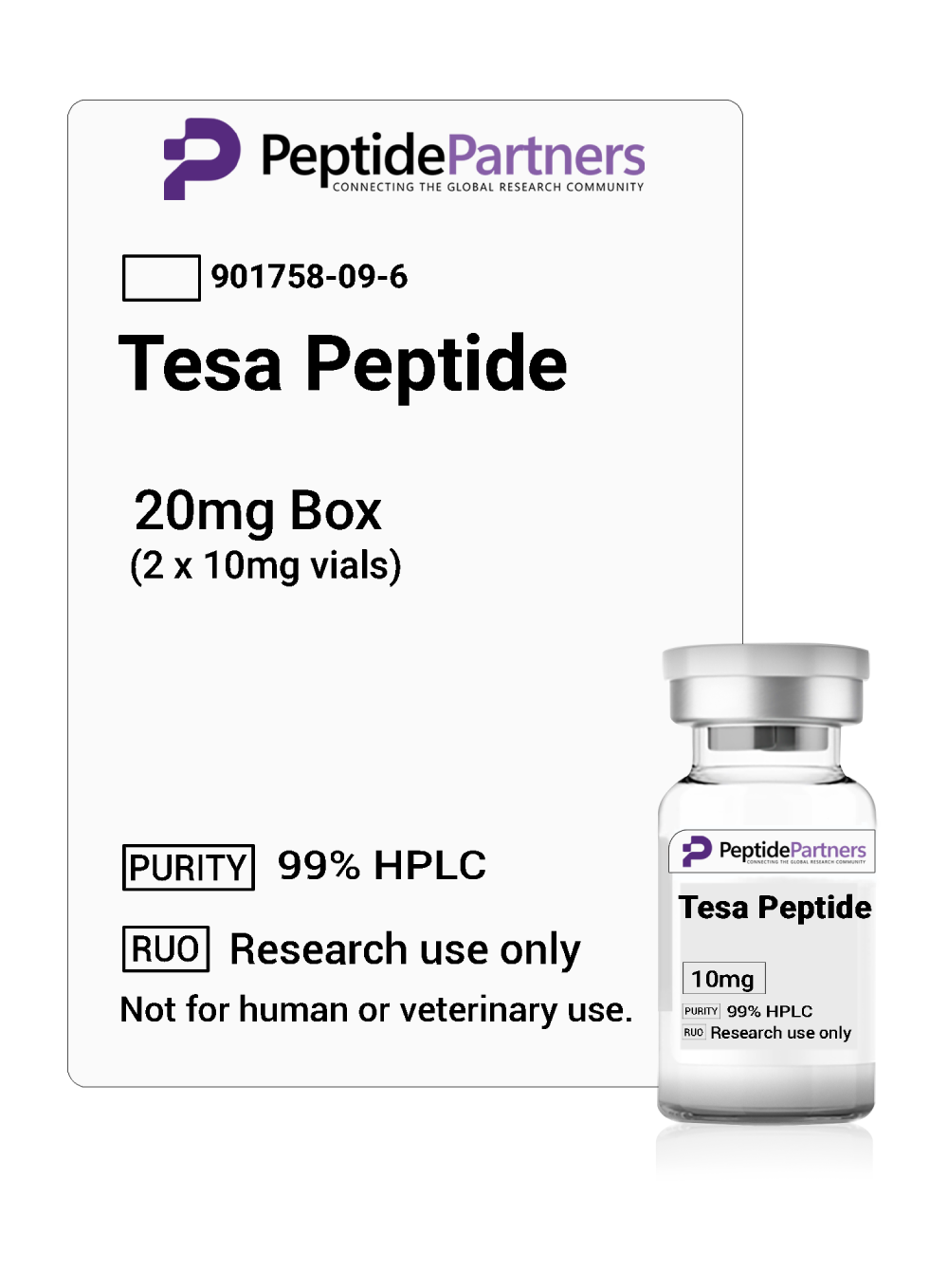
This product is solely intended for research purposes as a chemical compound. Its designation permits its use exclusively for in vitro testing and laboratory experimentation. All information regarding this product provided on our website is purely educational. By law, any form of bodily introduction of this product into humans or animals is strictly prohibited. It should only be handled by professionals who are licensed and qualified. This product is neither a drug, food, nor cosmetic, and must not be misrepresented, misused, or mislabeled as such.
In stock
Swipe right to view full table →
Save over 70%!
 |
|
| Cost per milligram | $4.40 – $5.90 |
| Purity | 99.7% |
| Certified Endotoxin-safe | Yes |
| Independently Tested | Yes |
Authors: Knoop A, Thomas A, Fichant E, Delahaut P, Schänzer W, Thevis M.
Source: https://pmc.ncbi.nlm.nih.gov/articles/PMC4830873/
This study reports the development and validation of a qualitative method for the simultaneous detection of four GHRHs, including Tesamorelin, in human plasma. The method employs immunoaffinity purification using a polyclonal GHRH antibody followed by nano-ultrahigh performance liquid chromatography-high resolution/high accuracy tandem mass spectrometry (LC-HRMS/MS). The in vitro experiments demonstrated the metabolic stability of Tesamorelin. The method was validated for specificity, linearity, recovery, lower limit of detection, imprecision, and ion suppression/enhancement effects, proving its fitness for purpose in sports drug testing.
Researchers developed a highly sensitive method to detect Tesamorelin and other growth hormone-releasing hormones (GHRHs) in human plasma. This new test uses a combination of immunoaffinity purification and liquid chromatography-mass spectrometry to identify these substances with high accuracy. The study also investigated the stability of Tesamorelin in a laboratory setting and found it to be metabolically stable. This is significant for anti-doping applications as it provides a reliable method for detecting the use of these banned substances in athletes.
Authors: Zhou F, Li JJ, Li XC, Jiang Y, Yang DH, Chen LN, Xu HE, Li MJ, Li XF.
Source: https://www.nature.com/articles/s41467-020-18945-0
This study elucidates the cryo-electron microscopy structure of the human growth hormone-releasing hormone receptor (GHRHR) in complex with its endogenous ligand GHRH and the stimulatory G protein (Gs). The structure reveals that GHRH binds to a novel site within the transmembrane domain of the receptor, which is distinct from the binding mode of other class B GPCRs. The study identifies key residues for GHRH binding and receptor activation, providing a structural basis for understanding the mechanism of action of GHRH and its analogues like Tesamorelin. This structural information is invaluable for the rational design of new therapeutic agents targeting the GHRHR.
Scientists have created a 3D map of the receptor in our bodies that Tesamorelin and other similar hormones bind to. This map, obtained using a technique called cryo-electron microscopy, shows exactly how the hormone ‘docks’ with the receptor to activate it. This is a crucial discovery because it helps us understand the fundamental mechanism of how Tesamorelin works at a molecular level. This knowledge can be used to design new and better drugs that target this receptor for various medical conditions.
Authors: Fourman LT, Billingsley JM, Agyapong G, Ho Sui SJ, Feldpausch MN, Purdy J, Zheng I, McClure CM, Corey KE, Torriani M, Kleiner DE, Hadigan CM, Chung RT, Grinspoon SK.
Source: https://insight.jci.org/articles/view/140134
This study investigated the effects of Tesamorelin on hepatic transcriptomic and proteomic signatures in patients with HIV-associated non-alcoholic fatty liver disease (NAFLD). The researchers performed RNA sequencing on liver biopsies and proteomic analysis of plasma samples from patients treated with Tesamorelin or placebo. The results showed that Tesamorelin treatment was associated with downregulation of hepatic gene sets involved in inflammation, tissue repair, and cell division. Furthermore, a targeted proteomic analysis revealed that Tesamorelin modulated the levels of several plasma proteins that are linked to these pathways. These findings provide a molecular basis for the observed clinical benefits of Tesamorelin in reducing liver fat and fibrosis in this patient population.
In this study, researchers investigated how Tesamorelin affects the liver in people with HIV-associated fatty liver disease. They analyzed liver tissue and blood samples from patients treated with Tesamorelin and found that the drug changed the activity of genes involved in inflammation, tissue repair, and cell division. Specifically, Tesamorelin reduced the activity of genes that cause inflammation and scarring in the liver. This study provides important insights into the molecular mechanisms by which Tesamorelin improves liver health in this patient population.
Storage:
All of our manufacturing partners produce peptides using the Lyophilization (Freeze Drying) process, ensuring products maintain stability for shipping and storage for 12+ months.
In lyophilized form, they are shelf-stable for many weeks. However, for long-term storage, it is recommended to store them in the freezer.
We often hear concerns about the standard “discard after 28 days of first use” disclaimer. Don’t worry, this has nothing to do with studies regarding the efficacy of specific peptides. 28 days is the FDA requirement for producers of multi-use vials to prove their bacteriostatic maintains efficacy. This minimum requirement becomes the de facto standard.
In our experience, if you use proper sterile procedures and refrigerated storage, you can continue sampling from the same reconstituted vial for 3+ months.
Peptide Partners is committed to providing high-purity peptides at wholesale prices by frequently auditing its manufacturing partners using third-party laboratories. Independent analysis is vital to ensuring the quality and authenticity of your research peptides. Never trust a supplier that doesn’t submit to third-party testing. Never trust a certification that cannot be independently verified. All of the certificates that we provide can be validated on the third-party laboratory’s website.
Each product description contains a Manufacturer ID corresponding to the producer of that product. The table below contains the most recent third-party analyses for all manufacturers and peptides listed on Peptide Partners.
| Peptide | Batch Id | Manufacturer | Date | Purity | Laboratory | |
|---|---|---|---|---|---|---|
| Ipamorelin | TB202601 | WF03 | 2026-01-14 | 99.92% | TrustPointe | View File |
| TB500 (TB4) | TB202601 | WF03 | 2026-01-14 | 99.86% | TrustPointe | View File |
| Retatrutide | RT202602 | WF03 | 2026-01-13 | 99.63% | TrustPointe | View File |
| PT-141 | PT202512 | VI32 | 2026-01-12 | 99.89% | BioRegen | View File |
| Semaglutide | SM202601 | MZ21 | 2026-01-10 | 99.70% | TrustPointe | View File |
| Cagrilintide | CAG202601 | MZ21 | 2026-01-10 | 99.33% | TrustPointe | View File |
| Tesamorelin | TES202601 | WF03 | 2025-12-29 | 99.71% | TrustPointe | View File |
| BPC-157 | BP202512 | WF03 | 2025-12-29 | 99.46% | TrustPointe | View File |
| BPC-157/TB-500 | BB202512 | WF03 | 2025-12-29 | 99.64% | TrustPointe | View File |
| GHK-Cu | GK202512 | SH07 | 2025-12-19 | 99.79% | BioRegen | View File |
| MOTS-c | MC202512 | WF03 | 2025-12-22 | 99.89% | BioRegen | View File |
| Retatrutide | RP260130 | VI32 | 2025-12-22 | 99.72% | TrustPointe | View File |
| SS-31 | SS202512 | WF03 | 2025-12-19 | 99.70% | TrustPointe | View File |
| Retatrutide | RP202601 | DF05 | 2025-12-22 | 99.63% | TrustPointe | View File |
| Ipamorelin/CJC-1295 (No DAC) | CJIP202512 | WF03 | 2025-12-09 | 99.80% | TrustPointe | View File |
| Retatrutide | RP202511 | DF05 | 2025-12-19 | 99.73% | TrustPointe | View File |
| Retatrutide | RP20251020 | DF05 | 2025-11-10 | 99.33% | TrustPointe | View File |
| Retatrutide | RP20251001 | DF05 | 2025-10-13 | 99.86% | TrustPointe | View File |
| Tirzepatide | TZ20250915 | DF05 | 2025-10-03 | 99.74% | TrustPointe | View File |
| Retatrutide | RP20250929 | VI32 | 2025-10-03 | 99.47% | TrustPointe | View File |
| Humanin | HP20250805 | WF03 | 2025-09-19 | 99.92% | BioRegen | View File |
| MOTS-c | YC20250807 | WF03 | 2025-09-19 | 99.87% | BioRegen | View File |
| DSIP | DS20250820 | SH07 | 2025-09-19 | 99.88% | BioRegen | View File |
| SS-31 | SY20250806 | WF03 | 2025-09-19 | 99.70% | BioRegen | View File |
| CJC/Ipamorelin | CI20250805 | WF03 | 2025-09-11 | 99.84% | TrustPointe | View File |
| BPC-157 | BP20250808 | WF03 | 2025-09-05 | 99.99% | TrustPointe | View File |
| Sermorelin | SM20250723 | WF03 | 2025-08-27 | 99.84% | BioRegen | View File |
| Tesamorelin | TS20250722 | WF03 | 2025-08-22 | 99.10% | TrustPointe | View File |
| CJC-1295 ND | CJ20250724 | WF03 | 2025-08-20 | 99.43% | TrustPointe | View File |
| Semaglutide | SM20250801 | EJ12 | 2025-08-20 | 99.34% | TrustPointe | View File |
| Ipamorelin | IP20250721 | WF03 | 2025-08-15 | 99.64% | TrustPointe | View File |
| GHK-Cu | CU20250717 | SH07 | 2025-08-09 | 99.73% | BioRegen | View File |
| Tirzepatide | TZ20250730 | EJ12 | 2025-08-08 | 99.41% | TrustPointe | View File |
| NAD+ | ND20250503 | SH07 | 2025-07-31 | 99.76% | BioRegen | View File |
| VIP | VP20250511 | SH07 | 2025-07-31 | 99.42% | BioRegen | View File |
| Retatrutide | CD20250708 | SH07 | 2025-07-25 | 99.42% | TrustPointe | View File |
| BPC/TB500 | BB20250630 | SH07 | 2025-07-17 | 99.52% | TrustPointe | View File |
| TB500 (TB4) | TB20250614 | SH07 | 2025-07-17 | 99.68% | TrustPointe | View File |
| Peptide | Batch Id | Manufacturer | Date | USP Conformation | Laboratory | |
|---|---|---|---|---|---|---|
| Ipamorelin | IP202601 | WF03 | 2026-01-13 | Conforms | TrustPointe | View File |
| TB500 | TB202601 | WF03 | 2026-01-13 | Conforms | TrustPointe | View File |
| Retatrutide | RT202602 | WF03 | 2026-01-13 | Conforms | TrustPointe | View File |
| PT-141 | PT202512 | VI32 | 2026-01-07 | Conforms | BioRegen | View File |
| Semaglutide | SM202601 | MZ21 | 2026-01-10 | Conforms | TrustPointe | View File |
| Cagrilintide | CAG202601 | MZ21 | 2026-01-10 | Conforms | TrustPointe | View File |
| Tesamorelin | TES202601 | WF03 | 2025-01-06 | Conforms | TrustPointe | View File |
| BPC-157 | BP202512 | WF03 | 2025-12-30 | Conforms | TrustPointe | View File |
| BPC-157/TB-500 | BB202512 | WF03 | 2025-12-30 | Conforms | TrustPointe | View File |
| Retatrutide | RP260130 | DF05 | 2025-12-22 | Conforms | TrustPointe | View File |
| SS-31 | SS202512 | WF03 | 2025-12-19 | Conforms | TrustPointe | View File |
| Retatrutide | RP202601 | DF05 | 2025-12-22 | Conforms | TrustPointe | View File |
| Ipamorelin/CJC-1295 (No DAC) | CJIP202512 | WF03 | 2025-12-08 | Conforms | TrustPointe | View File |
| Retatrutide | RP202511 | DF05 | 2025-11-10 | Conforms | TrustPointe | View File |
| Retatrutide | RP20251020 | DF05 | 2025-11-10 | Conforms | TrustPointe | View File |
| Retatrutide | RP20251001 | DF05 | 2025-10-13 | Conforms | TrustPointe | View File |
| Tirzepatide | TZ20250915 | DF05 | 2025-10-03 | Conforms | TrustPointe | View File |
| Retatrutide | RP20250929 | VI32 | 2025-10-03 | Conforms | TrustPointe | View File |
| Humanin | HP20250805 | WF03 | 2025-09-19 | Conforms | BioRegen | View File |
| MOTS-c | YC20250807 | WF03 | 2025-09-19 | Conforms | BioRegen | View File |
| DSIP | DS20250820 | SH07 | 2025-09-19 | Conforms | BioRegen | View File |
| SS-31 | SY20250806 | WF03 | 2025-09-19 | Conforms | BioRegen | View File |
| CJC/Ipamorelin | CI20250805 | WF03 | 2025-09-03 | Conforms | TrustPointe | View File |
| BPC-157 | BP20250808 | WF03 | 2025-09-03 | Conforms | TrustPointe | View File |
| Bacteriostatic Water | BAC20250807 | SH07 | 2025-08-27 | Conforms | BioRegen | View File |
| Tesamorelin | TS20250722 | WF03 | 2025-08-20 | Conforms | TrustPointe | View File |
| CJC-1295 ND | CJ20250724 | WF03 | 2025-08-20 | Conforms | TrustPointe | View File |
| Sermorelin | SM20250723 | WF03 | 2025-08-20 | Conforms | TrustPointe | View File |
| Semaglutide | SM20250801 | EJ12 | 2025-08-20 | Conforms | TrustPointe | View File |
| Ipamorelin | IP20250721 | WF03 | 2025-08-11 | Conforms | TrustPointe | View File |
| GHK-Cu | CU20250717 | SH07 | 2025-08-08 | Conforms | TrustPointe | View File |
| Tirzepatide | TZ20250730 | EJ12 | 2025-08-04 | Conforms | TrustPointe | View File |
| NAD+ | ND20250503 | SH07 | 2025-07-29 | Conforms | TrustPointe | View File |
| VIP | VP20250511 | SH07 | 2025-07-29 | Conforms | TrustPointe | View File |
| Retatrutide | CD20250708 | SH07 | 2025-07-24 | Conforms | TrustPointe | View File |
| BPC/TB500 | BB20250630 | SH07 | 2025-07-17 | Conforms | TrustPointe | View File |
| TB500 (TB4) | TB20250614 | SH07 | 2025-07-17 | Conforms | TrustPointe | View File |
| Peptide | Batch Id | Manufacturer | Date | USP Conformation | Laboratory | |
|---|---|---|---|---|---|---|
| Semaglutide | SM202601 | MZ21 | 2026-01-19 | Conforms | TrustPointe | View File |
| Cagrilintide | CAG202601 | MZ21 | 2026-01-19 | Conforms | TrustPointe | View File |
| Tesamorelin | TES202601 | WF03 | 2026-01-19 | Conforms | TrustPointe | View File |
| BPC-157 | BP202512 | WF03 | 2026-01-08 | Conforms | TrustPointe | View File |
| BPC-157/TB-500 | BB202512 | WF03 | 2026-01-08 | Conforms | TrustPointe | View File |
| Tirzepatide | TZ20250915 | DF05 | 2025-12-03 | Conforms | TrustPointe | View File |
| TB500 (TB4) | TB20250614 | SH07 | 2025-11-24 | Conforms | TrustPointe | View File |
| BPC-157 | BP20250808 | WF03 | 2025-11-12 | Conforms | TrustPointe | View File |
| BPC/TB500 | BB20250630 | SH07 | 2025-11-12 | Conforms | TrustPointe | View File |
| CJC-1295 ND | CJ20250724 | WF03 | 2025-11-12 | Conforms | TrustPointe | View File |
| GHK-Cu | CU20250717 | SH07 | 2025-11-12 | Conforms | TrustPointe | View File |
| Ipamorelin | IP20250721 | WF03 | 2025-11-12 | Conforms | TrustPointe | View File |
| Retatrutide | RP20251020 | DF05 | 2025-11-12 | Conforms | TrustPointe | View File |
| Sermorelin | SM20250723 | WF03 | 2025-11-12 | Conforms | TrustPointe | View File |
| SS-31 | SY20250806 | WF03 | 2025-11-12 | Conforms | TrustPointe | View File |
| TB500 (TB4) | TB20250614 | SH07 | 2025-11-12 | Conforms | TrustPointe | View File |
| Tesamorelin | TS20250722 | WF03 | 2025-11-12 | Conforms | TrustPointe | View File |
| Tirzepatide | TZ20250730 | EJ12 | 2025-11-12 | Conforms | TrustPointe | View File |
When obtaining research peptides, it is essential to validate the authenticity of the Certificate of Analysis (COA). Certificate fraud runs rampant throughout the research peptide supply community. The two most common forms are doctored images and stolen certificates. You can check for these two by making sure the third-party laboratory’s website shows that the certificate belongs to the supplier and the values haven’t been doctored. TrustPointe Analytics provides a few simple rules for verification:
Not only must one remain vigilant about potentially fraudulent certificates, one must also be aware that there are third-party laboratories whose results cannot be considered reliable or scientifically valid. Unfortunately, there is significant evidence to suggest that one of the most popular third-party testing labs does not use scientifically sound methodologies and, in some cases, has fabricated results. There isn’t an easy remedy for this problem, but when labs are particularly bad, there tend to be a lot of discussion threads on various social platforms.
Our friends at TrustPointe have provided the following detailed explanation to help interpret the results of the endotoxin testing.
We use the Charles River Endosafe PTS system to test for bacterial endotoxins following USP <85> guidelines:
The following are suitability parameters that verify the system was working properly and the sample prep dilution is appropriate for accurate results. Peptides often interfere with endotoxin detection due to their tendency to bind or mask endotoxins, which can lead to inaccurate low results. To overcome this, samples are typically tested at a large dilution to reduce matrix interference and ensure reliable recovery and detection in compliance with USP <85>. If the dilution is not correct, the run will fail suitability and we’ll need to adjust the dilution to ensure accurate results. We provide the suitability data to customers for transparency and so they can be confident in the results.
USP <85> Sample CV %:
USP <85> Spike CV %:
USP <85> Spike Recovery
Thank you for choosing Peptide Partners.
NOTICE: All information provided above is strictly intended for educational and informational purposes. Our products are designed for research use solely and are not approved for human consumption. Please refrain from any form of ingestion.
By making a purchase from Peptide Partners, you acknowledge that you are acquiring Research Chemicals. Our products are exclusively intended for laboratory research purposes.
It is imperative that only qualified and licensed professionals handle this product. Under no circumstances should it be utilized as a drug, agricultural or pesticide product, food additive, or household chemical. Misrepresentation of this product for such purposes is strictly prohibited by law. All content on our website is provided for educational use exclusively. Any form of introduction into the human or animal body is illegal.